Facts
The respondent-assessee, a company engaged in chemical manufacturing and power generation, claimed a deduction of ₹30,96,49,300/- under Section 80-IA(4) of the Income Tax Act, 1961, for its 90MW Captive Power Plant for Assessment Year 2010-11.
Source reference: p. 2The Assessing Officer (AO) disallowed the claim on 13.02.2013, questioning the rate adopted by the assessee for power supplied to its captive units.
Source reference: p. 3On appeal, the CIT(A) remitted the matter back to the AO, and the Income Tax Appellate Tribunal (ITAT) subsequently dismissed the Revenue's appeal on 19.03.2018.
Source reference: p. 3The Revenue then appealed to the High Court of Gujarat, challenging the market rate used for calculating the deduction.
Source reference: p. 2Issues
1. Whether the ITAT erred in law by allowing the assessee’s claim of deduction under Section 80-IA(4) based on the rate at which the Gujarat Electricity Board (GEB) supplied power to its consumers, rather than the lower rate at which power generating companies supplied power to the GEB?
Source reference: p. 2/para. 3Law Applied
Section 80-IA(4) of the Income Tax Act, 1961, regarding deductions for profits and gains from industrial undertakings engaged in infrastructure development.
Source reference: p. 2The core legal principle followed was established by the Supreme Court in Commissioner of Income Tax v. Jindal Steel and Power Ltd. (460 ITR 162), which determined that "market value" for captive power consumption must be equated with the rate charged by the State Electricity Board to its industrial consumers, rather than the price paid by the Board to power suppliers.
Source reference: p. 4-7Reasoning
The Court noted that the central dispute was the determination of "market value" for power transferred from the captive plant to the assessee's industrial units. The Revenue argued for a lower rate based on what the GEB pays suppliers, whereas the assessee utilized the higher retail rate charged by the GEB to industrial consumers.
Source reference: p. 4Relying on the Jindal Steel precedent, the Court reasoned that a consumer in the open market cannot purchase power at the wholesale "supplier" rate; therefore, the only realistic market comparison is the rate at which an industrial consumer actually purchases power from the grid.
Source reference: p. 5-6The Court further observed that the tariff paid by the GEB to suppliers is a result of statutory mandates and is not a competitive market price.
Source reference: p. 6Since this legal issue was already settled in favor of the assessee by both the Supreme Court and previous benches of the Gujarat High Court (Tax Appeal No. 817 of 2013), the Court found no reason to deviate from this position.
Source reference: p. 3, 8Holding
The Court answered the substantial question of law in favor of the assessee and against the Revenue.
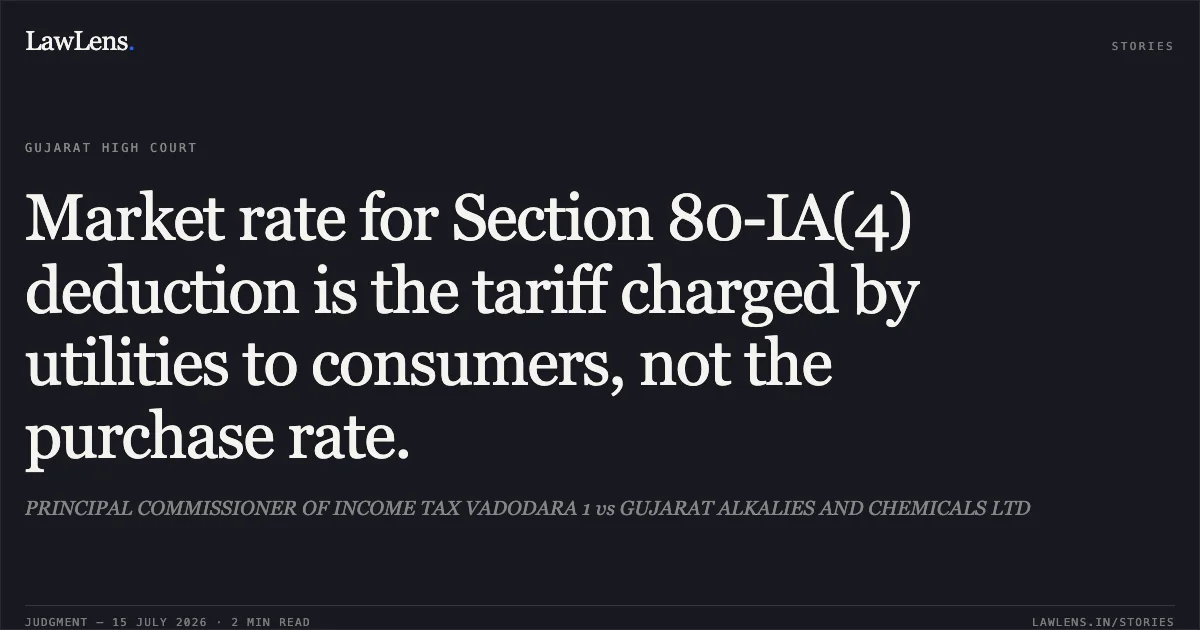
It held that the market value for computing deduction under Section 80-IA is the rate at which the State Electricity Board supplies power to consumers.
Source reference: p. 7Consequently, the ITAT's order was upheld, and the Tax Appeal was dismissed.
Source reference: p. 9Acts & Sections Cited
2 provisions across 1 statute referred to in this judgment. Each provision opens on LawLens.
Electricity Act, 20032
Original Court PDF
PRINCIPAL COMMISSIONER OF INCOME TAX VADODARA 1vsGUJARAT ALKALIES AND CHEMICALS LTD
Click to open original judgment
Original judgment, available to read, download and summarize on LawLens.in