Facts
The Respondent-Assessee is engaged in iron ore mining, manufacturing steel products, and power generation. For the assessment year 2017-18, the Assessee sought to transfer electricity from its "eligible units" (Qualifying for Section 80-IA deductions) to its "non-eligible" manufacturing units
Source reference: p. 2The Assessee valued this transfer at the rate charged by the State Power Distribution Company (CSPDCL) to industrial consumers (open market rate).
Source reference: p. 2However, the Transfer Pricing Officer (TPO) passed an order under Section 92-CA(3), determining an arm's length price berdasarkan the lower rate at which power is sold by generating companies to the Board
Source reference: p. 3This resulted in a downward adjustment of Rs. 49,52,68,006/-.
Source reference: p. 3The Income Tax Appellate Tribunal (ITAT) set aside this adjustment, relying on jurisdictional precedents
Source reference: p. 4The Revenue appealed, arguing that Transfer Pricing under Chapter X requires a distinct FAR (Functions, Assets, Risks) analysis regardless of Section 80-IA principles
Source reference: p. 4Issues
Whether the ITAT was justified in dismissing the appeal by relying upon the decision in TAXC Case No. 31/2012 (Godawari Power & Ispat Ltd.) without considering the merits and specific transfer pricing documentation?
Source reference: p. 2 / para 2Law Applied
The Court applied Section 80-IA(8) of the Income Tax Act, 1961, which dictates that intra-business transfers must correspond to the "market value," defined as the price the goods would fetch in the open market
Source reference: p. 7It specifically relied on the Supreme Court precedent in CIT v. M/s Jindal Steel & Power Ltd. (2023), which established that "market value" for electricity is the rate charged by the State Electricity Board to industrial consumers, rather than the lower rate at which the Board purchases power from suppliers
Source reference: p. 9The Court also referenced its own prior ruling in CIT v. Godawari Power & Ispat Ltd. (2014)
Source reference: p. 8Reasoning
The Court rejected the Revenue's contention that the ITAT failed to examine the FAR analysis or Chapter X procedures.
Source reference: p. 7-8It reasoned that the statutory definition of "market value" under the Explanation to Section 80-IA(8) explicitly includes the price goods fetch in the "open market"
Source reference: p. 7-8The Court observed that the Assessee’s manufacturing unit, if it were to buy power from the open market, would have to pay the consumer rate charged by CSPDCL
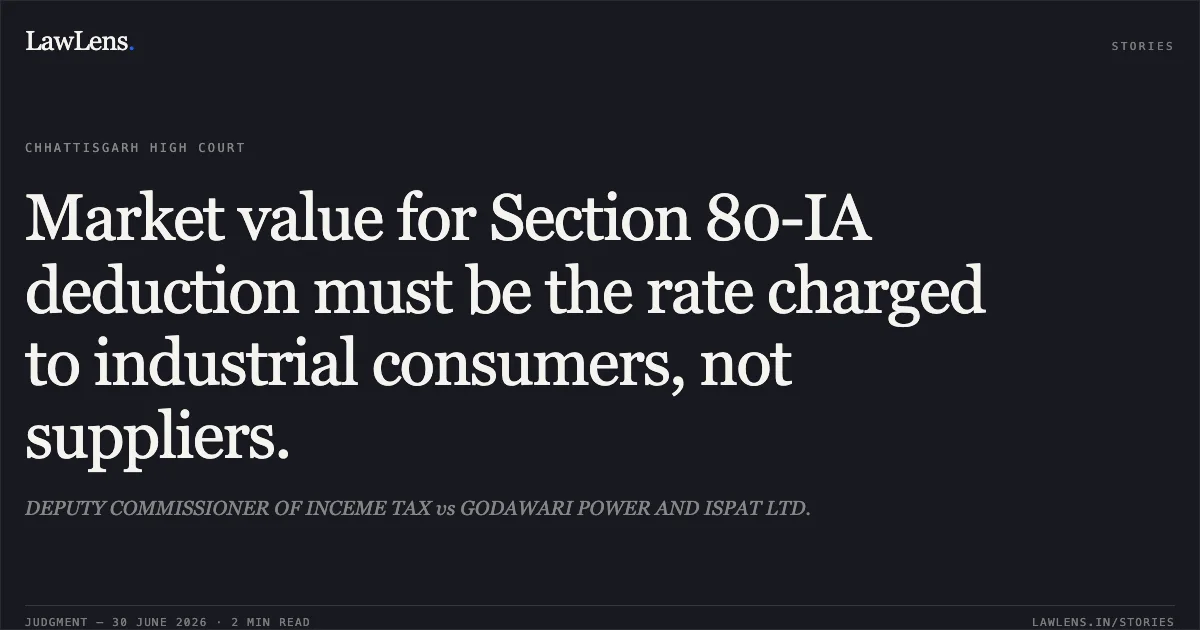
Source reference: p. 8-9Comparing the transfer price to the "supplier rate" (the rate at which the Assessee might sell surplus power to the Board) was deemed legally incorrect because that is not the rate available to a consumer in the open market
Source reference: para 31, p. 8Following the Supreme Court’s affirmation in Jindal Steel & Power Ltd., the Court held that once the market rate for a consumer is established, it constitutes the appropriate benchmark for Arm’s Length Price in such domestic transactions
Source reference: p. 9-10Holding
The Court answered the substantial question of law against the Revenue and in favor of the Assessee.
It held that the ITAT was justified in following the settled precedent that the consumer rate charged by the State Electricity Board is the correct "market value" for computing deductions and transfer pricing for captive power consumption
Source reference: p. 11The appeal was dismissed, affirming the ITAT’s order
Source reference: p. 11Acts & Sections Cited
8 provisions across 1 statute referred to in this judgment. Linked provisions open on LawLens.
Income Tax Act, 19618
Original Court PDF
DEPUTY COMMISSIONER OF INCEME TAXvsGODAWARI POWER AND ISPAT LTD.
Click to open original judgment
Original judgment, available to read, download and summarize on LawLens.in


