Facts
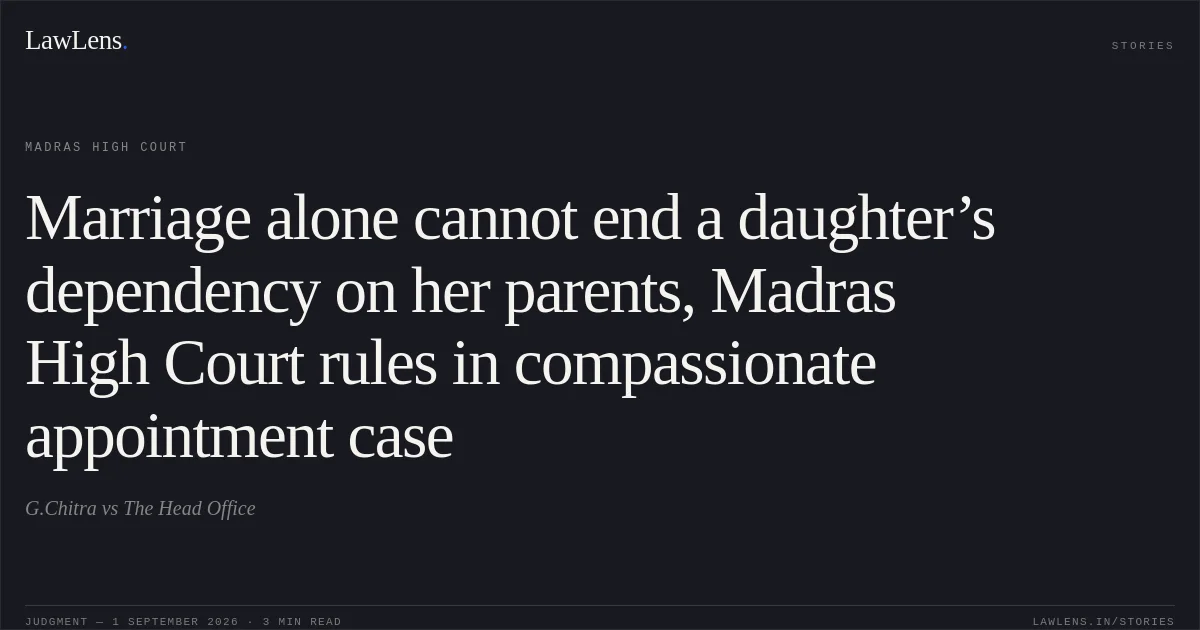
The petitioner, G. Chitra, was the daughter of P. Govindasamy, a Head Cashier/Award Staff employee of United Bank of India, subsequently merged with Punjab National Bank.
Source reference: para. 2Govindasamy died in service on 30.11.2015. His wife had predeceased him, and his surviving children were the petitioner and her brother, Vivek.
Source reference: para. 2The petitioner, claiming to be a housewife without independent income and dependent on her father, applied for compassionate appointment.
Source reference: para. 2The Bank rejected her claim on 23.11.2022 on the ground that she had married on 10.07.2013, before her father’s death, and therefore could not be treated as a dependent daughter under the applicable scheme.
Source reference: para. 2The petitioner challenged the rejection under Article 226 of the Constitution, contending that the Bank had improperly applied amendments introduced in 2020 and 2021 instead of the scheme prevailing on the date of death.
Source reference: paras. 3.1–3.2Issues
1. Whether the petitioner’s claim for compassionate appointment had to be considered under the scheme prevailing on the date of the employee’s death in 2015, rather than under subsequent amendments introduced in 2020 and 2021.
Source reference: paras. 3.1, 72. Whether the petitioner could be excluded from consideration as a “wholly dependent daughter” merely because she was married before the death of the employee.
Source reference: paras. 8–10, 13–163. Whether the Bank’s rejection of the petitioner’s claim was arbitrary and contrary to the constitutional principle of equality.
Source reference: paras. 10, 15–18Law Applied
The Court applied the settled principle that a claim for compassionate appointment must be decided under the scheme or policy prevailing on the date of the deceased employee’s death, and not under a subsequent scheme or amendment, relying on State of M.P. v. Ashish Awasthi, (2022) 2 SCC 157, as well as Indian Bank v. Promila, (2020) 2 SCC 729, and State of M.P. v. Amit Shrivas, (2020) 10 SCC 496.
Source reference: para. 7The Court further relied on Kulsum Nisha v. State of U.P. & Others, 2026 INSC 617, for the principle that marriage neither severs a daughter’s relationship with her parental family nor conclusively establishes the absence of dependency; dependency is a question of fact and cannot be determined solely by marital status.
Source reference: para. 16A gender-based distinction that excludes a married daughter while continuing to recognise a married son as a family member is constitutionally impermissible and inconsistent with the guarantee of equality.
Source reference: para. 16Reasoning
The Court held that the Bank had erred by relying on the 2020 and 2021 amendments, since the employee died in 2015 and the petitioner’s claim had to be assessed under the scheme then in force.
Source reference: para. 7Independently, even assuming that the amended requirement of a “wholly dependent daughter” applied, the rejection could not be sustained.
Source reference: no citationThe Bank relied principally on the petitioner’s marriage, her husband’s employment, her brother’s employment, and her residence at a different place.
Source reference: para. 9The Court found that these circumstances did not establish that she was not dependent on her father.
Source reference: no citationThe petitioner was a housewife with no independent income, and the fact that her husband earned an income did not automatically negate her dependence on her father.
Source reference: paras. 13–15Her subsequent residence away from her father’s property was attributed to water and drainage problems and, in any event, occurred after the employee’s death; it therefore could not retrospectively determine her dependency.
Source reference: paras. 11–12The Bank’s approach effectively treated marriage as terminating a daughter’s membership in, and dependency upon, her parental family, which the Court held to be based on an impermissible gender stereotype and contrary to Kulsum Nisha.
Source reference: paras. 13–18Holding
The Court allowed the writ petition and quashed the Bank’s rejection order dated 23.11.2022.
It held that the petitioner could not be denied compassionate appointment merely because she was a married daughter, particularly when the Bank had not properly assessed her actual dependency and had applied subsequent amendments to a 2015 claim.
Source reference: paras. 7, 18The respondents were directed to appoint the petitioner on compassionate grounds within eight weeks from receipt of the order. No costs were imposed.
Source reference: para. 19Original Court PDF
G.ChitravsThe Head Office
Click to open original judgment
Original judgment, available to read, download and summarize on LawLens.in