Facts
The appellant-husband challenged the judgment and decree dated 5 December 2023 passed by the Principal Judge, Family Court, Bhagalpur, dismissing his petition under Section 13(1)(i-a) of the Hindu Marriage Act, 1955, seeking dissolution of the marriage on the ground of cruelty.
Source reference: para. 1During the pendency of the appeal, the parties amicably resolved all disputes and filed a joint affidavit and separate supporting affidavits recording the settlement.
Source reference: para. 2Under the settlement, the husband agreed to pay ₹45,00,000 to the wife as full and final permanent alimony in three instalments of ₹15,00,000 each.
Source reference: para. 3(i)–(iv)Upon receipt of the entire amount, the wife agreed to withdraw or seek quashing of all pending proceedings, including Complaint Case No. 2077(c) of 2017 involving Sections 498A of the Indian Penal Code and 4 of the Dowry Prohibition Act, 1961.
Source reference: para. 3(i)–(iv)The parties also mutually agreed to dissolve their marriage and relinquish all future claims against each other.
Source reference: para. 3(v)–(vi)Both parties affirmed that the settlement was voluntary and free from coercion, undue influence or pressure.
Source reference: para. 4Issues
Whether the parties’ compromise concerning dissolution of marriage, permanent alimony and settlement of all matrimonial disputes should be accepted and recorded by the appellate court?
Source reference: paras. 2–6Whether, upon fulfilment of the settlement terms, the marriage should be dissolved and the impugned judgment dismissing the husband’s divorce petition should be set aside?
Source reference: paras. 7(b), 8–10Whether directions could be issued concerning the pending criminal complaint upon full payment of the agreed permanent alimony?
Source reference: para. 7(c)Law Applied
The Court considered the appellant’s matrimonial claim under Section 13(1)(i-a) of the Hindu Marriage Act, 1955, which permits dissolution of marriage on the ground of cruelty.
Source reference: para. 1It applied the principle that a genuine, voluntary and duly verified settlement between matrimonial parties may be accepted and recorded by the court, particularly where the parties have resolved their financial, matrimonial and future claims.
Source reference: paras. 2–6The Court further acted under its authority to mould appellate relief in terms of the compromise and directed that the decree of divorce would operate subject to payment of the agreed permanent alimony.
Source reference: para. 7(b)In relation to the criminal proceeding, the Court referred to Section 528 of the Bharatiya Nagarik Suraksha Sanhita, 2023, corresponding to Section 482 of the Code of Criminal Procedure, as the procedural route for seeking quashing, if required.
Source reference: para. 7(c)Reasoning
The Court examined the joint and supporting affidavits and found that the compromise was genuine, voluntary and understood by both parties.
Source reference: paras. 2, 4–5Since the parties themselves had agreed upon ₹45,00,000 as permanent alimony and had mutually consented to dissolve the marriage and end all disputes, the Court accepted the settlement rather than adjudicating the original cruelty claim on merits.
Source reference: paras. 3, 5–6It made dissolution of the marriage conditional upon payment of the entire alimony in the prescribed three-instalment schedule and required proof of each payment to be filed before the Court.
Source reference: para. 7(a)–(b)With respect to the criminal complaint, the Court linked its quashing to full payment and permitted the parties to place the order before the concerned court, while preserving the option of filing a formal application under Section 528 of the Bharatiya Nagarik Suraksha Sanhita, 2023.
Source reference: para. 7(c)Holding
The compromise was accepted and recorded.
The appeal was allowed, and the Family Court’s judgment and decree dated 5 December 2023 were set aside.
Source reference: paras. 6, 8The husband was directed to pay ₹45,00,000 to the wife in three equal instalments, with proof of payment to be filed before the Court.
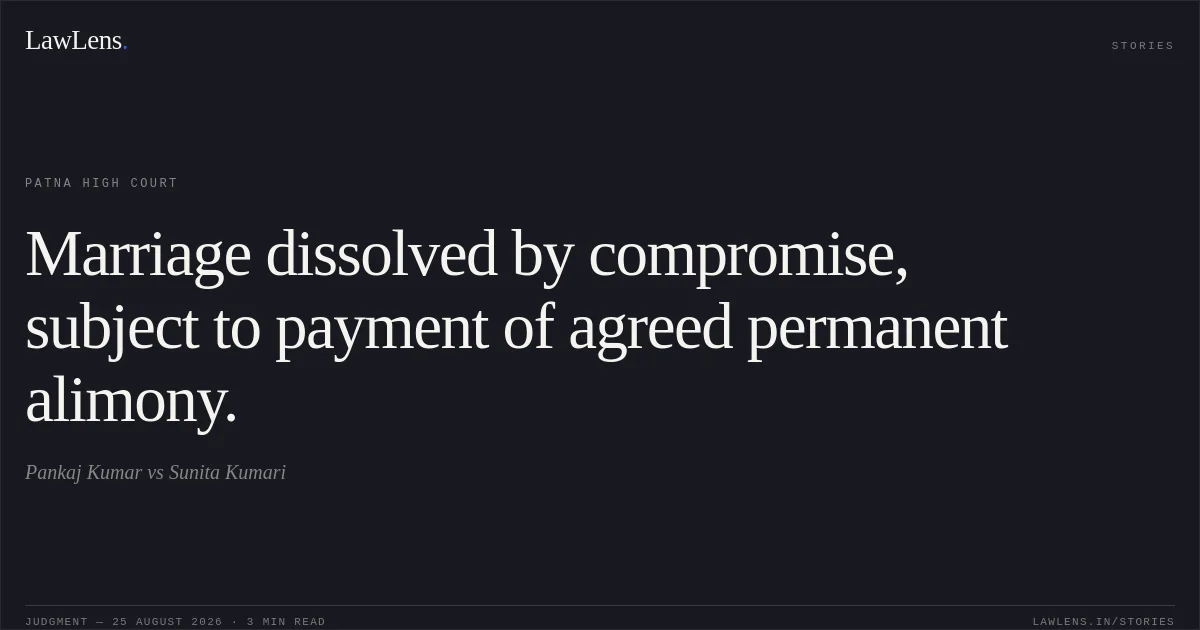
Source reference: para. 7(a)Subject to full payment, the parties’ marriage solemnized on 9 February 2014 stood dissolved by a decree of divorce.
Source reference: para. 7(b)Upon full payment and production of proof, the parties were permitted to seek consequential quashing of Complaint Case No. 2077(c) of 2017 in accordance with law.
Source reference: para. 7(c)The parties were bound by the settlement and barred from making further claims arising from the marriage; the compromise was directed to form part of the decree.
Source reference: paras. 7(d), 9–10Acts & Sections Cited
4 provisions across 4 statutes referred to in this judgment. Each provision opens on LawLens.
Hindu Marriage Act, 19551
Dowry Prohibition Act, 19611
Bharatiya Nagarik Suraksha Sanhita, 20231
Code of Criminal Procedure, 19731
Original Court PDF
Pankaj KumarvsSunita Kumari
Click to open original judgment
Original judgment, available to read, download and summarize on LawLens.in
![Courts will not interfere with transfers absent mala fides or violation of statutory rules.. M Ramya vs EMPLOYEES STATE INSURANCE CORPORATION (ESIC). CAT - ['Chennai']. LawLens](/stories/thumbnails/courts-will-not-interfere-with-transfers-absent-mala-fides-or-violation-of-statutory-rules-a6845e9ca6f548fca284c51c8351957f.webp)
![Courts cannot direct one-time recruitment age relaxation absent authority in the governing rules or advertisement.. UT OF PUDUCHERRY vs M ANDAL. CAT - ['Chennai']. LawLens](/stories/thumbnails/courts-cannot-direct-one-time-recruitment-age-relaxation-absent-authority-in-the-governing-895d78fde47143e2a8ed0207c4b6a44f.webp)
![A review cannot correct an allegedly erroneous decision absent an error apparent on the record.. Ajit Kumar Jha vs RAILWAY BOARD. CAT - ['Delhi']. LawLens](/stories/thumbnails/a-review-cannot-correct-an-allegedly-erroneous-decision-absent-an-error-apparent-on-the-re-8ac952fd4eba470c92f7da20af72a220.webp)