Facts
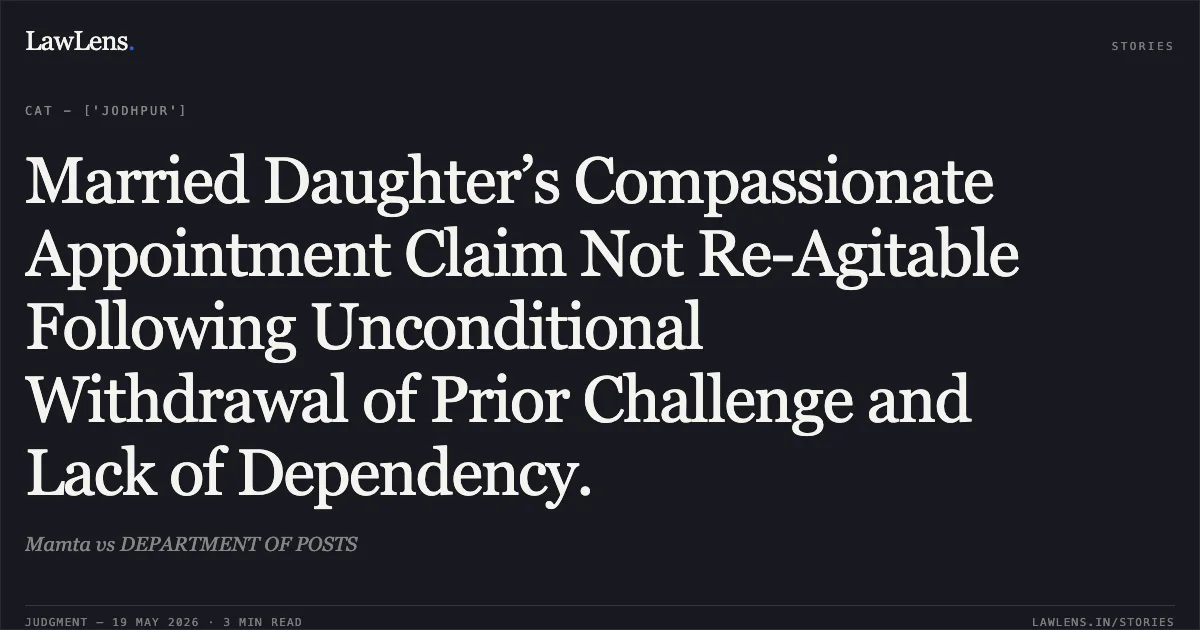
The applicant, an adopted daughter of late Chhoga Ram (who died on 30.10.2010 while serving as GDS BPM), sought compassionate appointment
Source reference: p. 2Her initial application was rejected by the Circle Relaxation Committee (CRC) in February 2014 on the grounds that, as a married daughter living with in-laws, she was not dependent on the deceased
Source reference: p. 2The applicant challenged this in OA No. 95/2014, which was dismissed as withdrawn on 07.04.2016 without liberty to file afresh
Source reference: p. 4Following a 2017 revision of the compassionate engagement scheme, her case was reviewed as a one-time measure by the Committee on Compassionate Engagement (CCE) on 30.12.2020 and again rejected on 11.01.2021
Source reference: p. 2The applicant filed the present OA claiming her rejection was due to a lack of a computer certificate and citing parity with the Vinod Kumar Rot case
Source reference: p. 3Issues
1. Whether the applicant meets the definition of a "Dependent Family Member" under the revised compassionate appointment scheme
Source reference: p. 52. Whether the applicant is barred by the principle of res judicata from re-agitating the issue of dependency
Source reference: p. 53. Whether the rejection was based on technical disqualification (computer literacy) or substantive lack of dependency
Source reference: p. 6Law Applied
The court applied the "Scheme for engagement of a dependent of deceased Gramin Dak Sevaks on Compassionate Grounds" as revised on 30.05.2017, which defines "Dependent Family Member" and stipulates that dependency must exist at the time of the employee's death
Source reference: p. 5The court also applied the procedural principle of res judicata, which prevents a party from re-litigating an issue that has already been decided or abandoned in previous litigation
Source reference: p. 5The court emphasized the established legal principle that compassionate appointment is not a right to employment but a remedial measure to mitigate immediate financial crisis caused by the breadwinner's death
Source reference: p. 6Reasoning
The Tribunal found that the applicant’s case did not fail due to a lack of computer training, as she alleged, but because she failed to establish dependency on the deceased at the time of his death in 2010
Source reference: p. 6The Bench noted that her initial rejection in 2014 was specifically due to her status as a married daughter living with her in-laws, and her subsequent withdrawal of OA No. 95/2014 without liberty to refile created a legal estoppel under the principle of res judicata
Source reference: p. 5The court distinguished the Vinod Kumar Rot case, noting that the dismissal there was based on qualification (computer certificate), whereas here, it was a substantive failure to meet the "Dependent Family Member" criteria under the 2017 revised scheme
Source reference: p. 5-6The Tribunal reasoned that since she was married and not dependent at the time of the death, she did not fall within the object of the scheme, which is to help the family overcome a sudden financial crisis
Source reference: p. 6Holding
The Tribunal held that the respondents did not err in rejecting the applicant's claim as she was not a dependent of the deceased employee at the time of death
The OA was dismissed, and it was ruled that the claim was an attempt to secure employment rather than a genuine need for immediate financial relief under the compassionate scheme. The OA and associated Misc. Application were dismissed with no order as to costs
Source reference: p. 6Acts & Sections Cited
1 provisions across 1 statute referred to in this judgment. Linked provisions open on LawLens.
Right to Information Act, 20051
Original Court PDF
MamtavsDEPARTMENT OF POSTS
Click to open original judgment
Original judgment, available to read, download and summarize on LawLens.in