01Facts
The petitioner, a married daughter of a Commercial Tax Officer who died in service on 5 May 2021, sought compassionate appointment after her father relinquished his claim.
pp. 2–4The Department rejected her application on the ground that she was not dependent on her mother at the time of her death, including because she was living with her husband.
pp. 2–4The petitioner challenged the rejection endorsements before the Karnataka State Administrative Tribunal, which dismissed her application on 10 March 2025. She then challenged the Tribunal’s order and the endorsements before the High Court.
pp. 2–402Issues
i.Whether the petitioner established that she was dependent on her deceased mother, as required to qualify for compassionate appointment under the applicable rules.
pp. 5–8ii.Whether the Tribunal or the respondent authorities committed an error warranting interference with their decisions rejecting the petitioner’s claim.
pp. 6–903Law Applied
Under Rule 3 of the Karnataka Civil Services (Appointment on Compassionate Grounds) Rules, 1996, compassionate appointment is not claimable as a matter of right or granted as a matter of course.
pp. 6–7Rule 4 requires the claimant to establish dependency and financial crisis or destitution, including that income from all sources does not exceed the prescribed limit.
pp. 6–7The 2021 amendment permits married daughters to claim compassionate appointment, but they must still establish dependency on the deceased government servant.
pp. 6–704Reasoning
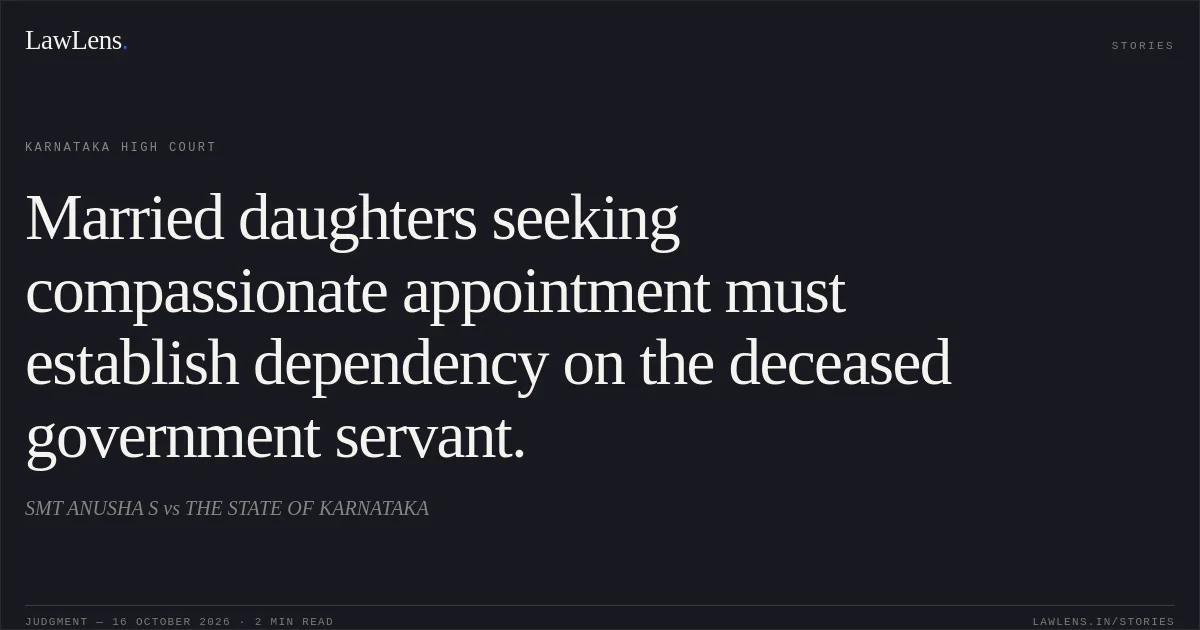
The Court accepted that a married daughter may seek compassionate appointment under the amended Rules, but held that the amendment did not dispense with the requirement to prove dependency.
pp. 7–9Although the petitioner asserted that she had lived with and cared for her mother, she produced no cogent material establishing that assertion.
pp. 7–9The residential certificate and police verification filed by the State before the Tribunal indicated that, after marriage, she lived with her husband at a different place.
pp. 7–9The Court therefore found no basis to disturb the authorities’ assessment or the Tribunal’s decision.
pp. 7–905Holding
The High Court held that the petitioner had not established dependency on her deceased mother and found no error or illegality in the rejection endorsements or the Tribunal’s order.
pp. 8–9It dismissed the writ petition.
pp. 8–9Original Court PDF
SMT ANUSHA SvsTHE STATE OF KARNATAKA
Click to open original judgment
Original judgment, available to read, download and summarize on LawLens.in