Facts
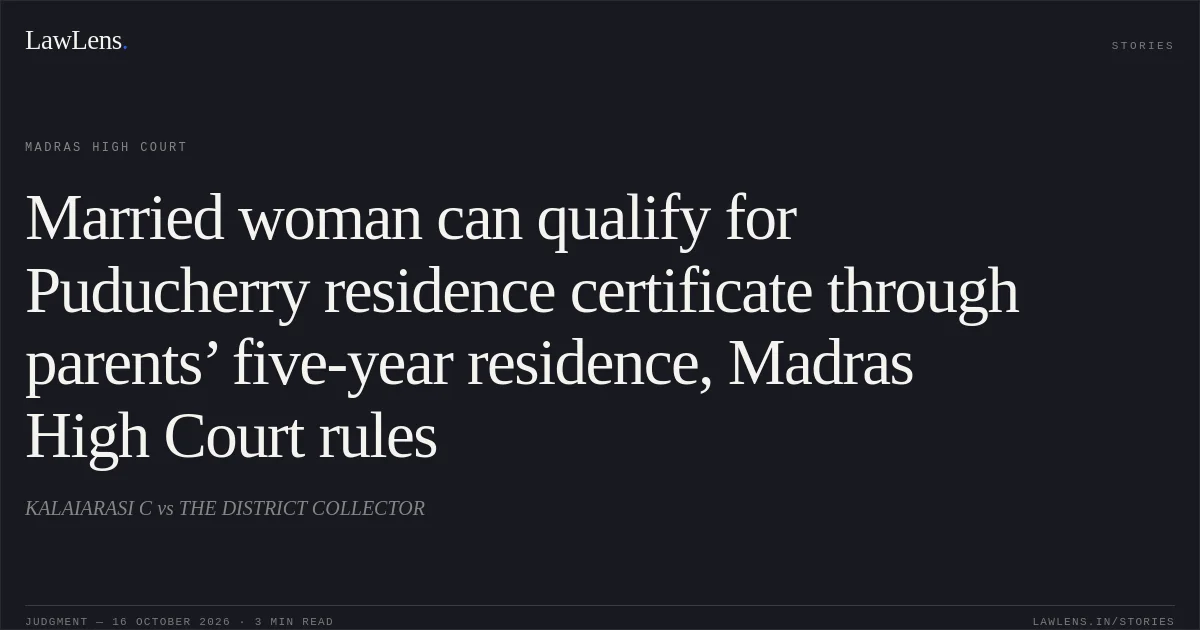
The petitioner was born and educated in Puducherry, completed her MBBS there, and applied for a residence certificate to support her application for postgraduate medical admission through CENTAC.
Source reference: pp. 4–9The Tahsildar rejected her application, stating that after her marriage on 14 November 2024 she was not ordinarily residing at her Puducherry address; the Sub-Collector dismissed her appeal on similar grounds, including that she had moved to Tamil Nadu with her husband.
Source reference: pp. 4–9The petitioner challenged both decisions and also sought admission-related relief, including conversion of a management-quota seat.
Source reference: no citationThe Court found it undisputed that her parents had continuously resided in Puducherry for the five years preceding her application.
Source reference: pp. 13–14, 16Issues
Whether the petitioner was entitled to a Puducherry residence certificate under the parental-residence criterion, notwithstanding her marriage and alleged post-marital residence outside Puducherry.
Source reference: pp. 13–16Whether issuance of the residence certificate entitled the petitioner to admission or to conversion or adjustment of a management-quota seat.
Source reference: pp. 15–16Law Applied
The Puducherry residence guidelines dated 6 October 2003 prescribe independent categories for establishing residence, including where the candidate or either parent has resided continuously in the Union Territory for at least five years preceding the application; the parental-residence route must have independent effect and cannot be made conditional on the candidate’s own continuous residence in every case.
Source reference: pp. 10–12, 14, 16–17In Divya Dinesh v. Government of Puducherry, W.P. No. 711 of 2022, decided 29 March 2022, the Court held that these categories are independent and distinguished the 2010 Note concerning married women whose names remain on family ration cards.
Source reference: p. 14The 2010 Note must be read harmoniously with the governing criteria and does not create an absolute bar for married women; marriage alone cannot extinguish eligibility otherwise established under the guidelines.
Source reference: pp. 13–15The Court also referred to Articles 14 and 15 of the Constitution in noting the concern raised by a marriage-based distinction.
Source reference: p. 15The nativity conditions in G.O. Ms. No. 48 dated 12 December 2002 do not determine a separate claim under the residence guidelines.
Source reference: pp. 6–8, 15Reasoning
The petitioner’s claim was based on the guideline category allowing qualification through a parent’s continuous Puducherry residence.
Source reference: pp. 13–16Since her parents’ residence for the required five-year period was undisputed, the authorities could not reject that independent basis solely because she was married or allegedly living with her husband in Tamil Nadu.
Source reference: pp. 13–16Requiring her own continuous residence in addition to the parent’s residence would nullify the parental alternative in the guidelines.
Source reference: pp. 13–16The 2010 Note and the appellate authority’s reliance on nativity requirements did not alter that conclusion; the Court therefore found it unnecessary to resolve the competing claims about the petitioner’s own post-marital residence.
Source reference: pp. 13–16However, a residence certificate alone did not establish entitlement to admission or seat conversion, which remained subject to the applicable rules, merit, reservation, seat availability, and admission deadlines.
Source reference: p. 16Holding
The Court allowed the writ petition, set aside the impugned orders, and directed the Tahsildar to issue the petitioner a residence certificate forthwith.
It confined its finding to certificate eligibility and declined to direct admission, conversion of a management-quota seat, or adjustment of seats in a succeeding year; any admission claim remained subject to the applicable requirements.
Source reference: p. 16No costs; connected miscellaneous petitions were closed.
Source reference: p. 16Original Court PDF
KALAIARASI CvsTHE DISTRICT COLLECTOR
Click to open original judgment
Original judgment, available to read, download and summarize on LawLens.in