Facts
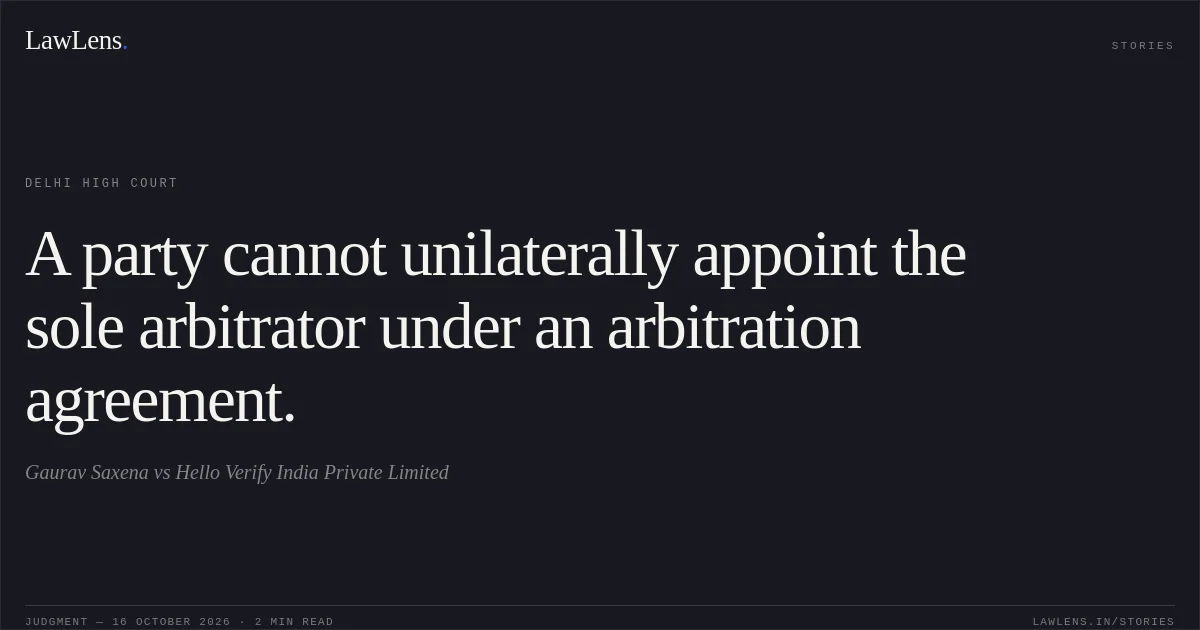
The petitioner, formerly employed by the respondent as General Manager (Sales), claimed unpaid terminal dues, including salary and client-meeting expenses, totalling Rs. 5,87,739, besides interest and other reliefs.
Source reference: p. 1–2After a recovery suit was disposed of with return of the plaint, the petitioner invoked the arbitration clause in the Employment Agreement dated 4 February 2022 by notice dated 19 December 2025, seeking appointment of a sole arbitrator; the respondent did not appoint one.
Source reference: p. 2The respondent objected that the Section 21 notice had been sent to the wrong address.
Source reference: p. 3Issues
Whether the objection that the Section 21 notice was sent to the respondent’s wrong address prevented the Court from constituting an arbitral tribunal.
Source reference: p. 3–4Whether the respondent could appoint the sole arbitrator under the Employment Agreement, or an independent arbitrator should be appointed.
Source reference: p. 5Whether the petitioner’s disputes arising from the Employment Agreement could be referred to arbitration.
Source reference: p. 4–5Law Applied
Section 11(6) of the Arbitration and Conciliation Act, 1996 empowers the Court to act where the agreed appointment procedure fails, while Section 21 ordinarily requires notice to commence arbitration and is a necessary precondition to a Section 11 application; under Adavya Projects (P) Ltd. v. Vishal Structurals (P) Ltd., non-service of that notice does not, by itself, nullify the tribunal’s jurisdiction.
Source reference: p. 3–4The Court referred to SBI General Insurance Co. Ltd. v. Krish Spinning and Interplay Between Arbitration Agreements under Arbitration Act, 1996 & Stamp Act, 1899, In re, as well as Aslam Ismail Khan Deshmukh v. ASAP Fluids Private Limited and Maharashtra State Electricity Distribution Co. Ltd. v. R.Z. Malpani, in support of constituting the tribunal where the arbitration agreement and arbitrable disputes were evident.
Source reference: p. 4–5Under TRF Ltd. v. Energo Engineering Projects Ltd., Perkins Eastman Architects DPC v. HSCC (India) Ltd. and Bharat Broadband Network Ltd. v. United Telecoms Ltd., a party that is ineligible to act as arbitrator cannot itself appoint the arbitrator.
Source reference: p. 5Reasoning
The Court found that the Employment Agreement contained an arbitration clause and that the petitioner’s claims arose from that agreement.
Source reference: p. 2–3, 4–5Applying Adavya Projects, it held that the respondent’s objection about service of the Section 21 notice to the wrong address did not prevent constitution of the tribunal, particularly since the arbitration agreement’s existence was not disputed.
Source reference: p. 3–4Because the respondent had failed to act under the appointment procedure and could not itself appoint the arbitrator consistently with the cited authorities, the Court appointed an independent sole arbitrator.
Source reference: p. 5Holding
The petition was allowed to the extent that Mr. Divyansh Rathi was appointed as sole arbitrator to decide disputes arising from the Employment Agreement, under the aegis and rules of the Delhi International Arbitration Centre.
The arbitrator was directed to consider the respondent’s jurisdictional objections at the outset, subject to the required Section 12 disclosures; the parties’ substantive claims and contentions were left open for determination, and the Court expressed no view on their merits.
Source reference: p. 5–6Acts & Sections Cited
5 provisions across 1 statute referred to in this judgment. Each provision opens on LawLens.
Arbitration and Conciliation Act, 19965
Original Court PDF
Gaurav SaxenavsHello Verify India Private Limited
Click to open original judgment
Original judgment, available to read, download and summarize on LawLens.in