Facts
The appellants challenged their convictions under the POCSO Act.
Source reference: no citationBy judgment dated 14 August 2025, the High Court found ambiguity concerning the prosecutrix’s age and directed the Special Court to record additional evidence on that limited issue under Section 94 of the Juvenile Justice Act, including an ossification examination if necessary.
Source reference: p.2–3, paras 1–3Pursuant to that direction, additional evidence was recorded, including an ossification report assessing the prosecutrix’s age as between 25 and 40 years as on 20 January 2026, and the testimony of PW-10, a primary school teacher, who produced school records recording the prosecutrix’s date of birth as 9 February 2000.
Source reference: p.3–4, para 4The appellants were not re-examined under Section 313 of the Code of Criminal Procedure, 1973 (“CrPC”) after the additional evidence was placed on record.
Source reference: p.4, paras 5–6; p.7, paras 16–17Issues
Whether the appellants were required to be re-examined under Section 313 CrPC after additional evidence concerning the prosecutrix’s age was recorded pursuant to the High Court’s directions?
Source reference: p.7, paras 16–18Whether failure to put the additional incriminating circumstances to the appellants caused prejudice sufficient to warrant setting aside the judgment and remanding the matter?
Source reference: p.7–8, paras 18–21Whether the appellate court could cure the defect by directing a retrial or remand from the stage of recording supplementary statements under Section 313 CrPC?
Source reference: p.7–9, paras 19–20Law Applied
Section 313(1)(b) CrPC requires the court, after prosecution evidence and before the accused is called upon to enter defence, to question the accused generally on the case so that the accused may personally explain circumstances appearing in the evidence against them.
Source reference: p.4–5, para 12The provision embodies the principles of natural justice and fair trial; a material circumstance not put to the accused cannot ordinarily be used against them, although every violation does not automatically invalidate the proceedings and the court must assess actual or likely prejudice.
Source reference: p.5–7, paras 13–15The Court relied on Basavaraj R. Patil v. State of Karnataka, which held that the ultimate test is whether the accused received a fair opportunity to explain the prosecution case; Kuldip Singh v. State of Delhi, which prohibits reliance on an important incriminating circumstance not put to the accused; and Nar Singh v. State of Haryana, which permits an appellate court to order retrial from the stage of recording the accused’s Section 313 statement where non-compliance has caused prejudice.
Source reference: p.5–8, paras 13–19It also relied on Aejaz Ahmad Sheikh v. State of U.P., recognising that an appellate court may itself record a further statement or direct the Trial Court to do so.
Source reference: p.8–9, para 20The additional evidence was material because the determination of age under Section 94 of the Juvenile Justice Act affected the applicability of the POCSO Act.
Source reference: p.2–3, paras 2–3; p.7, para 18Reasoning
The Court held that the additional evidence was fresh, non-repetitive, and directly concerned the prosecutrix’s age, which was central to determining whether the POCSO Act applied and whether the appellants could rely on consent.
Source reference: p.7, para 18Since the school records, testimony of PW-10, and ossification report were introduced after the appellants’ original Section 313 examinations, those circumstances had never been put to them for explanation.
Source reference: p.7, paras 16–17The appellants therefore suffered apparent, or at least likely, prejudice under the principles stated in Basavaraj R. Patil, Kuldip Singh, and Nar Singh.
Source reference: no citationThe Court rejected the submission that the appellants’ prior knowledge of the proceedings eliminated the need for examination, because Section 313 requires the relevant incriminating circumstances appearing in the evidence to be specifically or fairly put to the accused.
Source reference: no citationThe defect could appropriately be cured by remanding the case to the Trial Court from the stage of supplementary examination under Section 313 CrPC, consistent with Nar Singh and Aejaz Ahmad Sheikh.
Source reference: p.7–9, paras 19–21Holding
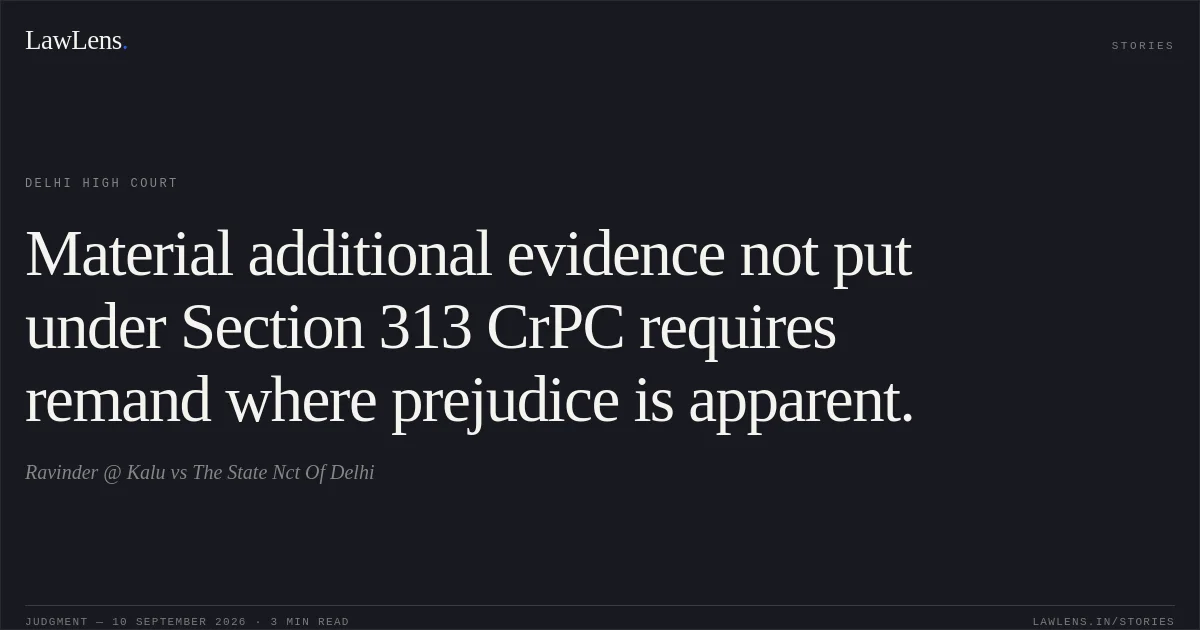
The Court answered the issues in favour of the appellants and held that, after the recording of material additional evidence, the appellants ought to have been re-examined under Section 313 CrPC.
The failure to do so caused prejudice and constituted a procedural defect requiring correction.
Source reference: p.9, para 21Accordingly, the impugned judgment of the learned ASJ was set aside, and the matters were remanded to the Trial Court to proceed afresh from the stage of recording the appellants’ statements under Section 313 CrPC in accordance with law.
Source reference: p.9, para 22The Special Court was requested to endeavour to dispose of the matter preferably within six months, having regard to the fact that the incident dated back to 2016.
Source reference: p.9, para 23Acts & Sections Cited
10 provisions across 6 statutes referred to in this judgment. Each provision opens on LawLens.
Protection of Children from Sexual Offences Act, 20122
Indian Penal Code, 18603
Juvenile Justice (Care and Protection of Children) Act, 2015.1
Bharatiya Nagarik Suraksha Sanhita, 20232
Bharatiya Sakshya Adhiniyam, 20231
Code of Criminal Procedure, 19731
Original Court PDF
Ravinder @ KaluvsThe State Nct Of Delhi
Click to open original judgment
Original judgment, available to read, download and summarize on LawLens.in