Facts
The State of Gujarat appealed against the acquittal order dated 13.04.2007 passed by the Special Judge, Bharuch, in a case involving alleged offences under Sections 143, 147, 149, 323, 325, and 504 of the IPC and Section 3(1)(x) [erroneously cited as 3(5)(x) in some records] of the SC/ST (Prevention of Atrocities) Act.
Source reference: para 1The complainant alleged that on 28.08.2005, at approximately 9:30 p.m., the accused persons assaulted him with a spade handle and a baseball bat near a gym in Ankleshwar and used derogatory caste-based slurs.
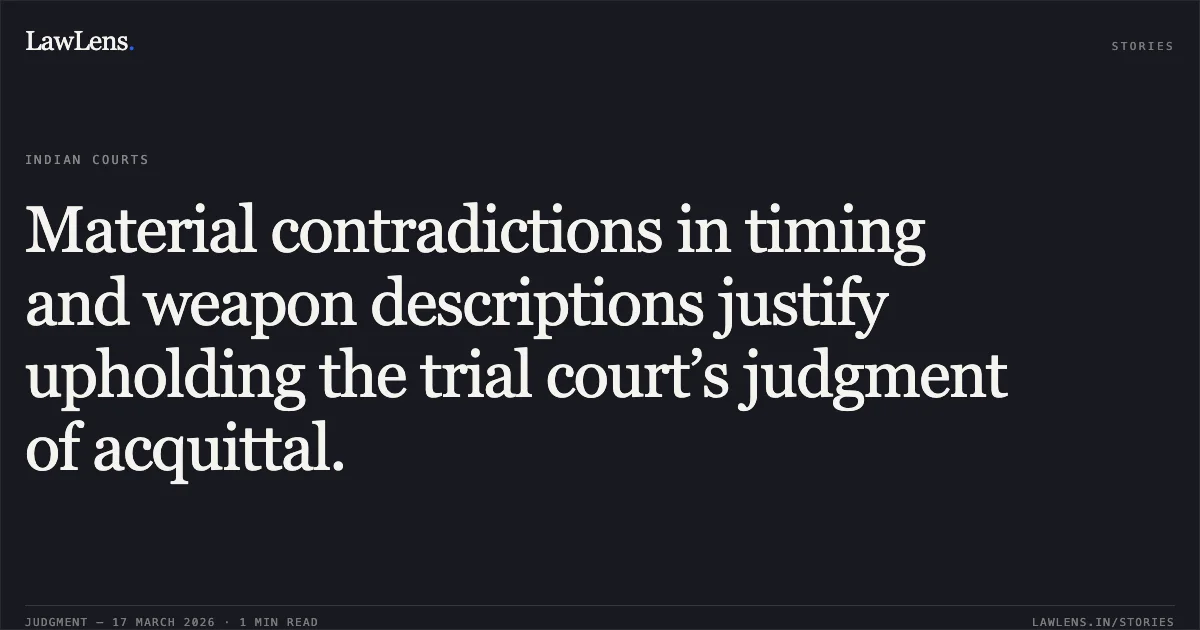
Source reference: para 2During the trial, significant discrepancies emerged: medical records cited different weapons (hockey sticks and pipes vs. the alleged baseball bat), and the timings recorded in police and medical documents were contradictory (e.g., a police yadi prepared before the recorded time of the incident).
Source reference: para 8.2Furthermore, the defense proved that Accused No. 4 was hospitalized for a road accident at the time of the alleged assault.
Source reference: para 8.7Issues
1. Whether the prosecution proved the charges beyond a reasonable doubt in light of significant contradictions between medical evidence and ocular testimony.
Source reference: para 52. Whether the alleged insults and intimidation were specifically directed at the complainant because of his caste, as required for a conviction under the SC/ST Act.
Source reference: para 8.113. Whether the High Court should interfere with a trial court’s judgment of acquittal if the view taken by the lower court is a "possible" and "reasonable" view.
Source reference: para 14-16Law Applied
The court applied the Indian Penal Code and the Scheduled Castes and the Scheduled Tribes (Prevention of Atrocities) Act, 1989.
Source reference: para 1It relied on Sajan Sakhariya v. State of Kerala (2024), which establishes that an offence under Section 3(1)(x) is not made out unless the insult or intimidation is directed at the victim specifically because of their caste identity.
Source reference: para 8.11Regarding appellate jurisdiction, the court applied principles from Chandrappa v. State of Karnataka (2007) and Ram Kumar v. State of Haryana (1995), holding that the "double presumption of innocence" applies in acquittal appeals and the appellate court should be slow to disturb a finding of fact unless it is patently perverse or illegal.
Source reference: para 13, 15Reasoning
The court found the prosecution's evidence to be inherently unreliable due to fundamental contradictions. First, the medical evidence (Exh. 40, 41, 52, 62) was inconsistent: one hospital record cited an assault by "hockey stick," another by "pipes," while the complaint mentioned a "baseball bat".
Source reference: para 8.2, 8.5Second, the timeline was logically impossible, as the police yadi (10:25 p.m.) predated the recorded incident time in certain documents (10:30 p.m.).
Source reference: para 8.2Third, the court highlighted that Accused No. 4 was proven to be in a hospital with a head fracture during the incident, rendering the prosecution's narrative of his involvement false.
Source reference: para 8.7Fourth, the court noted that despite 35-40 people being present at the scene, the prosecution only examined friends of the complainant and failed to produce independent witnesses; furthermore, a key witness (P.W. 8) turned hostile.
Source reference: para 8.4, 8.8Finally, the court observed that the evidence failed to satisfy the requirements of the SC/ST Act as there was no proof the alleged abuse was motivated specifically by the victim's caste status.
Source reference: para 8.11Holding
The High Court dismissed the State's appeal and confirmed the judgment of acquittal.
The court held that the prosecution failed to establish the guilt of the accused beyond a reasonable doubt due to "patent perversity" in the evidence and material omissions.
Source reference: para 16, 18The court concluded that the trial court’s decision was a reasonable view based on the evidence, and in the absence of manifest illegality or perversity, the appellate court must not substitute its own view for that of the trial judge.
Source reference: para 14, 18Acts & Sections Cited
10 provisions across 3 statutes referred to in this judgment. Each provision opens on LawLens.
Indian Penal Code, 18607
Scheduled Castes and the Scheduled Tribes (Prevention of Atrocities) Act, 19891
Code of Criminal Procedure, 19732
Original Court PDF
STATE OF GUJARATvsHITESHBHAI JESINGBHAI PATEL
Click to open original judgment
Original judgment, available to read, download and summarize on LawLens.in