Facts
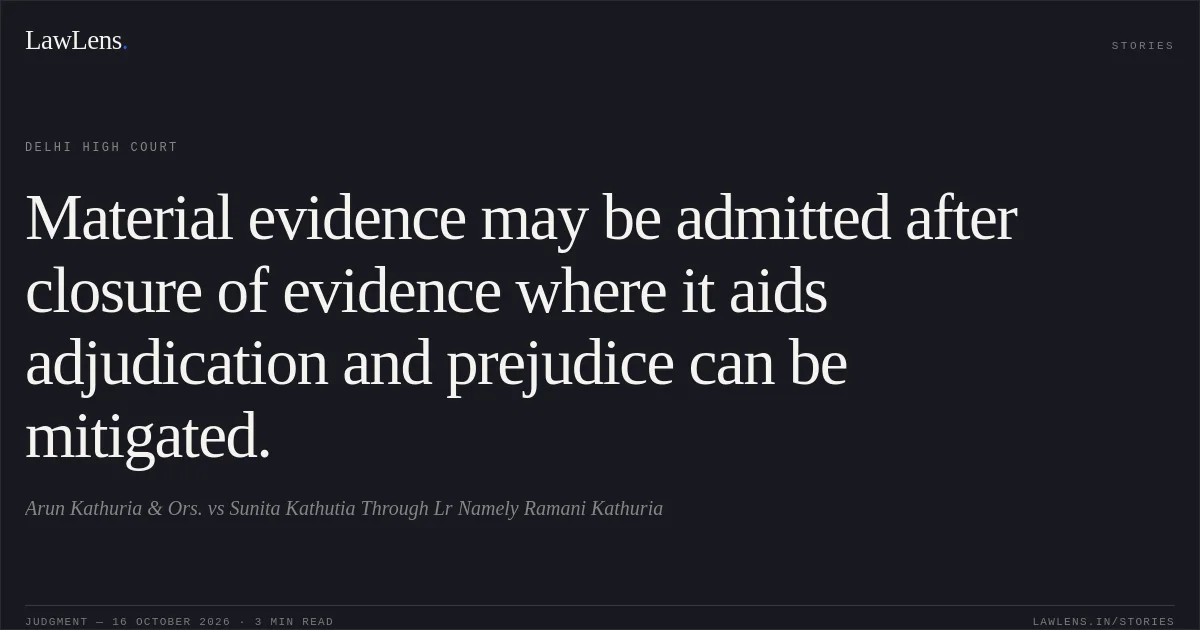
The petitions challenged a common order refusing the petitioners leave to place on record a cancellation report and accompanying documents from criminal proceedings concerning the genuineness of a Will, and refusing permission to summon Tarun Babbar to identify the signatures of his deceased father, an attesting witness to the Will.
Source reference: para. 1, 16–19The petitioners’ evidence in the civil suit had closed in 2018, and the suit had reached final arguments.
Source reference: para. 10–12, 17, 21, 24They stated that they obtained the complete criminal-court record in October 2024 and later located Tarun Babbar, who had provided an affidavit concerning his familiarity with his father’s signatures.
Source reference: para. 10–12, 17, 21, 24The Trial Court dismissed the applications as belated.
Source reference: para. 18Issues
Whether the Trial Court was justified in refusing leave under Order VIII Rule 1A(3) CPC to produce the cancellation report and accompanying documents at the advanced stage of the suit.
Source reference: para. 40–44Whether the Trial Court was justified in refusing permission under Order XVI CPC to summon Tarun Babbar to identify his deceased father’s signatures on the Will.
Source reference: para. 40, 45–47Law Applied
Under Order VIII Rule 1A(3) CPC and Order XVI CPC, a court may permit production of documents or examination of a witness after the usual evidentiary stage, but relevance alone does not entitle a party to reopen its case.
Source reference: para. 41–42The court must assess the explanation for delay, the stage of proceedings, the materiality of the evidence, its effect on the party’s case, and prejudice to the opposing party; safeguards or costs may address prejudice.
Source reference: para. 41–42Sugandhi (Dead) by LRs. v. P. Rajkumar and Levaku Pedda Reddamma v. Gottumukkala Venkata Subbamma support a justice-oriented exercise of discretion and permit delay to be addressed, where appropriate, through costs.
Source reference: para. 42Sudesh v. Vijender Singh identifies materiality, bona fides, irreversible prejudice, and the availability of safeguards as relevant considerations when deciding whether to reopen evidence.
Source reference: para. 51Proof of the signatures and sufficiency of the proposed testimony remain matters for the Trial Court under the applicable evidence law, including Sections 67 and 68 of the Bharatiya Sakshya Adhiniyam, 2023.
Source reference: para. 46Reasoning
The Court held that the applications’ lateness and the closure of evidence warranted scrutiny but were not, by themselves, decisive.
Source reference: para. 43–44The documents arose from criminal proceedings concerning the same Will already in dispute and did not introduce a new case; their relevance and evidentiary effect were for the Trial Court to assess.
Source reference: para. 43–44Tarun Babbar was proposed to identify his father’s signatures on an existing document, rather than to introduce a new factual foundation.
Source reference: para. 46–48The respondent could cross-examine him and contest his familiarity with the signatures, as well as the admissibility and sufficiency of the evidence; any prejudice could therefore be addressed through procedural safeguards.
Source reference: para. 46–48The Trial Court had adopted an unduly restrictive approach by treating delay and procedural stage as determinative without sufficiently considering materiality.
Source reference: para. 48Holding
The Court set aside the common order and allowed the applications under Order VIII Rule 1A(3) and Order XVI CPC, subject to payment of ₹75,000 in costs to the respondent within one week.
It directed the Trial Court to complete Tarun Babbar’s examination on one date, subject to its convenience, and thereafter proceed with the suit in accordance with law, without being influenced by the judgment except as necessary to implement it.
Source reference: para. 53The Court expressed no opinion on the merits of the dispute.
Source reference: para. 55Acts & Sections Cited
8 provisions across 3 statutes referred to in this judgment. Each provision opens on LawLens.
Indian Penal Code, 18604
Code of Criminal Procedure, 19732
Bharatiya Sakshya Adhiniyam, 20232
Original Court PDF
Arun Kathuria & Ors.vsSunita Kathutia Through Lr Namely Ramani Kathuria
Click to open original judgment
Original judgment, available to read, download and summarize on LawLens.in