Facts
The deceased, Rahul, was found injured after allegedly falling from a roof in an intoxicated state, according to an initial police report by a village Chaukidar
Source reference: para. 2The respondent (deceased's brother) filed an FIR alleging the petitioners murdered Rahul after consuming liquor
Source reference: para. 3Following a police investigation, a "final report" was submitted concluding no case was made out against the petitioners
Source reference: para. 4Dissatisfied, the respondent filed a protest petition, which the Magistrate treated as a complaint case. After recording statements from seven witnesses under Sections 200 and 202 Cr.P.C., the Magistrate summoned the petitioners to face trial for murder (Section 302 IPC) via order dated 20.01.2024
Source reference: para. 4The petitioners challenged this via a revision petition, which was dismissed on 18.12.2024
Source reference: para. 1Issues
1. Whether the Magistrate exercised proper judicial discretion and application of mind in summoning the accused for murder after a police final report had been filed
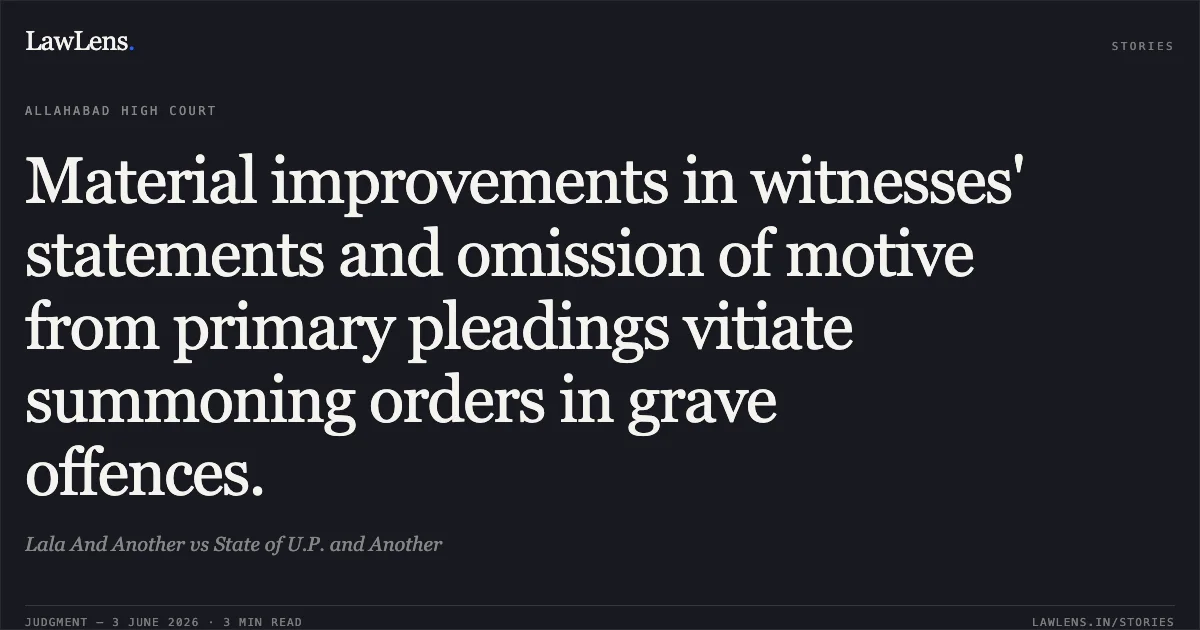
Source reference: para. 16, 212. Whether material improvements and omissions between an FIR/protest petition and subsequent statements during a complaint inquiry vitiate a summoning order
Source reference: para. 18, 283. Whether the High Court should interfere with a summoning order under Article 227 when the evidence does not prima facie form a coherent chain of circumstances
Source reference: para. 28, 30Law Applied
The Court applied the procedural mandates of Chapter XV of the Code of Criminal Procedure (Cr.P.C.) regarding the treatment of protest petitions as complaints through Sections 200 and 202
Source reference: para. 21It invoked Section 302 of the Indian Penal Code (IPC) regarding the gravity of the offense of murder
Source reference: para. 22The Court emphasized the principle that while a Magistrate has the power to disagree with a police final report, such power must be exercised with "great caution" and "judicial mind," ensuring that an inquiry is not a mere "empty formality" or a substitute for a full investigation where scientific or forensic evidence is required
Source reference: para. 22-23The court also relied on the principle that material improvements (such as a new motive) surfacing for the first time in oral testimony raise serious doubts regarding the genuineness of the accusation
Source reference: para. 18Reasoning
The Court found that the Magistrate failed to address critical gaps in the prosecution's story, notably the lack of explanation as to why the deceased was found at a different location (Maharaj Singh’s house) than where the assault allegedly occurred
Source reference: para. 17The Court observed that the motive—a claim that the deceased was carrying Rs.35,000—was a "material improvement" introduced only during the oral inquiry and was absent from the FIR and the protest petition
Source reference: para. 18The Court scrutinized the testimony of P.W.-2, finding his conduct "unnatural" as he claimed to be too afraid to intervene in the assault yet was later the recipient of a voluntary confession by the accused
Source reference: para. 20The Court reasoned that in serious cases like murder, a Magistrate cannot be a "mere spectator" but must test the credibility of witnesses, especially when the police investigation had already concluded no crime occurred
Source reference: para. 24-25The Court concluded that the summoning order was passed "mechanically" without identifying specific material to override the police's final report findings
Source reference: para. 28-29Holding
The Court held that the summoning order suffered from non-application of judicial mind and failed to properly scrutinize the material inconsistencies and improvements in the witnesses' testimonies
The petition was allowed, and the orders dated 18.12.2024 (Revisional Court) and 20.01.2024 (Magistrate) were set aside. The Court emphasized that for grave offenses, the summoning order must reflect deep scrutiny and disclose clear reasons for proceeding against the accused in the face of a final report
Source reference: para. 31, para. 28Acts & Sections Cited
3 provisions across 2 statutes referred to in this judgment. Each provision opens on LawLens.
Indian Penal Code, 18601
Code of Criminal Procedure, 19732
Original Court PDF
Lala And AnothervsState of U.P. and Another
Click to open original judgment
Original judgment, available to read, download and summarize on LawLens.in