Facts
On 6 September 2014, the appellant allegedly entered the informant’s house while she was alone, assaulted her, attempted to outrage her modesty, and snatched her mangalsutra while fleeing.
Source reference: para. 3; p. 2The written report was lodged on the same day, and the FIR was registered for offences including Sections 323, 448, 376 and 379 of the Indian Penal Code.
Source reference: para. 4; p. 2During investigation, the victim was medically examined and her statement under Section 164 Cr.P.C. was recorded, in which she alleged that the appellant had raped her.
Source reference: para. 4; p. 2The trial court convicted the appellant under Sections 323, 448 and 376 IPC and sentenced him to seven years’ rigorous imprisonment for rape and six months’ rigorous imprisonment for each of the other offences, with the sentences to run concurrently.
Source reference: para. 2; p. 1Issues
Whether the prosecution proved beyond reasonable doubt that the appellant committed offences under Sections 323, 448 and 376 IPC?
Source reference: paras. 7–9; pp. 3–4Whether the subsequent allegation of rape in the Section 164 Cr.P.C. statement, despite its absence from the FIR and the lack of corroborative medical evidence, rendered the prosecution case doubtful?
Source reference: paras. 7–9; pp. 3–4Whether the appellant was entitled to the benefit of doubt and acquittal?
Source reference: paras. 7, 9 and 11–13; pp. 3–5Law Applied
The court applied Sections 323, 448 and 376 of the Indian Penal Code, which respectively penalise voluntarily causing hurt, house-trespass, and rape.
Source reference: no citationThe prosecution was required to establish the charged offences beyond reasonable doubt.
Source reference: paras. 7–9; pp. 3–4The court applied the principle that material contradictions, substantial improvements in the victim’s version, omission of a vital allegation from the FIR, lack of corroborative medical evidence, and absence of reliable independent witnesses may create reasonable doubt regarding the prosecution case.
Source reference: paras. 7–9; pp. 3–4Where such reasonable doubt exists, the accused is entitled to its benefit.
Source reference: paras. 7–9; pp. 3–4Reasoning
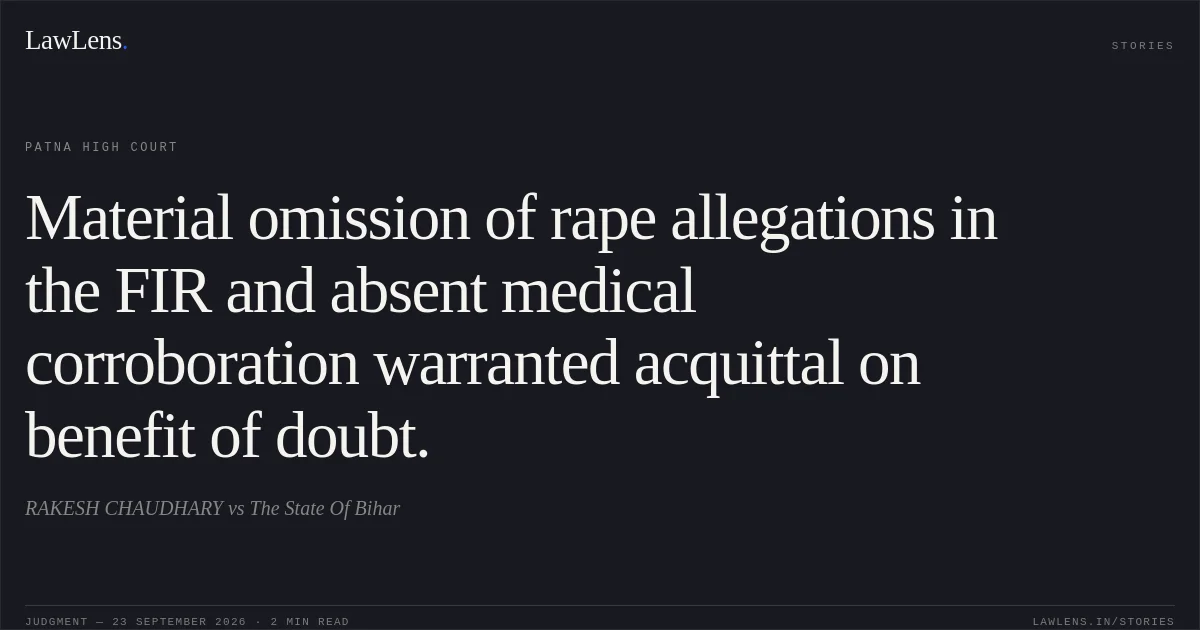
The court found that the allegation of rape was not mentioned in the first information report and was introduced subsequently in the victim’s statement under Section 164 Cr.P.C., making the allegation susceptible to being treated as an afterthought.
Source reference: paras. 7–8; pp. 3–4Although P.W. 2 and the informant supported the appellant’s presence in the house and the alleged snatching of the mangalsutra, the court considered P.W. 2 an interested witness and found that the remaining witnesses mainly established the victim’s distressed condition rather than the commission of rape.
Source reference: para. 7; p. 3The medical evidence did not establish rape, and the prosecution lacked independent corroboration.
Source reference: paras. 5, 7 and 9; pp. 2–4These omissions, contradictions and evidentiary deficiencies cumulatively created reasonable doubt regarding the offences, requiring the benefit of doubt to be extended to the appellant.
Source reference: paras. 7 and 9; p. 4Holding
The High Court held that the prosecution failed to prove the charges beyond reasonable doubt.
It set aside the judgment of conviction dated 2 November 2017 and the order of sentence dated 8 November 2017, acquitted the appellant of the offences under Sections 323, 448 and 376 IPC, and discharged him from the liability of his bail bond.
Source reference: paras. 11–13; p. 5The appeal was accordingly allowed.
Source reference: para. 13; p. 5Acts & Sections Cited
5 provisions across 2 statutes referred to in this judgment. Each provision opens on LawLens.
Indian Penal Code, 18604
Code of Criminal Procedure, 19731
Original Court PDF
RAKESH CHAUDHARYvsThe State Of Bihar
Click to open original judgment
Original judgment, available to read, download and summarize on LawLens.in