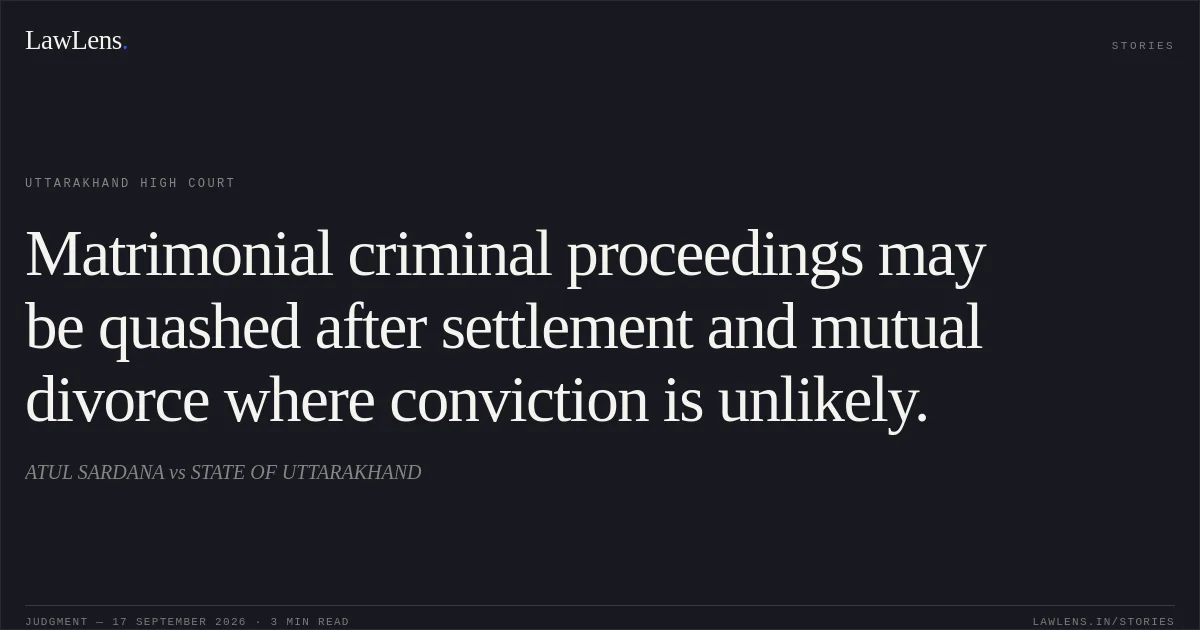
Facts
The applicants, Dr. Atul Sardana and others, were involved in matrimonial disputes with respondent no. 2, Dr. Vandana Sardana.
Source reference: para. 2The disputes resulted in: (i) proceedings under Section 406 IPC in Criminal Case No. 1739 of 2023 before the Judicial Magistrate, Nainital; (ii) proceedings under Section 12 of the Protection of Women from Domestic Violence Act, 2005, in Criminal Misc. Case No. 205 of 2021 before the Almora court; and (iii) proceedings under Sections 498-A, 323 and 506 IPC in Criminal Case No. 161 of 2022 arising from FIR No. 92 of 2021 at Police Station Kotwali Almora.
Source reference: para. 2During the pendency of the proceedings, the parties entered into a mutual settlement dated 14 March 2024, under which they agreed to withdraw the pending criminal and other matrimonial proceedings.
Source reference: paras. 4–5Subsequently, their marriage was dissolved by mutual consent under Section 13-B of the Hindu Marriage Act, 1955, by judgment dated 6 November 2024 passed by the Principal Judge, Family Court, Nainital.
Source reference: para. 6The applicants therefore sought quashing of the impugned orders, charge-sheet and consequential criminal proceedings under Section 482 Cr.P.C.
Source reference: paras. 2, 6–7Issues
Whether the High Court should exercise its inherent jurisdiction under Section 482 Cr.P.C. to quash criminal proceedings arising from a matrimonial dispute after the parties have amicably settled their disputes and obtained a decree of mutual divorce?
Source reference: paras. 7–10Whether continuation of proceedings under Sections 406, 498-A, 323 and 506 IPC and Section 12 of the Protection of Women from Domestic Violence Act, 2005, would serve any meaningful purpose where the complainant has settled the dispute and agreed to withdraw the cases?
Source reference: paras. 4, 7–10Law Applied
The Court applied the inherent jurisdiction of the High Court under Section 482 Cr.P.C. to prevent abuse of the process of court and secure the ends of justice.
Source reference: paras. 7–10It relied principally on B.S. Joshi v. State of Haryana, (2003) 4 SCC 675, which holds that matrimonial criminal proceedings may be quashed despite the offences being non-compoundable where the parties have amicably resolved their disputes, the marriage has been dissolved or the parties have separated, and continuation of the prosecution would be futile because there is little or no likelihood of conviction.
Source reference: para. 8The Court also referred to State of Karnataka v. L. Muniswamy, (1977) 2 SCC 699, recognising that the High Court may quash criminal proceedings where doing so is necessary to secure the ends of justice.
Source reference: para. 8Reasoning
The Court found that the proceedings arose exclusively from a matrimonial dispute and that the parties had voluntarily entered into a settlement covering the criminal cases and related matrimonial litigation.
Source reference: paras. 3–5The subsequent decree of divorce by mutual consent confirmed that the matrimonial relationship had ended and that the settlement had been acted upon.
Source reference: para. 6Applying the principle in B.S. Joshi, the Court concluded that the complainant’s settlement and agreement to withdraw the proceedings substantially removed the possibility of a successful prosecution.
Source reference: paras. 7–10Continuing the cases would therefore amount to a futile exercise and would not advance the interests of justice.
Source reference: paras. 7–10The State also raised no objection to disposal of the matters in terms of the settlement.
Source reference: para. 8Holding
The High Court answered the issues in favour of the applicants and exercised its inherent jurisdiction under Section 482 Cr.P.C.
All three applications were allowed.
Source reference: para. 11The Court quashed: (i) the summoning/cognizance order dated 10 August 2023 and consequential order dated 18 September 2023 in Criminal Case No. 1739 of 2023 under Section 406 IPC; (ii) the order dated 1 April 2021 in proceedings under Section 12 of the Protection of Women from Domestic Violence Act, 2005; and (iii) the charge-sheet dated 31 March 2023, cognizance order dated 2 December 2022 and entire proceedings in Criminal Case No. 161 of 2022 arising from FIR No. 92 of 2021 under Sections 498-A, 323 and 506 IPC.
Source reference: para. 11The applications and all pending applications were accordingly disposed of.
Source reference: paras. 12–13Acts & Sections Cited
6 provisions across 3 statutes referred to in this judgment. Each provision opens on LawLens.
Code of Criminal Procedure, 19732
Indian Penal Code, 18603
Protection of Women from Domestic Violence Act, 20051
Original Court PDF
ATUL SARDANAvsSTATE OF UTTARAKHAND
Click to open original judgment
Original judgment, available to read, download and summarize on LawLens.in
![Relief is made contingent on the Supreme Court’s eventual determination in the analogous pending case.. Ashok Tolani vs REVENUE. CAT - ['Jaipur']. LawLens](/stories/thumbnails/relief-is-made-contingent-on-the-supreme-courts-eventual-determination-in-the-analogous-pe-0a05b6600e0644cf9facfda571d15955.webp)