Facts
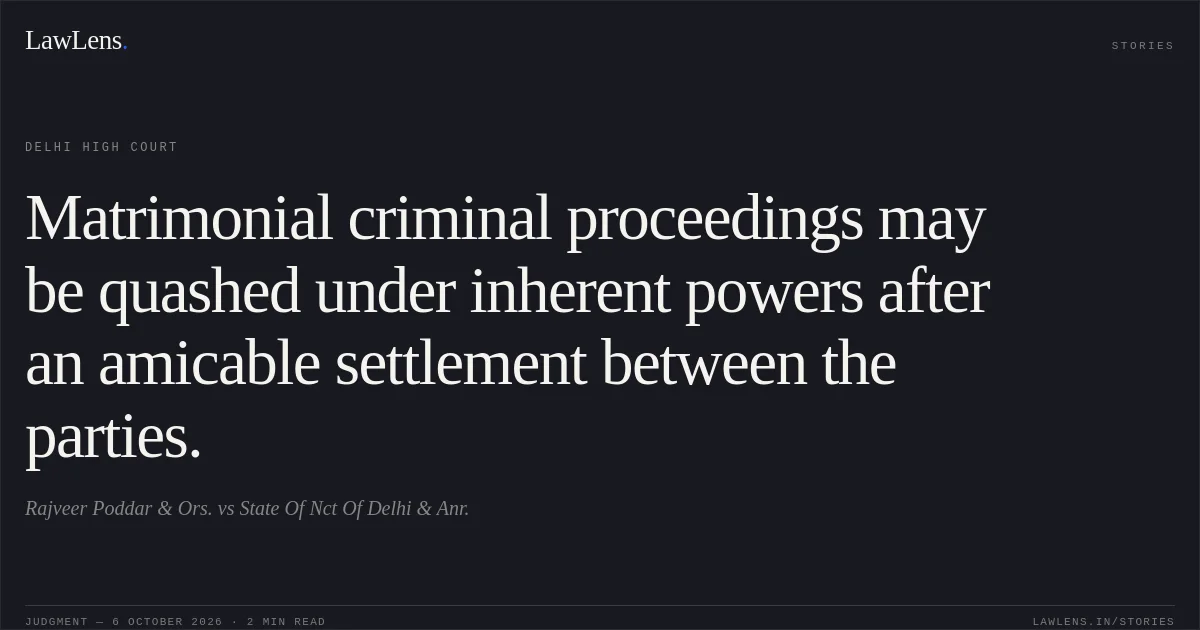
The petitioners sought quashing under Section 528 of the Bharatiya Nagarik Suraksha Sanhita, 2023 (BNSS), of FIR No. 140/2019, registered at P.S. Ranhola under Sections 498A/34 IPC, and the proceedings arising from it.
Source reference: p. 1, para. 1The FIR followed the complainant’s allegations of dowry-related physical and mental harassment by the petitioners; the parties had been living separately since 7 August 2017.
Source reference: p. 2, paras. 2–3A charge-sheet under Sections 498A/406/34 IPC had been filed, and the case was pending at the prosecution-evidence stage.
Source reference: p. 2, para. 4The parties later entered into a written settlement; the first motion for divorce was completed, the second motion was pending, and petitioner No. 1 had paid the agreed settlement amount of ₹14,00,000.
Source reference: pp. 2–3, paras. 5–6The complainant confirmed the settlement and consented to quashing the FIR.
Source reference: p. 3, paras. 7–8Issues
1. Whether the High Court should exercise its inherent jurisdiction under Section 528 BNSS to quash the FIR and consequential proceedings in light of the parties’ settlement.
Source reference: p. 3, paras. 8–102. Whether continuation of the criminal proceedings would serve any useful purpose where the dispute was private in nature and the complainant no longer wished to press the charges.
Source reference: p. 3, para. 9Law Applied
Section 528 BNSS preserves the High Court’s inherent powers to make orders necessary to give effect to an order under the Sanhita, prevent abuse of the process of a court, or otherwise secure the ends of justice.
Source reference: p. 1, para. 1; p. 3, para. 10The Court applied the principle that criminal proceedings arising from a private dispute may be quashed on settlement where continuation would serve no useful purpose and quashing would secure the ends of justice.
Source reference: p. 3, paras. 9–10Reasoning
The Court considered that the parties had amicably settled their dispute, the full settlement amount had been paid, and the complainant had personally confirmed that her consent was voluntary and that she had no objection to quashing.
Source reference: p. 3, paras. 6–8Given the private nature of the dispute and the complainant’s decision not to pursue the charges, the Court concluded that continuing the prosecution would serve no useful purpose and exercised its inherent power to secure the ends of justice.
Source reference: p. 3, paras. 9–10Holding
The Court allowed the petition and quashed FIR No. 140/2019, registered under Sections 498A/34 IPC, together with all consequential proceedings.
It directed that the parties’ original affidavits be submitted to the Trial Court and the concerned SHO/IO within four weeks.
Source reference: p. 3, para. 11Pending applications, if any, were also disposed of.
Source reference: p. 4, para. 13Acts & Sections Cited
3 provisions across 2 statutes referred to in this judgment. Each provision opens on LawLens.
Bharatiya Nagarik Suraksha Sanhita, 20231
Indian Penal Code, 18602
Original Court PDF
Rajveer Poddar & Ors.vsState Of Nct Of Delhi & Anr.
Click to open original judgment
Original judgment, available to read, download and summarize on LawLens.in