Facts
Opposite Party No. 2 alleged that she married Petitioner No. 1 in 2007 and was thereafter subjected to mental and physical cruelty by the petitioners in connection with a demand for a Scorpio car. She further alleged an attempt to burn her, forced miscarriage in 2020, and theft at her parental home
Source reference: para. 3On these allegations, Balia P.S. Case No. 334 of 2023 was registered under Sections 341, 323, 504, 506, 379, 307 and 498A of the IPC and Sections 3/4 of the Dowry Prohibition Act, 1961
Source reference: para. 2Subsequently, the parties settled their disputes; the petitioners paid ₹10 lakhs to Opposite Party No. 2 as full and final settlement, and the parties obtained a mutual-consent divorce in Divorce Case No. 94 of 2024
Source reference: para. 5Opposite Party No. 2 supported the compromise and expressly stated that she had no objection to quashing the criminal proceedings
Source reference: para. 6Issues
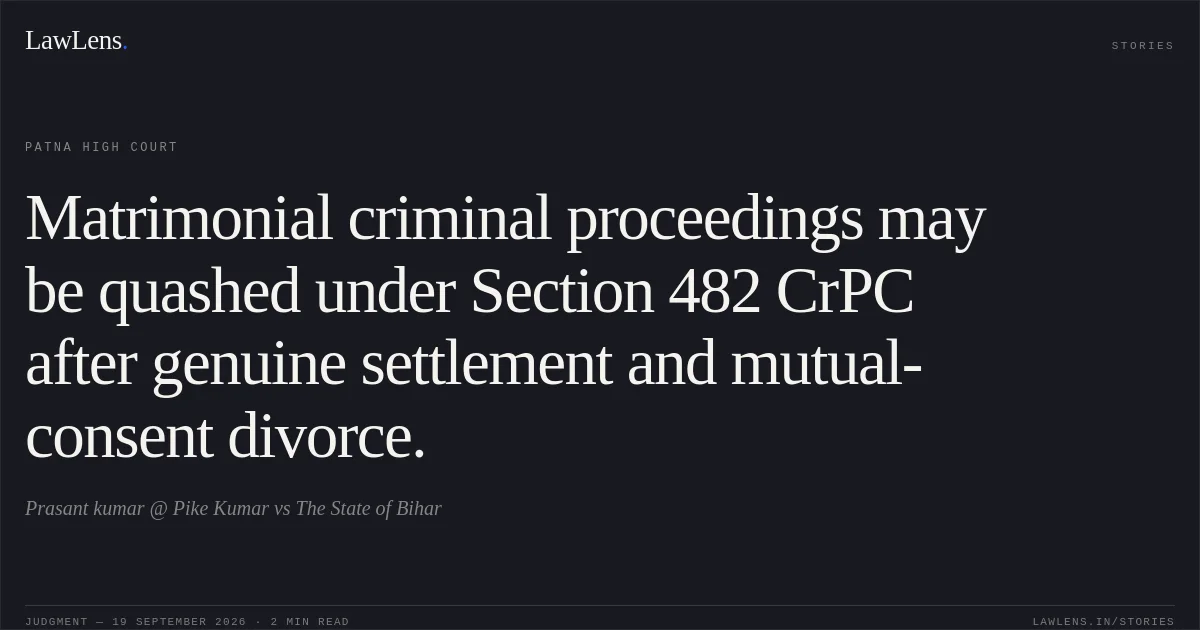
Whether the High Court should exercise its inherent jurisdiction under Section 482 of the Cr.P.C. to quash criminal proceedings arising from a matrimonial dispute after the parties have entered into a compromise and obtained a mutual-consent divorce?
Source reference: paras. 5–8Whether continuation of the FIR and prosecution would serve any legitimate purpose in view of the full and final settlement and the consent of the complainant to quashing?
Source reference: paras. 5–8Law Applied
The Court considered the offences alleged under Sections 341, 323, 504, 506, 379, 307 and 498A of the IPC and Sections 3/4 of the Dowry Prohibition Act, 1961
Source reference: para. 2It applied the inherent jurisdiction under Section 482 of the Cr.P.C. to prevent abuse of the process of court and secure the ends of justice.
Source reference: no citationRelying on Mange Ram v. State of Madhya Pradesh & Anr., 2025 SCC OnLine SC 1681, the Court held that criminal proceedings arising principally out of matrimonial disputes may be quashed where the parties have genuinely compromised their dispute, particularly when the settlement has brought the matrimonial litigation to an end
Source reference: para. 7Reasoning
The Court treated the dispute as having been resolved through a genuine and comprehensive settlement. The parties had obtained a mutual-consent divorce, the petitioners had paid ₹10 lakhs towards full and final settlement, and the complainant supported quashing of the proceedings
Source reference: paras. 5–6Applying the principle in Mange Ram, the Court concluded that continuation of the prosecution, despite the settlement and termination of the matrimonial relationship, would unnecessarily consume judicial time and would not advance any useful or legitimate purpose
Source reference: paras. 7–8The Court therefore found it appropriate to exercise its inherent powers under Section 482 of the Cr.P.C.
Source reference: no citationHolding
The High Court allowed the application and quashed Balia P.S. Case No. 334 of 2023, along with all consequential prosecution, insofar as the petitioners were concerned
The proceedings were terminated on the basis of the parties’ compromise, mutual-consent divorce, full and final settlement, and the complainant’s consent to quashing
Source reference: paras. 5–10Acts & Sections Cited
10 provisions across 4 statutes referred to in this judgment. Each provision opens on LawLens.
Indian Penal Code, 18606
Hindu Marriage Act, 19551
Code of Criminal Procedure, 19731
Original Court PDF
Prasant kumar @ Pike KumarvsThe State of Bihar
Click to open original judgment
Original judgment, available to read, download and summarize on LawLens.in