Facts
The complainant, V. Vandana Kumari @ Priti, married petitioner no. 1, Manish Mishra, on 30 January 2022. She alleged that her husband, father-in-law and mother-in-law subjected her to mental and physical cruelty in connection with dowry demands and compelled her to leave the matrimonial home.
Source reference: para. 3On the basis of her complaint, the Sub-Divisional Judicial Magistrate, Chapra at Saran, took cognizance on 9 November 2022 of offences under Sections 498A and 504/34 of the IPC and Section 4 of the Dowry Prohibition Act.
Source reference: para. 2During the pendency of the proceedings, the parties entered into a Memorandum of Settlement dated 18 February 2024 and agreed to withdraw their respective litigations, including pursuing divorce by mutual consent under Section 13(B) of the Hindu Marriage Act.
Source reference: para. 6A petition for mutual-consent divorce was subsequently filed before the Family Court, Patna, as Matrimonial Case No. 631 of 2025, which remained pending because all related proceedings had not yet been withdrawn.
Source reference: para. 7Issues
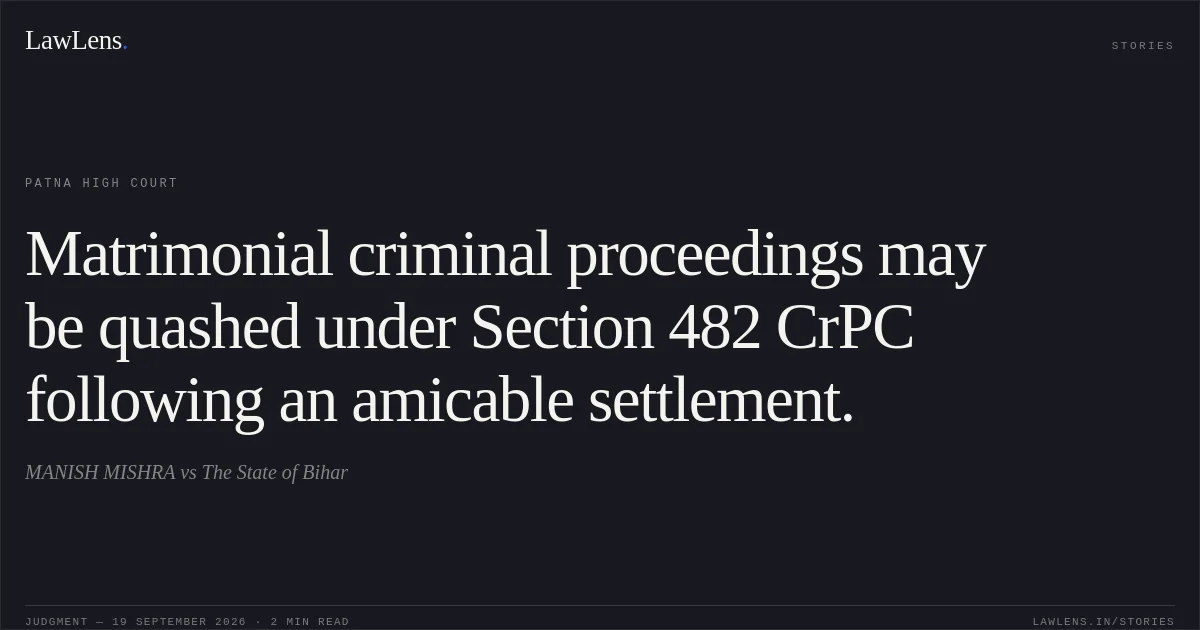
Whether the High Court should exercise its inherent jurisdiction under Section 482 of the CrPC to quash criminal proceedings arising from matrimonial offences after the parties have amicably settled their dispute?
Source reference: paras. 6–10Whether the criminal proceedings and the order taking cognizance dated 9 November 2022 should be quashed to facilitate implementation of the parties’ settlement and mutual-consent divorce?
Source reference: paras. 7–11Law Applied
The Court exercised its inherent jurisdiction under Section 482 of the Code of Criminal Procedure to prevent abuse of the process of court and secure the ends of justice.
Source reference: paras. 8–10Relying on Mange Ram v. State of Madhya Pradesh & Anr., 2025 SCC OnLine SC 1681, the Court held that, particularly in matrimonial disputes resolved through compromise, courts may quash criminal proceedings to bring a peaceful and final quietus to the litigation.
Source reference: para. 9The Court also considered the parties’ settlement and their agreement to pursue mutual-consent divorce under Section 13(B) of the Hindu Marriage Act.
Source reference: paras. 6–7Reasoning
The Court noted that the dispute arose out of the matrimonial relationship and that the complainant and the petitioners had voluntarily entered into an amicable settlement covering the pending disputes.
Source reference: para. 6Since the parties no longer wished to pursue the criminal case and continuation of the proceedings was obstructing the mutual-consent divorce pending before the Family Court, Patna, the Court considered that quashing would advance the ends of justice rather than serve any useful prosecutorial purpose.
Source reference: paras. 7–10Applying the principle in Mange Ram, the Court treated the settlement as a sufficient basis for exercising its inherent jurisdiction under Section 482 CrPC, without adjudicating the petitioners’ alternative contention regarding territorial jurisdiction.
Source reference: paras. 4, 9–10Holding
The Court answered the issues in favour of the petitioners.
It quashed the order dated 9 November 2022 passed by the Sub-Divisional Judicial Magistrate, Chapra at Saran, in Complaint Case No. 2377 of 2022, as well as all criminal proceedings arising from that complaint.
Source reference: para. 11The application under Section 482 CrPC was accordingly allowed.
Source reference: para. 12The parties were directed to adhere to the terms of their settlement, including withdrawal of all litigation against each other.
Source reference: para. 13Acts & Sections Cited
5 provisions across 4 statutes referred to in this judgment. Each provision opens on LawLens.
Indian Penal Code, 18602
Dowry Prohibition Act, 19611
Hindu Marriage Act, 19551
Code of Criminal Procedure, 19731
Original Court PDF
MANISH MISHRAvsThe State of Bihar
Click to open original judgment
Original judgment, available to read, download and summarize on LawLens.in