01Facts
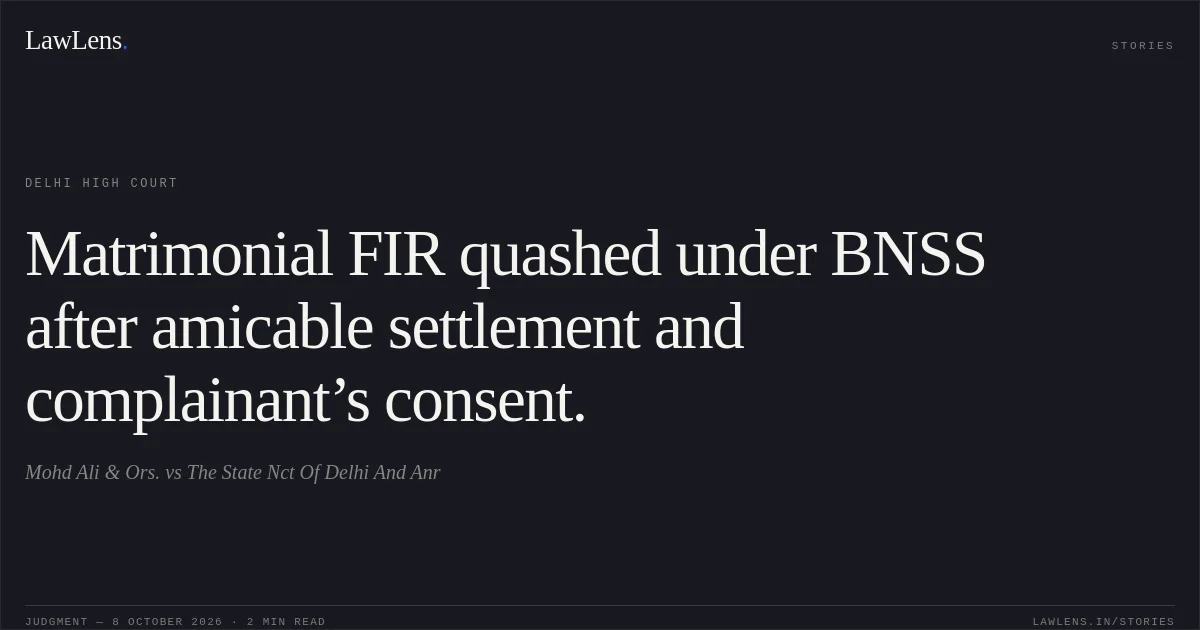
The petitioners sought quashing under Section 528 of the Bharatiya Nagarik Suraksha Sanhita, 2023 (BNSS), of FIR No. 316/2024, registered at P.S. Kalindi Kunj under Sections 498A, 406 and 34 IPC, and the proceedings arising from it
p. 2 · ¶ 5Respondent No. 2 had complained of dowry-related physical and mental harassment by the petitioners.
p. 2 · ¶ 7, 9The parties later settled their disputes through a written settlement dated 18 August 2025 during proceedings under Section 125 Cr.P.C.
p. 2 · ¶ 7, 9They subsequently obtained a divorce by mutual consent/Talaq-E-Mubarat; petitioner No. 1 paid the agreed settlement amount of ₹6,75,000 and returned the household articles. The parties agreed that their minor daughter would remain in respondent No. 2’s custody
p. 3 · ¶ 10Respondent No. 2 confirmed the settlement was voluntary, that she had received the agreed amount and articles, and that she had no objection to quashing the FIR
p. 3 · ¶ 11–1202Issues
i.Whether the High Court should exercise its inherent powers under Section 528 BNSS to quash the FIR and consequential proceedings in view of the parties’ settlement
p. 2 · ¶ 5 · p. 3 · ¶ 13–14ii.Whether continuation of the criminal proceedings would serve any useful purpose where the complainant had settled the dispute and did not wish to pursue the charges
p. 3 · ¶ 12–1303Law Applied
Section 528 BNSS preserves the High Court’s inherent power to make orders necessary to give effect to orders under the Sanhita, prevent abuse of the process of any court, or otherwise secure the ends of justice
p. 3 · ¶ 14In exercising that power, the Court considered that the dispute was primarily private, did not involve public interest, and had been amicably resolved; the complainant’s position and the circumstances of the settlement were relevant to whether criminal proceedings should continue
p. 3 · ¶ 12–14The FIR invoked Sections 498A, 406 and 34 IPC
p. 2 · ¶ 5Provisions in the judgment · 4 · Linked ones open on LawLens
Bharatiya Nagarik Suraksha Sanhita, 2023 Section 528
Indian Penal Code, 1860 Section 406Section 34
Code of Criminal Procedure, 1973 Section 125
04Reasoning
The Court found that the settlement had been implemented: the agreed amount and household articles had been delivered, the parties’ marriage had ended, and the child’s custody had been agreed
p. 3 · ¶ 10Respondent No. 2 appeared in person, confirmed that the settlement was voluntary, and expressly consented to quashing
p. 3 · ¶ 11–12Given the private nature of the dispute, the completed settlement, and the complainant’s unwillingness to press the charges, the Court concluded that continuing the prosecution would serve no useful purpose and that quashing was appropriate to secure the ends of justice
p. 3 · ¶ 13–1405Holding
The Court answered the issues in favour of quashing and allowed the petition.
p. 3 · ¶ 15It quashed FIR No. 316/2024, registered under Sections 498A, 406 and 34 IPC, together with all consequential proceedings
p. 3 · ¶ 15The parties’ original affidavits were directed to be submitted to the Trial Court and the concerned SHO/IO within four weeks
p. 4 · ¶ 15The petition and any pending applications were disposed of accordingly
p. 4 · ¶ 16–17Original Court PDF
Mohd Ali & Ors.vsThe State Nct Of Delhi And Anr
Click to open original judgment
Original judgment, available to read, download and summarize on LawLens.in