Facts
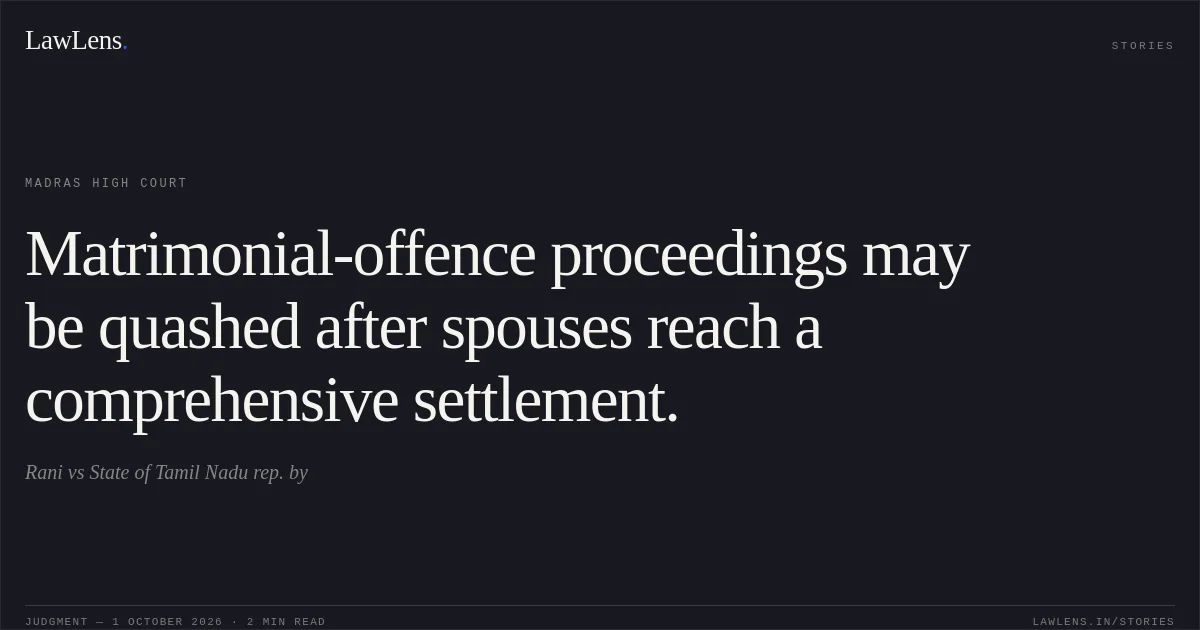
The petitioners, who were accused in C.C. No. 481 of 2024 before the Additional Mahila Court, Madurai, sought to quash the charge sheet alleging offences under Sections 498A, 406 and 506(1) of the IPC.
Source reference: p. 4During the proceedings, the complainant and her husband (A1) informed the Court that they had agreed to seek divorce by mutual consent.
Source reference: pp. 4–8Their joint compromise provided for a total settlement of Rs. 23,00,000, of which Rs. 10,00,000 had been paid and the remaining Rs. 13,00,000 was payable when the final divorce decree was passed; it also addressed the complainant’s belongings, the child’s savings account, and withdrawal of related proceedings.
Source reference: pp. 4–8Issues
Whether the charge sheet in C.C. No. 481 of 2024 should be quashed in view of the parties’ compromise and proposed divorce by mutual consent.
Source reference: pp. 4–5Whether the criminal proceedings should be quashed against all accused petitioners, including the husband’s family members, pursuant to that compromise.
Source reference: p. 8Law Applied
The petitions invoked Section 528 of the Bharatiya Nagarik Suraksha Sanhita, 2023, seeking quashing of the criminal proceedings.
Source reference: p. 3The charge-sheeted offences were under Sections 498A, 406 and 506(1) of the Indian Penal Code.
Source reference: p. 4The parties’ compromise referred to initiating mutual-consent divorce proceedings under Section 19(iii-a) of the Hindu Marriage Act, 1955.
Source reference: p. 5The order cites no precedent or separately states a legal test governing quashing on the basis of compromise.
Source reference: no citationReasoning
The Court recorded the complainant’s statement that she and A1 had decided to obtain a divorce by mutual consent and that she had received the first settlement instalment of Rs. 10,00,000.
Source reference: p. 4It also noted the terms of the joint compromise, including payment of the balance on the final divorce decree and the parties’ agreement to withdraw or not pursue related proceedings.
Source reference: pp. 5–8On that basis, the Court quashed the charge sheet against all accused; it gave no further analysis of the statutory quashing power or the nature of the alleged offences.
Source reference: p. 8Holding
The Court allowed the criminal original petitions and quashed the charge sheet in C.C. No. 481 of 2024 against all the accused.
It directed that the joint compromise memo form part of the order and closed the connected miscellaneous petitions.
Source reference: p. 8Acts & Sections Cited
4 provisions across 3 statutes referred to in this judgment. Each provision opens on LawLens.
Bharatiya Nagarik Suraksha Sanhita, 20231
Indian Penal Code, 18602
Hindu Marriage Act, 19551
Original Court PDF
RanivsState of Tamil Nadu rep. by
Click to open original judgment
Original judgment, available to read, download and summarize on LawLens.in