Facts
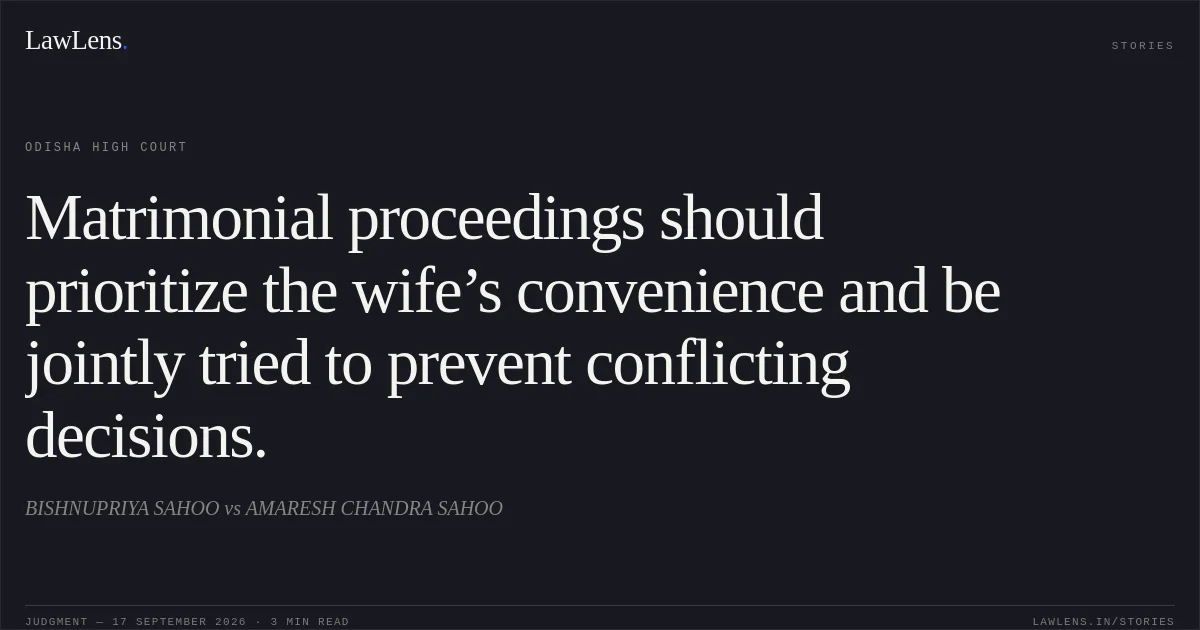
The petitioner-wife sought transfer of C.P. No. 22 of 2026, pending before the Family Court, Bhadrak, to the Family Court-II, Bhubaneswar.
Source reference: para. 1The opposite party-husband appeared but filed no objection and, through counsel, consented to the transfer.
Source reference: para. 2He submitted that he was working outside Odisha as a software engineer and requested permission to appear through virtual mode because frequent travel to Bhubaneswar would be difficult.
Source reference: paras. 2–3The petitioner further informed the Court that C.P. No. 433 of 2026, filed under Section 9 of the Hindu Marriage Act, 1955 for restitution of conjugal rights, was already pending between the parties before the Family Court-II, Bhubaneswar, and sought analogous hearing of both proceedings.
Source reference: para. 4Issues
Whether C.P. No. 22 of 2026 should be transferred from the Family Court, Bhadrak, to the Family Court-II, Bhubaneswar, having regard to the petitioner-wife’s convenience and the husband’s consent?
Source reference: paras. 1–6Whether C.P. No. 22 of 2026 and C.P. No. 433 of 2026 should be tried together to prevent multiplicity of proceedings and conflicting judgments?
Source reference: paras. 4–9Whether the parties could be permitted to appear through virtual mode, subject to the Family Court’s permission and the requirement of physical presence for effective hearings such as examination and cross-examination?
Source reference: paras. 3, 10–12Law Applied
The Court exercised its power to transfer proceedings under Section 24 of the Code of Civil Procedure, 1908, applying the principle that transfer must serve the ends of justice.
Source reference: para. 5In matrimonial proceedings, the Court relied on N.C.V. Aishwarya v. A.S. Saravana Karthik Sha, 2022 SCC OnLine SC 1199, which holds that the wife’s convenience is generally to be given primacy after considering the parties’ economic circumstances, social position, living standards, and means of livelihood.
Source reference: para. 5The same decision further establishes that proceedings between the same parties involving common questions of fact and law, and interdependent decisions, should preferably be tried together to avoid multiplicity of proceedings and conflicting decisions.
Source reference: para. 5The Court also directed that virtual appearances be regulated in accordance with the Orissa High Court Video Conferencing for Courts Rules, 2020.
Source reference: para. 11Reasoning
The Court found that the petitioner-wife’s request was supported by the circumstances pleaded in the transfer petition and by the existence of a related restitution proceeding already pending before the Family Court-II, Bhubaneswar.
Source reference: paras. 4–6Applying the settled principle that the wife’s convenience ordinarily merits consideration in matrimonial transfer matters, and noting the husband’s express consent to the transfer, the Court held that the transfer was justified.
Source reference: paras. 5–6Since both proceedings arose between the same parties and could involve overlapping factual and legal issues, their joint trial before the same Court would reduce duplication and the risk of inconsistent findings.
Source reference: paras. 5, 9At the same time, recognising the husband’s employment outside Odisha, the Court permitted virtual appearances where authorised by the Family Court, while preserving the requirement of physical attendance when necessary for witness examination, cross-examination, or other effective hearings.
Source reference: paras. 10–12Holding
The transfer petition was allowed.
The Family Court, Bhadrak, was directed to transmit the record in C.P. No. 22 of 2026 to the Family Court-II, Bhubaneswar, preferably within seven days of production of the certified judgment.
Source reference: para. 7The transferee Court was directed to re-register the case, if necessary, and proceed expeditiously in accordance with law.
Source reference: para. 8C.P. No. 22 of 2026 and C.P. No. 433 of 2026 were ordered to be tried together.
Source reference: para. 9Both parties were permitted to seek appearance through virtual mode, subject to the Court’s permission, but were required to appear physically when directed for effective hearings.
Source reference: paras. 10–12The parties were directed to avoid unnecessary adjournments and cooperate in the early disposal of the proceedings.
Source reference: paras. 13–15Acts & Sections Cited
2 provisions across 2 statutes referred to in this judgment. Each provision opens on LawLens.
Hindu Marriage Act, 19551
Code of Civil Procedure, 19081
Original Court PDF
BISHNUPRIYA SAHOOvsAMARESH CHANDRA SAHOO
Click to open original judgment
Original judgment, available to read, download and summarize on LawLens.in