Facts
Opposite Party No. 2 alleged that she married Petitioner No. 1, Kumar Gaurav Arya, on 25 March 2012 according to Hindu rites. She alleged that, shortly after marriage, the petitioners demanded a Scorpio vehicle as dowry, subjected her to abuse and harassment, expelled her from the matrimonial home, retained her ornaments, and subsequently threatened her and her family during a visit on 2 November 2014. She further alleged that Petitioner No. 1 contracted a second marriage with Priti Kumari
Source reference: p. 2–3; para. 3The complaint was referred for investigation under Section 156(3) of the Code of Criminal Procedure and registered as Sare (Nalanda) P.S. Case No. 23 of 2015. The Magistrate took cognizance of offences under Sections 498A, 494, 379, 504, 506 and 34 of the Indian Penal Code against the petitioners by orders dated 30 January 2017/21 February 2017
Source reference: p. 2; para. 2The petitioners sought quashing of the cognizance order, contending that the allegations against Petitioners Nos. 2–5 were vague and omnibus. They also relied on official and departmental materials allegedly showing that Opposite Party No. 2 had been treated as married to one Dilip Kumar, and on a subsequent ceremony involving another person, to challenge the genuineness of her case
Source reference: p. 3–6; paras. 4–4.5The State and Opposite Party No. 2 opposed the application, arguing that the FIR, investigation and charge-sheet disclosed a prima facie case
Source reference: p. 7–8; paras. 5–6.3Issues
Whether the general and omnibus allegations against Petitioners Nos. 2–5, without attribution of specific overt acts, justified continuation of the criminal proceedings under Sections 498A, 494, 379, 504, 506 and 34 IPC?
Source reference: p. 8–9; para. 8Whether, in view of the materials relied upon by the petitioners concerning Opposite Party No. 2’s alleged prior marriage and subsequent conduct, continuation of the prosecution against Petitioner No. 1 amounted to an abuse of the process of court?
Source reference: p. 9–10; para. 8Whether the cognizance order dated 30 January 2017/21 February 2017 was liable to be quashed in exercise of the High Court’s inherent jurisdiction?
Source reference: p. 2, 9–10; paras. 2, 9Law Applied
The Court considered the offences alleged under Sections 498A, 494, 379, 504, 506 and 34 of the IPC and exercised its inherent jurisdiction to prevent abuse of the process of court.
Source reference: p. 5–9; paras. 4.5, 7–8It relied on State of Haryana v. Bhajan Lal, 1992 Supp (1) SCC 335, concerning the categories of cases in which criminal proceedings may be quashed; Preeti Gupta v. State of Jharkhand, (2010) 7 SCC 667, and K. Subba Rao v. State of Telangana, (2018) 14 SCC 452, cautioning against implicating relatives on the basis of vague, general and omnibus allegations; Geeta Mehrotra v. State of U.P., (2012) 10 SCC 741, Rajesh Sharma v. State of U.P., (2018) 10 SCC 472, and Kahkashan Kausar v. State of Bihar, (2022) 6 SCC 599, on the need for specific allegations against relatives in matrimonial prosecutions; and Abhishek v. State of Madhya Pradesh, (2023) 16 SCC 666, concerning the impermissibility of mechanically prosecuting the husband’s relatives without concrete allegations.
Source reference: p. 5–9; paras. 4.5, 7–8The Court also referred to Achin Gupta v. State of Haryana, (2024) 6 SCR 129, for the principle that every matrimonial disagreement or conduct causing annoyance does not necessarily constitute cruelty.
Source reference: p. 5–6; para. 4.5Reasoning
The Court found that the allegations against Petitioners Nos. 2–5 were general and omnibus and did not specify their individual acts of cruelty, dowry demand or other offences.
Source reference: p. 8–9; para. 8Petitioners Nos. 4 and 5 were the married sister-in-law and her husband, residing at a distant place and visiting the matrimonial home only on important occasions; their implication was therefore considered improper in the absence of specific allegations.
Source reference: p. 9; para. 8The Court similarly held that the prosecution against Petitioners Nos. 2 and 3, the parents-in-law, was not sustainable because the allegations lacked specific particulars.
Source reference: p. 9; para. 8As to Petitioner No. 1, the Court relied on the departmental proceedings against Dilip Kumar, the alleged prior relationship or marriage of Opposite Party No. 2 with him, and the complaint filed by Dilip Kumar’s alleged wife.
Source reference: p. 9–10; para. 8It also noted the petitioners’ assertion regarding Opposite Party No. 2’s later ceremony with Shashi Kumar Yadav and the admission on her behalf that the ceremony was an engagement.
Source reference: p. 9–10; para. 8On this basis, the Court concluded that Opposite Party No. 2’s conduct and version were “under cloud” and that the prosecution appeared vexatious, malicious and instituted with an oblique purpose.
Source reference: p. 10; para. 9Holding
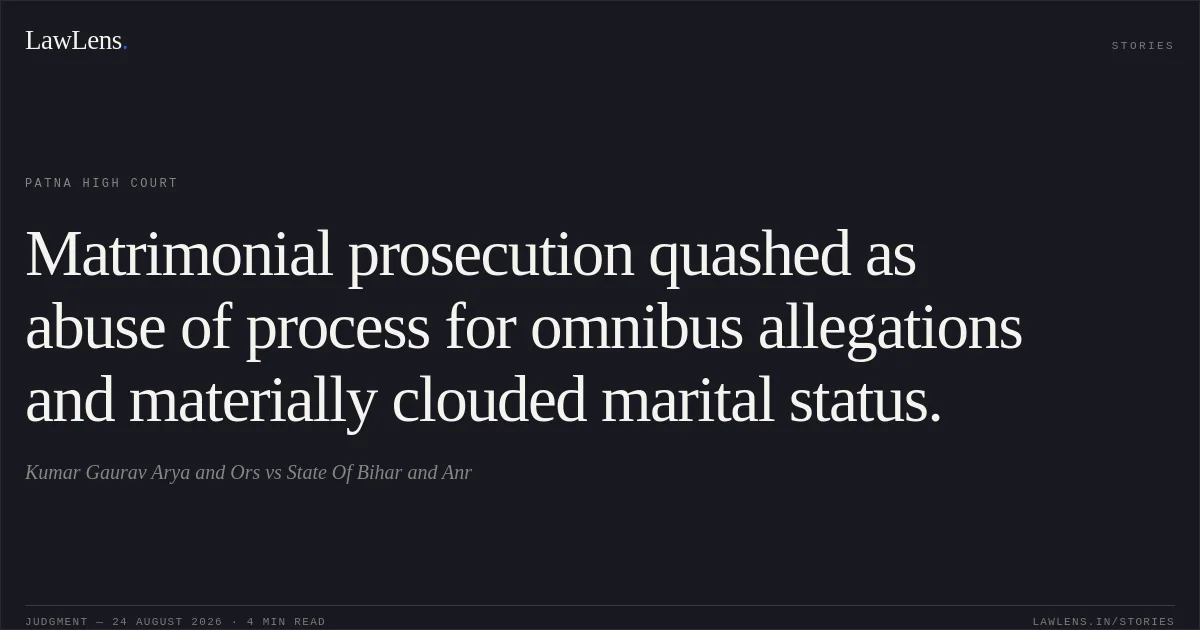
The High Court held that the allegations against Petitioners Nos. 2–5 were vague, general and unsupported by specific overt acts, while the prosecution against Petitioner No. 1 was also considered vexatious in light of the materials concerning Opposite Party No. 2’s alleged prior and subsequent relationships.
The Court accordingly held that continuation of the prosecution would amount to an abuse of the process of court.
Source reference: p. 9–10; para. 9The cognizance orders dated 30 January 2017/21 February 2017 in Complaint Case No. 1435(C) of 2014, which resulted in Sare (Nalanda) P.S. Case No. 23 of 2015 and G.R. No. 802 of 2015, were quashed in respect of all petitioners.
Source reference: p. 10; paras. 9–10The criminal miscellaneous application was allowed.
Source reference: p. 10; paras. 9–10Acts & Sections Cited
7 provisions across 2 statutes referred to in this judgment. Linked provisions open on LawLens.
Indian Penal Code, 18606
Code of Criminal Procedure, 19731
Original Court PDF
Kumar Gaurav Arya and OrsvsState Of Bihar and Anr
Click to open original judgment
Original judgment, available to read, download and summarize on LawLens.in