Facts
The Petitioner, a proprietary concern engaged in the business of plastic recycling, obtained GST registration effective 16 March 2023
Source reference: para. 4(i)In March 2024, the proprietor was diagnosed with Stage V chronic kidney disease, rendering the business temporarily non-operational
Source reference: para. 4(ii)Following a field visit on 29 May 2024, Respondent No. 3 initiated proceedings for ab-initio cancellation of registration
Source reference: para. 4(iii)A Show-Cause Notice (SCN) was issued on 11 June 2024 alleging non-conduct of business from the declared premises
Source reference: para. 4(iv)Despite the Petitioner filing a manual reply on 26 June 2024 explaining the medical exigencies, Respondent No. 3 passed an order on 22 August 2024 (Impugned Order-1) cancelling the registration
Source reference: para. 4(v)-(vi)A subsequent application for revocation was rejected via an ex-parte order dated 10 October 2024 (Impugned Order-2) on the grounds that no reply was filed to a second SCN dated 27 September 2024
Source reference: para. 4(vi)Issues
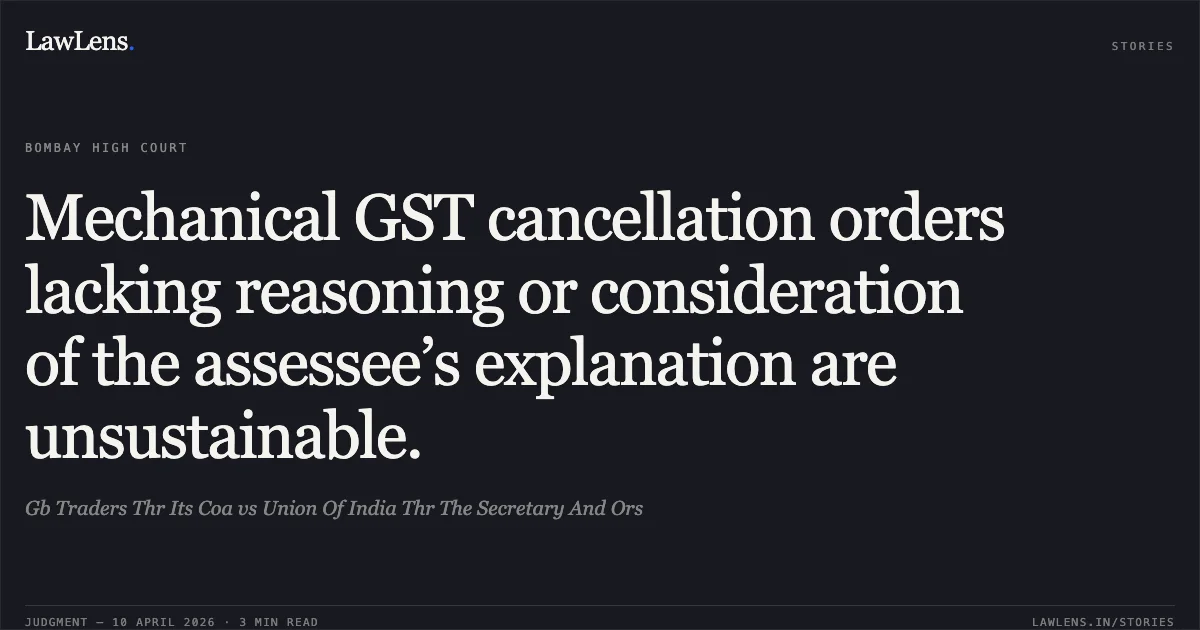
1. Whether the cancellation of the Petitioner’s GST registration was arbitrary due to the failure of the Respondents to consider the proprietor's medical condition
Source reference: para. 72. Whether the impugned show-cause notices and orders were legally sustainable given the lack of specific reasoning and discussion of the Petitioner's submissions
Source reference: para. 8-9Law Applied
The Court applied Sections 29 and 30 of the Central Goods and Services Tax (CGST) Act, 2017, read with Rule 21(a) of the CGST Rules, 2017
Source reference: para. 2-4It relied on the principle established in Makersburry India Pvt. Ltd. v. State of Maharashtra, which mandates that an SCN must set out adequate reasons to enable an effective reply, otherwise the consequential order is liable to be quashed
Source reference: para. 9The Court further applied the doctrine from Monit Trading Private Limited v. Union of India, holding that vague and mechanical orders passed without considering bonafide explanations constitute a breach of natural justice and an arbitrary exercise of power
Source reference: para. 10Reasoning
The Court observed that the Respondents acted with "high-handedness" by failing to consider the genuine medical crisis (Stage V kidney disease) which caused the temporary cessation of business
Source reference: para. 7The Court found that both the SCNs and the impugned orders were passed "mechanically and in a standardised manner" without any discussion of the documents or explanations provided by the Petitioner
Source reference: para. 8Applying the ratio in Makersburry, the Court held that the SCNs were defective as they were vague and lacked specific grounds
Source reference: para. 9The Court further noted that the casual approach of the authorities resulted in civil consequences, infringing upon the Petitioner’s rights under Articles 14, 19(1)(g), and 300A of the Constitution
Source reference: para. 10The Court emphasized that administrative adjudication must strictly adhere to the rule of law and cannot "throw to the wind all cannons of fairness"
Source reference: para. 10Holding
The Court quashed and set aside the SCNs dated 11 June 2024 and 27 September 2024, along with the Impugned Orders dated 22 August 2024 and 10 October 2024
The Court directed the immediate restoration of the Petitioner’s GST registration
Source reference: para. 12(vi)Liberty was granted to the Respondents to initiate fresh proceedings only if tangible material exists, provided that any new SCN contains appropriate reasons and the Petitioner is granted a personal hearing
Source reference: para. 12(ii)The Court clarified that while the Revenue may exercise power to suspend registration if permissible by law, such actions must be non-arbitrary and reasoned
Source reference: para. 12(vi)Acts & Sections Cited
2 provisions across 1 statute referred to in this judgment. Each provision opens on LawLens.
Central Goods and Services Tax Act, 20172
Original Court PDF
Gb Traders Thr Its CoavsUnion Of India Thr The Secretary And Ors
Click to open original judgment
Original judgment, available to read, download and summarize on LawLens.in