Facts
The applicant is the widow of Late Shri Pritam Kumar, who was appointed as an LDC in the Military Engineer Service (MES) in 1998
Source reference: p.3Between 2011 and 2012, the deceased employee remained on Extra Ordinary Leave (EOL) on medical grounds for 259 days
Source reference: p.3He subsequently remained absent from duty from July 16, 2012, to January 28, 2019, without sanctioned leave
Source reference: p.3Invoking DoPT Notification dated March 29, 2012, the respondents approved his "deemed resignation" on January 28, 2019, due to continuous absence exceeding five years
Source reference: p.4The employee died on February 27, 2019
Source reference: p.4The applicant’s requests for family pension and terminal benefits were rejected by the respondents on February 19, 2022, and April 5, 2022, on the grounds that under Rule 26 of the CCS (Pension) Rules, resignation entails forfeiture of past service
Source reference: p.4-5Issues
1. Whether the administrative authorities were justified in invoking "deemed resignation" without considering the employee's medical history and the involuntary nature of his absence
Source reference: para. 102. Whether the applicant is entitled to family pension and terminal benefits despite the order of deemed resignation passed shortly before the employee's death
Source reference: para. 3, 14Law Applied
Rule 12(2) of the CCS (Leave) Rules, 1972, which stipulates that a government servant absent for over five years is deemed to have resigned, provided they are given a reasonable opportunity to explain
Source reference: p.6Rule 26 of the CCS (Pension) Rules, which states that resignation entails forfeiture of past service
Source reference: p.6the precedent in Ashok Kumar Dabas (Dead) v. DTC, which held that while family pension might be inadmissible upon resignation, legal heirs remain entitled to gratuity and leave encashment under specific circumstances
Source reference: p.8-9Reasoning
The Tribunal observed that the deceased employee had a documented history of serious ailments, having availed 259 days of EOL on medical certificates prior to his prolonged absence
Source reference: para. 10The court inferred that there was no intent to abandon service; rather, the absence was a result of medical compulsions and deteriorated health
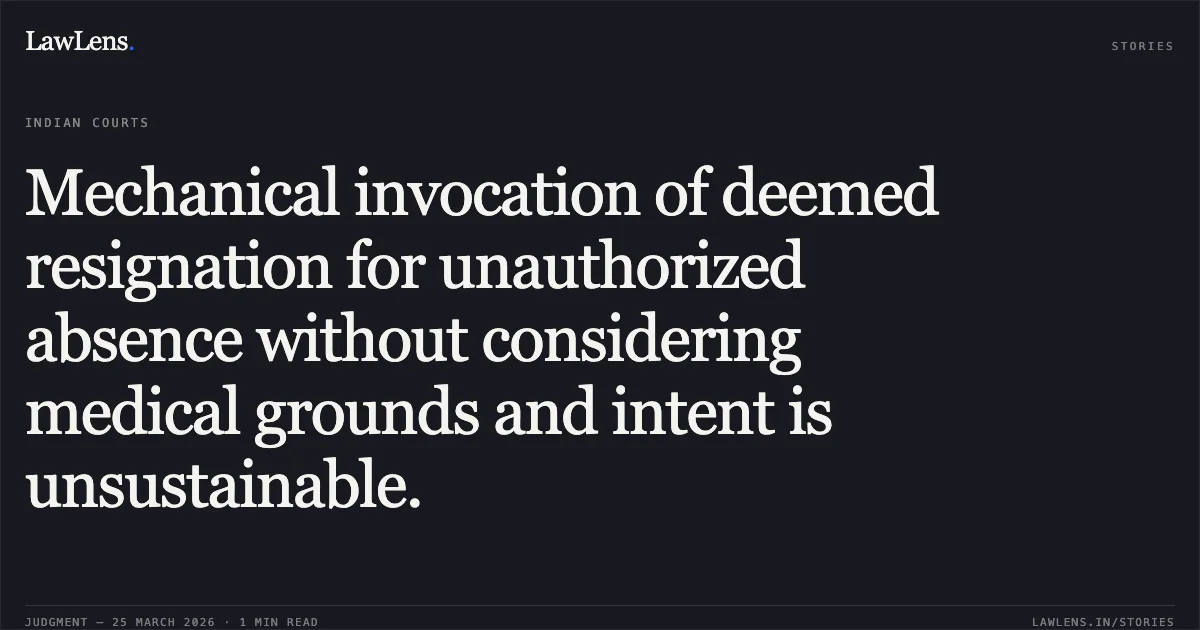
Source reference: para. 10It found that the respondents acted in a "mechanical manner" by failing to examine the representations regarding the employee's illness before passing the deemed resignation order
Source reference: para. 10, 12The Tribunal distinguished this case from Ashok Kumar Dabas because the "intention" to resign was not directly attributable to the husband, as his absence was forced by illness leading to his eventual death
Source reference: para. 13the administrative decision failed to account for the "exceptional circumstances" or the "compelling reasons" behind the absence
Source reference: para. 10, 12Holding
The Tribunal quashed the deemed resignation order dated January 28, 2019, and the subsequent rejection orders dated February 19, 2022, and April 5, 2022
The court directed the respondents to re-examine the matter and pass a reasoned, speaking order regarding the deemed resignation and the grant of family pension and gratuity with interest
Source reference: para. 14The order must be implemented within 12 weeks of receipt
Source reference: para. 14The O.A. was disposed of with liberty to the applicant to approach the forum again if grievances remain
Source reference: para. 15Original Court PDF
BIMLAvsDEFENCE
Click to open original judgment
Original judgment, available to read, download and summarize on LawLens.in