Facts
The respondent, a Gram Sevak-cum-Secretary, was accused of demanding and accepting illegal gratification for releasing the second installment of a dwelling unit allotment under the Indira Awaas Yojana
Source reference: para 2A trap was organized by the Anti-Corruption Bureau on April 23, 2006, leading to the recovery of tainted currency
Source reference: para 2Following investigation and the procurement of a prosecution sanction, the respondent was charged under Sections 7 and 13(1)(d) read with 13(2) of the Prevention of Corruption Act (PC Act), 1988
Source reference: para 3The trial court (Special Judge, PC Act Cases, Jodhpur) acquitted the respondent on March 26, 2012, primarily finding the prosecution sanction to be a mechanical exercise
Source reference: para 1, 6.7The State appealed this acquittal
Source reference: para 1Issues
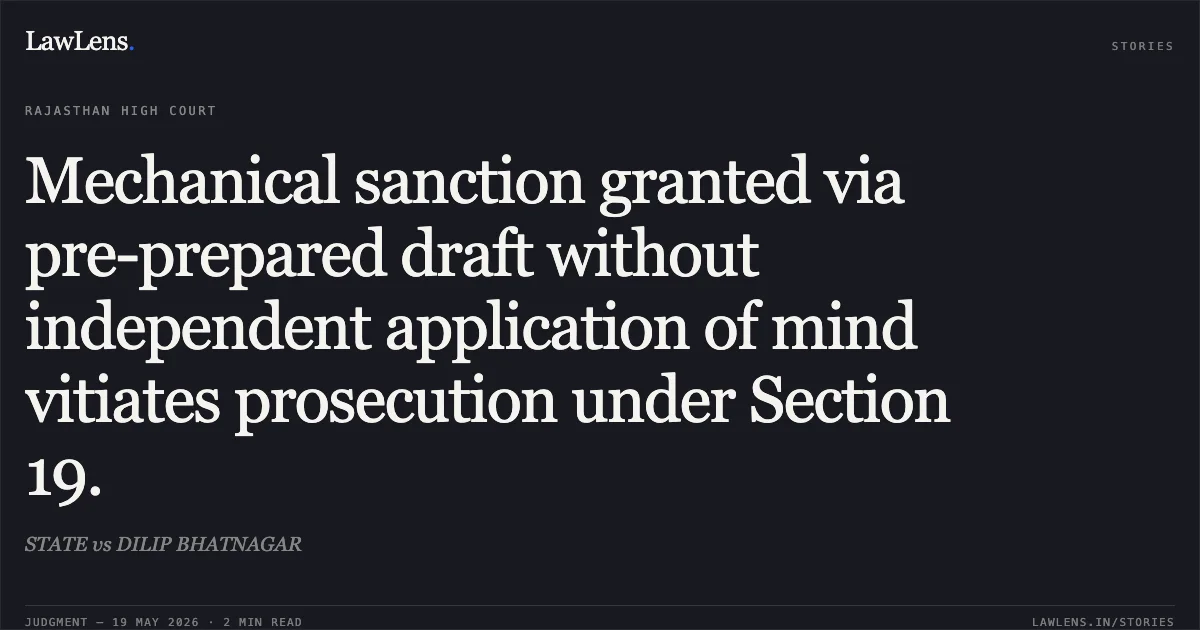
1. Whether the prosecution sanction granted under Section 19 of the PC Act was valid or a mere mechanical exercise devoid of independent application of mind
Source reference: para 5, 6.22. Whether the appellate court should interfere with the trial court’s judgment of acquittal given the evidence on record
Source reference: para 6.1, 6.4Law Applied
The Court applied Section 19 of the Prevention of Corruption Act, 1988, which establishes previous sanction as a jurisdictional precondition for taking cognizance
Source reference: para 6.2.1It relied on State of Karnataka v. Ameerjan and Mohd. Iqbal Ahmad v. State of Andhra Pradesh to affirm that sanction requires a "conscious scrutiny" of material and "genuine satisfaction," rather than mechanical approval
Source reference: para 6.3the court applied the principles from Mallappa & Ors. v. State of Karnataka regarding appeals against acquittal, which mandate that if two views are possible, the view favoring the accused must prevail, and interference is only warranted in cases of manifest perversity or illegality
Source reference: para 6.4Reasoning
The Court observed that the sanction order (Exhibit P/9) was virtually identical to a draft proforma (Exhibit D/2) sent by the investigating agency to the sanctioning authority
Source reference: para 6.5, 6.6The document retained the same punctuation, language, and textual composition as the template, indicating that the sanctioning authority merely affixed a signature without independent evaluation of the witness statements or facts
Source reference: para 6.6, 6.7The Court reasoned that since a valid sanction is a "jurisdictional trigger," its absence or invalidity (due to lack of application of mind) renders the entire proceedings, from cognizance to trial, void ab initio
Source reference: para 6.2.1, 7.1Furthermore, since the trial court’s appreciation of this documentary evidence was judicious and comprehensive, there was no manifest illegality to justify overturning the acquittal
Source reference: para 7.2, 7.3Holding
the prosecution sanction was a "mechanical exercise lacking independent application of mind," which constituted a fatal jurisdictional infirmity
The High Court dismissed the appeal and affirmed the judgment of acquittal dated March 26, 2012
Source reference: para 8Acts & Sections Cited
8 provisions across 2 statutes referred to in this judgment. Each provision opens on LawLens.
Code of Criminal Procedure, 19732
Prevention of Corruption Act, 19886
Original Court PDF
STATEvsDILIP BHATNAGAR
Click to open original judgment
Original judgment, available to read, download and summarize on LawLens.in


