Facts
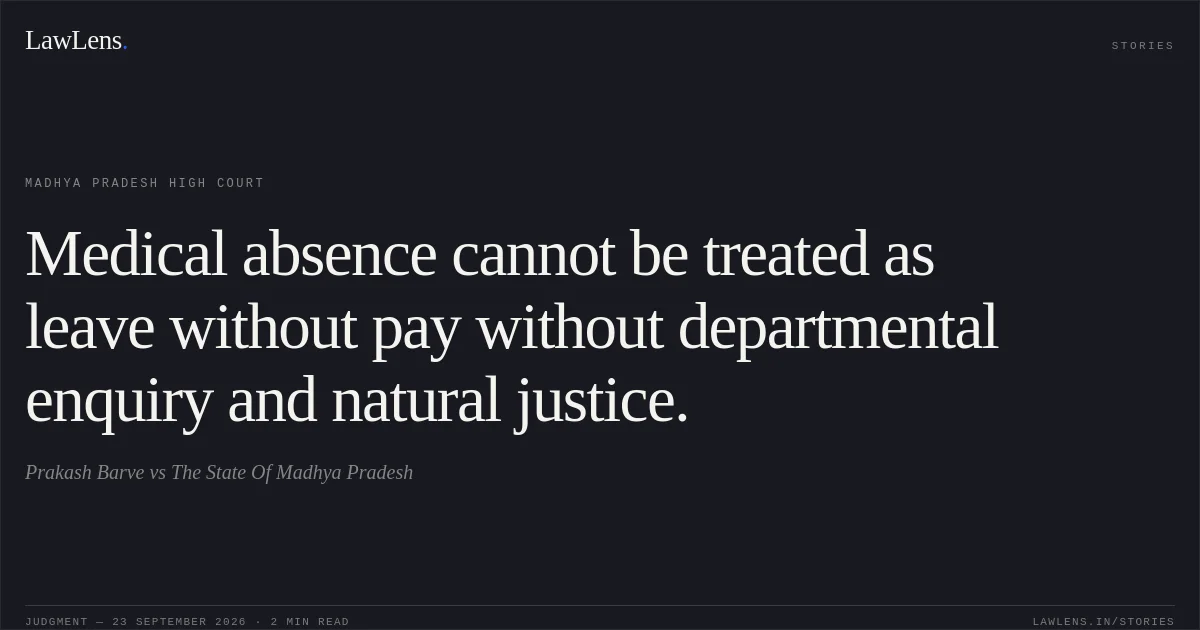
The petitioner challenged the respondents’ decision to treat his medically supported absence from 30 May 2009 to 8 September 2009 as leave without pay.
Source reference: p.1He contended that his medical certificates were neither disputed nor referred for verification by a competent Medical Board, and that no departmental enquiry or opportunity of hearing was provided before the adverse order was passed.
Source reference: p.1The petitioner relied on Ashok Rana v. State of M.P. & Others, W.P. No. 22687 of 2018, whose decision had been upheld in W.A. No. 1169 of 2021.
Source reference: pp.1–2The respondents opposed the petition but did not dispute that no enquiry had been conducted or that the petitioner had not been examined by a Medical Board.
Source reference: p.1Issues
1. Whether the respondents could treat the petitioner’s medically supported absence as leave without pay without conducting a departmental enquiry or providing an opportunity of hearing.
Source reference: pp.1–32. Whether, in the absence of a finding that the petitioner’s medical absence was wilful or unauthorised, the period was required to be regularised against permissible leave.
Source reference: p.3Law Applied
The Court applied the principles of natural justice and disciplinary law, holding that an adverse or penal order treating an employee’s absence as misconduct or unauthorised absence cannot be passed without notice, an opportunity of hearing, and a proper departmental enquiry where the alleged absence is disputed.
Source reference: pp.2–3Relying on Ashok Rana v. State of M.P. & Others, as affirmed by the Division Bench in W.A. No. 1169 of 2021, the Court held that medical certificates submitted in the prescribed form could not be rejected or treated as establishing misconduct without appropriate verification and enquiry.
Source reference: p.2The Court further recognised salary and admissible medical leave benefits as the petitioner’s property interests, which could not be adversely affected without a lawful determination that the absence was unauthorised.
Source reference: p.3Reasoning
The petitioner had submitted medical certificates, and the respondents neither challenged their authenticity through a competent Medical Board nor initiated proceedings to establish that the absence was wilful or unauthorised.
Source reference: pp.1–3Since treating the period as leave without pay had an adverse and penal consequence, the respondents were required to comply with natural justice and establish the alleged misconduct through a departmental enquiry.
Source reference: pp.2–3In the absence of such enquiry or any finding of unauthorised absence, the impugned treatment of the period as leave without pay was legally unsustainable.
Source reference: pp.2–3The principle in Ashok Rana directly applied to the petitioner’s case.
Source reference: pp.2–3Holding
The Court set aside the order treating the petitioner’s medical absence from 30 May 2009 to 8 September 2009 as leave without pay.
It directed the respondents to regularise the period against permissible leave within 60 days and to pass consequential orders regarding pay fixation and related benefits.
Source reference: p.3The writ petition was accordingly disposed of.
Source reference: p.3Original Court PDF
Prakash BarvevsThe State Of Madhya Pradesh
Click to open original judgment
Original judgment, available to read, download and summarize on LawLens.in