Facts
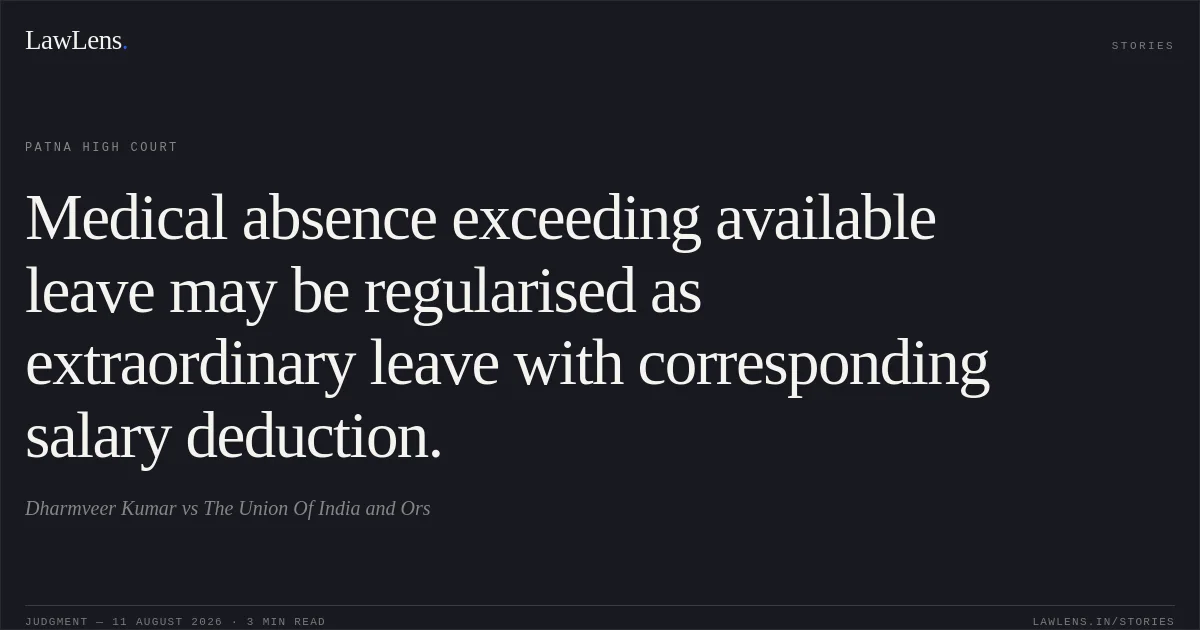
The petitioner, a Constable/Sepoy in the Indo-Tibetan Border Police, developed recurrent inguinal hernia following an earlier hydrocele operation and was referred for treatment to Composite Hospital, CRPF, Guwahati.
Source reference: para. 3–5, 20He remained under treatment, hospitalisation, or medically advised rest from September 2010 to July 2011 and reported for duty on 14 July 2011.
Source reference: para. 3–5, 20The respondents regularised 45 days as commuted leave and 95 days as earned leave, but treated the remaining period from 20 January 2011 to 13 July 2011—175 days—as extraordinary leave because no further leave was available in his account.
Source reference: para. 7, 20Consequently, salary and allowances for that period were ordered to be recovered.
Source reference: para. 7, 20Issues
Whether the respondents were justified in regularising 175 days of the petitioner’s medical absence as extraordinary leave, with consequential deduction of pay and allowances, under the applicable Leave Rules?
Source reference: para. 20–23Whether the regularisation of absence and recovery of salary constituted a punitive order requiring compliance with principles of natural justice and the principles stated in State of Punjab v. Rafiq Masih?
Source reference: para. 19, 23, 28Whether the petitioner was entitled to protection or benefits under the Persons with Disabilities (Equal Opportunities, Protection of Rights and Full Participation) Act, 1995 or the Rights of Persons with Disabilities Act, 2016?
Source reference: para. 13, 23–28Whether the petitioner was entitled to special disability leave under Rule 44 of the CCS (Leave) Rules, 1972 or the applicable special disability leave regulations?
Source reference: para. 16, 28Law Applied
The Court applied the Central Civil Services (Leave) Rules, 1972, particularly the principle that where available leave is exhausted, the remaining period may be regularised as extraordinary leave, for which leave salary is not payable.
Source reference: para. 9, 20–22The Court considered the principle in Krushnakant B. Parmar v. Union of India, 2012 (3) SCC 178, that unauthorised absence is not necessarily wilful and constitutes misconduct only where wilfulness is established.
Source reference: para. 9–10It also considered Rule 44 of the CCS (Leave) Rules, 1972 concerning special disability leave.
Source reference: para. 16The Court held that the PWD Act, 1995 was the relevant disability statute for the period in question, while the Rights of Persons with Disabilities Act, 2016 was inapplicable retrospectively.
Source reference: para. 23Section 47 of the PWD Act, 1995 was considered along with the Central Government notification dated 10 September 2002 exempting combatant personnel of the ITBP and other Central Para-Military Forces from Section 47.
Source reference: para. 24–27The principle in State of Punjab v. Rafiq Masih, (2015) 4 SCC 334, concerning impermissible recovery from employees, was not applied because the impugned action was treated as leave regularisation and not as a punitive recovery order.
Source reference: para. 19, 23Reasoning
The Court found that the respondents had taken a lenient view by first adjusting the petitioner’s absence against commuted leave and earned leave, and by regularising the balance 175 days as extraordinary leave after the petitioner’s leave account was exhausted.
Source reference: para. 20–22Since extraordinary leave did not carry entitlement to salary for the relevant period, the consequential deduction was held to follow from the applicable Leave Rules.
Source reference: no citationThe Court distinguished the petitioner’s reliance on Krushnakant B. Parmar by holding that the challenged order merely regularised the absence and did not impose a disciplinary punishment.
Source reference: para. 23The disability-based claims were rejected because the 2016 Act did not apply, the petitioner had not established a qualifying disability under the 1995 Act through the requisite medical certification, and combatant personnel of the ITBP stood exempted from Section 47 by the 2002 notification.
Source reference: para. 23–27The claim for special disability leave also failed because the petitioner had not made a specific, properly pleaded claim establishing entitlement under Rule 44 or the relevant regulations.
Source reference: para. 28Holding
The writ petition was dismissed.
The Court upheld the respondents’ decision to treat the period from 20 January 2011 to 13 July 2011 as 175 days of extraordinary leave and the consequential deduction of pay and allowances, holding that the action was an administrative regularisation of leave and not a punishment.
Source reference: para. 23, 28–29The petitioner was also denied relief under disability legislation and special disability leave for want of statutory applicability, qualifying disability certification, and adequate pleadings.
Source reference: para. 23–28Pending applications, if any, were disposed of.
Source reference: para. 30Acts & Sections Cited
1 provisions across 1 statute referred to in this judgment. Each provision opens on LawLens.
Rights of Persons with Disabilities Act, 2016.1
Original Court PDF
Dharmveer KumarvsThe Union Of India and Ors
Click to open original judgment
Original judgment, available to read, download and summarize on LawLens.in