Facts
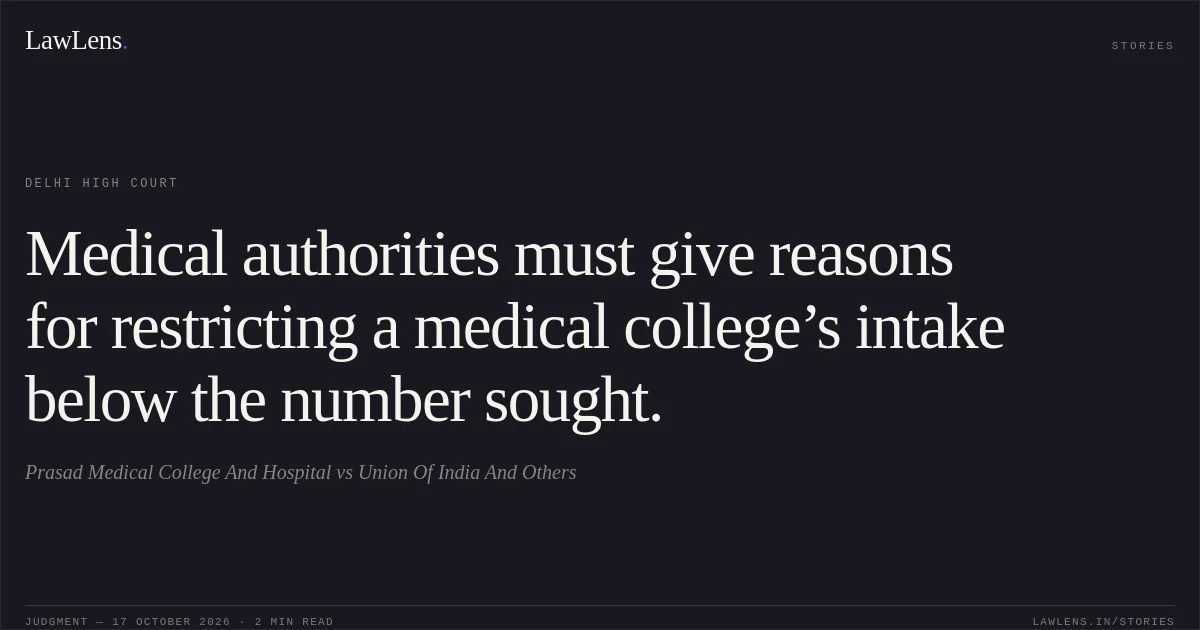
The petitioner, a 635-bed hospital in Unnao, Uttar Pradesh, applied for approval to establish an MBBS course with an annual intake of 150 students for academic year 2026–27.
Source reference: para. 1–3The Medical Assessment and Rating Board rejected the application, citing deficiencies in faculty and bed occupancy.
Source reference: para. 1–3On the petitioner’s first appeal under Section 28(5) of the National Medical Commission Act, 2019, the National Medical Commission permitted an intake of 50 seats.
Source reference: para. 1–3The petitioner’s second appeal under Section 28(6) was dismissed by the Central Government.
Source reference: para. 1–3The petitioner challenged both orders, principally contending that the restriction to 50 seats was unsupported by reasons.
Source reference: para. 1–3Issues
1. Whether the first appellate authority’s decision to approve only 50 of the 150 seats sought was sustainable when it did not disclose reasons for restricting the intake.
Source reference: para. 5–6, 92. Whether the Court should intervene under Article 226 where an expert authority’s decision adversely affects the petitioner but does not explain the basis for its conclusion.
Source reference: para. 7–9Law Applied
Section 28(5) and (6) of the National Medical Commission Act, 2019 provide for first and second appeals in the approval process.
Source reference: para. 3, 5–6Although courts ordinarily defer to expert assessments involving specialised knowledge, an authority exercising quasi-judicial functions must give reasons for a decision that adversely affects a party; reference to an expert assessment alone does not substitute for those reasons.
Source reference: para. 8–9Relying on B.V. Nagesh v. H.V. Sreenivasa Murthy, (2010) 13 SCC 530, the Court noted that an appellate decision must reflect application of mind and give reasons on the issues raised.
Source reference: para. 10It also relied on Kranti Associates (P) Ltd. v. Masood Ahmed Khan, (2010) 9 SCC 496, for the principles that reasoned decisions restrain arbitrariness, demonstrate consideration of relevant factors, and facilitate judicial review.
Source reference: para. 11–12Reasoning
The first appellate authority granted approval for 50 seats but did not explain why the petitioner was eligible for that intake yet not for the remaining 100 seats sought.
Source reference: para. 8–9The Court held that deference to expert judgment did not remove the obligation to disclose the reasoning behind that distinction.
Source reference: para. 8–9Because the challenged order did not state the rationale for limiting the intake, the Court could not assess whether the decision rested on relevant considerations.
Source reference: para. 8–9Holding
The Court did not grant approval for 150 seats or determine that the petitioner was entitled to that intake.
It directed the first appellate authority to reconsider the petitioner’s request for the 2026–27 academic year and issue a detailed, reasoned and speaking order within 10 days.
Source reference: para. 12–13The petition and pending applications were disposed of.
Source reference: para. 12–13Acts & Sections Cited
1 provisions across 1 statute referred to in this judgment. Each provision opens on LawLens.
National Medical Commission Act, 20191
Original Court PDF
Prasad Medical College And HospitalvsUnion Of India And Others
Click to open original judgment
Original judgment, available to read, download and summarize on LawLens.in