Facts
The husband of the respondent, late Sreekantan Nair, was enrolled in the Indian Army on August 7, 1973. On July 15, 1979, he was "invalided out" of service due to a diagnosis of ‘Schizophrenia’
Source reference: p. 2The Release Medical Board (RMB) assessed his disability at 60% for two years but classified it as "constitutional in origin," asserting it was neither attributable to nor aggravated by military service
Source reference: p. 3Consequently, his claim for disability pension was rejected by the Ministry of Defence. Following his death in 1994, his widow (the respondent) approached the Armed Forces Tribunal (AFT), which set aside the earlier rejections and granted the pension
Source reference: p. 2The Union of India challenged this order before the High Court via a Writ Petition.
Source reference: no citationIssues
1. Whether the disability ‘Schizophrenia’ can be deemed attributable to or aggravated by military service when the medical board provides no reasoning for its "constitutional" classification
Source reference: p. 3 / para. 52. Whether the High Court should interfere with the AFT's order under Article 226 in light of the delay in filing the claim and the finality of medical board opinions
Source reference: p. 10 / para. 12Law Applied
The court primarily applied Regulation 423(a) and (c) of the Regulations for Medical Services for Armed Forces, 1983, which mandates that a disease resulting in discharge is deemed to have arisen in service if no note was made of it at the time of enrolment
Source reference: p. 9Rules 4, 5, and 14 of the Entitlement Rules for Casualty Pensionary Awards, 1982, which establish the onus of proof on the authorities to displace the presumption of service-connection
Source reference: p. 3Precedential weight was given to Rajumon T.M v. Union of India (2025 SCC OnLine SC 1064), focusing on the cognitive impairment of Schizophrenia
Source reference: p. 4, 11Veer Pal Singh v. Secretary, Ministry of Defence (2013 8 SCC 83), which detailed the clinical nature of the disorder
Source reference: p. 4-8Union of India v. Parashotam Dass (2025 5 SCC 786) was cited regarding the scope of High Court jurisdiction under Article 226
Source reference: p. 10Reasoning
The Court reasoned that social security legislation must be interpreted liberally to favor the beneficiary
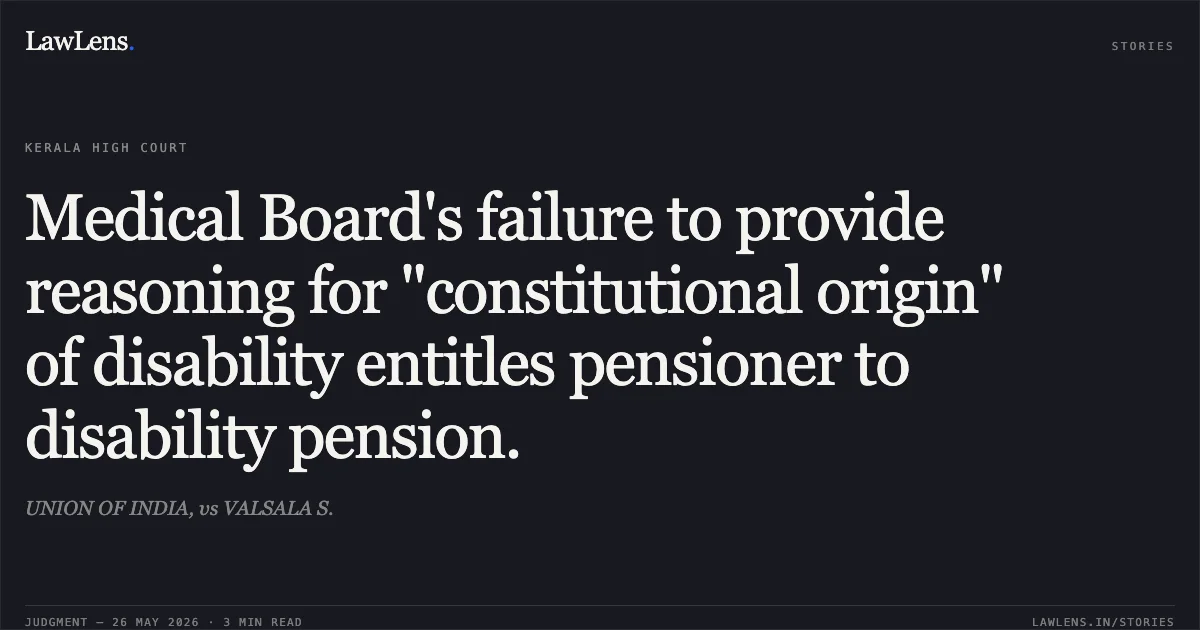
Source reference: p. 9It noted that the deceased was fit at the time of recruitment, and the RMB failed to provide any specific medical reasoning or evidence to support the conclusion that the schizophrenia was "constitutional" rather than triggered by service conditions
Source reference: p. 3, 11Citing Rajumon, the court emphasized that an opinion "sans reasons" is legally invalid
Source reference: p. 11Furthermore, the court excused the delay in seeking legal recourse by noting that Schizophrenia is a debilitating brain disorder that impairs a person’s ability to advance their own legal cause
Source reference: p. 4, 8The court found that the Union of India failed to discharge its heavy burden of proof to rebut the statutory presumption of attributability
Source reference: p. 9-10Holding
The Court answered the issues in favor of the respondent, holding that the lack of reasoning in the Medical Board's report rendered the denial of pension illegal
It held that the High Court should not exercise its discretionary jurisdiction under Article 226 to overturn a beneficial order unless there is a jurisdictional error or a denial of fundamental rights, neither of which were present here. The Writ Petition was dismissed, confirming the AFT’s order for grant of disability pension
Source reference: p. 11Original Court PDF
UNION OF INDIA,vsVALSALA S.
Click to open original judgment
Original judgment, available to read, download and summarize on LawLens.in