Facts
Petitioner No. 1, M/s Super Cardio Devices Pvt. Ltd., manufactured Heart Lung Packs at its premises in Bahadurgarh, Haryana; petitioner Nos. 2 and 3 were its directors, with petitioner No. 2 also described as the Manufacturing Chemist.
Source reference: para. 2Following an inspection on 28 October 2010, the Drugs Control Officer alleged that the petitioners were manufacturing Heart Lung Packs without a valid drug-manufacturing licence and took samples under the Drugs and Cosmetics Act, 1940 and the Rules framed thereunder.
Source reference: para. 2A subsequent inspection was conducted on 18 April 2012, after which sanction was obtained and Complaint No. 1231 was filed alleging offences under Sections 18(c), 27(b)(ii), 28B, 28A and 27(d) of the Act, along with Rules 74 and 78 and the relevant Schedules.
Source reference: paras. 1–2The Chief Judicial Magistrate, Jhajjar, summoned the petitioners on 16 July 2013. A revision filed against the summoning order was dismissed by the Sessions Judge, Jhajjar, on 29 October 2014.
Source reference: paras. 1–2The petitioners therefore invoked Section 482 Cr.P.C., corresponding to Section 528 of the Bharatiya Nagarik Suraksha Sanhita, 2023, seeking quashing of the complaint and consequential proceedings.
Source reference: para. 1The prosecution relied principally on the Central Government notification dated 6 October 2005, which specified certain medical devices, including “Catheters”, under Section 3(b)(iv), and on subsequent departmental communications dated 20 March 2009 and 7 September 2012 stating or suggesting that Heart Lung Packs fell within the notified categories.
Source reference: paras. 3–4, 7The petitioners contended that Heart Lung Pack was an extracorporeal tubing circuit, distinct from a catheter, and had not been specifically notified as a drug in the Official Gazette.
Source reference: paras. 3–5Issues
Whether Heart Lung Pack manufactured by the petitioners on 28 October 2010 could legally be treated as a “drug” under Section 3(b)(iv) of the Drugs and Cosmetics Act, 1940, so as to require a manufacturing licence and attract the penal provisions of the Act?
Source reference: para. 9Whether the complaint, summoning order and consequential criminal proceedings were liable to be quashed under Section 482 Cr.P.C. on the ground that the foundational statutory requirement for treating the product as a “drug” was absent or legally doubtful?
Source reference: paras. 16–18Law Applied
Section 3(b)(iv) of the Drugs and Cosmetics Act, 1940 includes within “drug” such devices intended for specified medical purposes as are specified by the Central Government by notification in the Official Gazette after consultation with the Drugs Technical Advisory Board; mere medical use of a device is insufficient to bring it within the statutory definition.
Source reference: para. 9Criminal liability under the Act must be founded upon a clear and legally operative statutory notification, and an administrative clarification or departmental communication cannot substitute for the notification required by Section 3(b)(iv).
Source reference: paras. 11–13Penal provisions are to be strictly construed; where a penal provision admits of more than one reasonable interpretation, the interpretation exposing the accused to criminal liability should not be adopted unless the statutory requirement is clearly satisfied, as reaffirmed in Tolaram Relumal v. State of Bombay, AIR 1954 SC 496.
Source reference: para. 13The Court also relied on Biogenetic Drugs (P) Ltd. v. State of Himachal Pradesh, 2025:HHC:20463, for the principle that regulatory obligations cannot be created merely through administrative orders or office instructions, and on Kirti Kumar Jayantilal Patel v. State of Maharashtra, MANU/MH/1218/2023, for the principle that criminal prosecution cannot be sustained on the basis of a regulatory requirement that was not legally applicable at the time of manufacture.
Source reference: paras. 11–12, 15The High Court may exercise inherent jurisdiction under Section 482 Cr.P.C. where continuation of proceedings would amount to an abuse of process, particularly when a foundational ingredient of the alleged offence is absent on the admitted record.
Source reference: para. 17Reasoning
The Court found that the 6 October 2005 Gazette notification specified “Catheters” but did not specifically mention Heart Lung Pack.
Source reference: para. 10The petitioners’ case that Heart Lung Pack was an extracorporeal, customised tubing system, rather than a catheter inserted into the body, created a material distinction that could not be resolved merely by relying on the product’s medical use or on a later departmental description.
Source reference: paras. 10–11, 15Although the 20 March 2009 clarification referred to Heart Lung Pack, it was not an Official Gazette notification under Section 3(b)(iv); moreover, the CDSCO circular dated 5 May 2009 recorded that the matter was still pending approval and directed continuation of the earlier practice until further orders.
Source reference: para. 12The communication dated 7 September 2012, issued after the alleged manufacture in 2010, was likewise only an administrative communication and could not retrospectively create the statutory basis for criminal liability.
Source reference: para. 13Since the entire prosecution for manufacture without a licence depended on Heart Lung Pack first being legally established as a “drug”, the absence of a clear, operative statutory notification meant that the foundational ingredient of the alleged offences was not made out.
Source reference: paras. 16–18The Court held that deciding this issue did not require a mini-trial or appreciation of disputed evidence because the relevant notifications and communications were undisputed documents forming part of the record.
Source reference: para. 17Holding
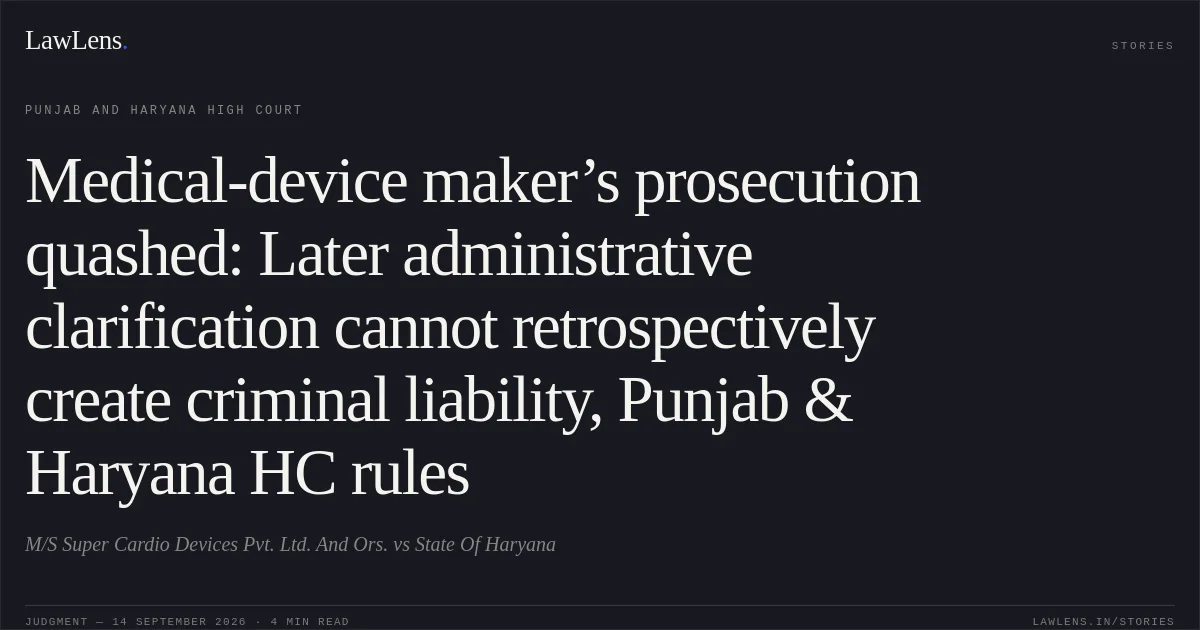
The Court held that the prosecution had failed to establish that Heart Lung Pack was covered by a valid statutory notification under Section 3(b)(iv) of the Drugs and Cosmetics Act, 1940, on the relevant date, namely 28 October 2010.
Subsequent administrative communications could not retrospectively impose criminal liability.
Source reference: para. 18Continuation of the proceedings would therefore amount to an abuse of the process of law.
Source reference: para. 18The petition was allowed, and Complaint No. 1231 dated 16 July 2013, the summoning order dated 16 July 2013, the revisional order dated 29 October 2014, and all consequential proceedings were quashed.
Source reference: para. 19Acts & Sections Cited
5 provisions across 3 statutes referred to in this judgment. Each provision opens on LawLens.
Bharatiya Nagarik Suraksha Sanhita, 20231
Drugs and Cosmetics Act, 19403
Code of Criminal Procedure, 19731
Original Court PDF
M/S Super Cardio Devices Pvt. Ltd. And Ors.vsState Of Haryana
Click to open original judgment
Original judgment, available to read, download and summarize on LawLens.in
![A senior employee’s pay must be stepped up when a junior in the same cadre and post draws higher pay.. Nirmal Dev vs N E Rly.. CAT - ['Allahabad']. LawLens](/stories/thumbnails/a-senior-employees-pay-must-be-stepped-up-when-a-junior-in-the-same-cadre-and-post-draws-h-9f64fdc124814a90ad0adf013f00b440.webp)