Facts
The Appellant (Accused No. 1) married the deceased, Rupali, in April 2012
Source reference: p. 2On August 23, 2015, the Appellant’s brother informed Rupali’s father (P.W. 1) of her death
Source reference: p. 2The Appellant’s father reported to the police that the Appellant claimed Rupali attempted suicide by hanging
Source reference: p. 2P.W. 1 discovered fresh injuries on Rupali’s cheek and missing jewelry (earrings, anklet, and toe rings)
Source reference: p. 3The Trial Court convicted the Appellant under Sections 302 and 201 r/w 34 of the IPC, while acquitting the accused of dowry harassment (Section 498-A)
Source reference: p. 4The High Court of Bombay upheld the Appellant's conviction for murder, concluding the death was homicidal strangulation rather than suicide
Source reference: p. 4-5Issues
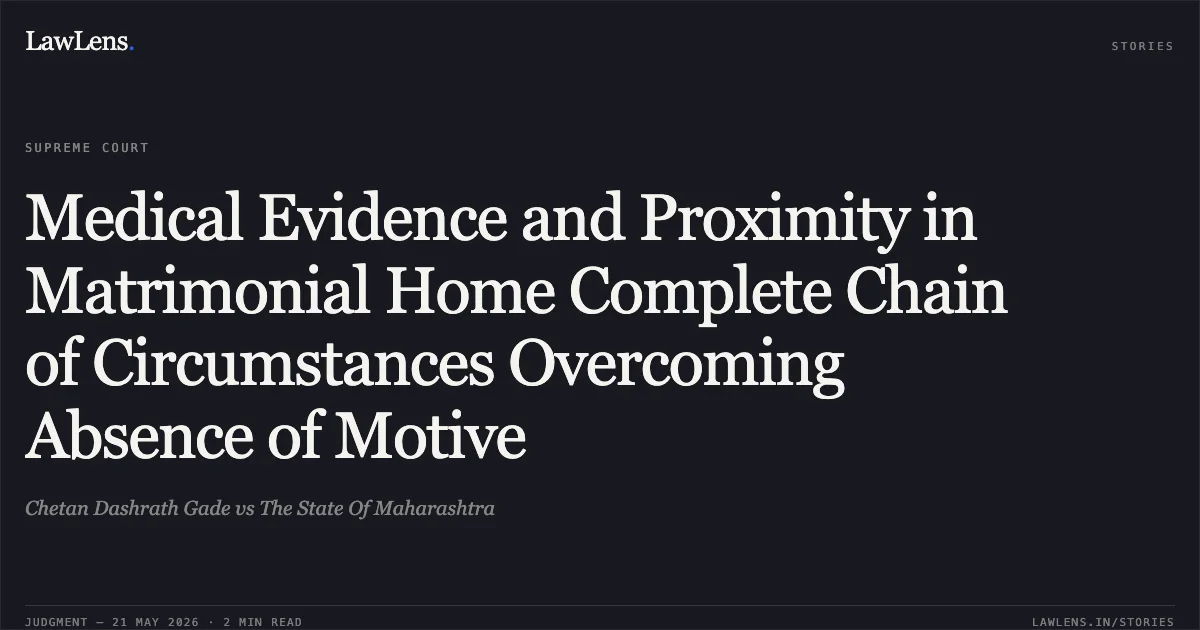
1. Whether the Trial Court and High Court rightly convicted the Appellant for murder under Section 302 IPC based on circumstantial evidence
Source reference: p. 6, para. 132. Whether the medical evidence and conduct of the accused supported a finding of homicidal strangulation over suicide
Source reference: p. 12-13, para. 18-19Law Applied
The Court applied Section 302 (Murder) and Section 201 (Causing disappearance of evidence) of the IPC
Source reference: p. 1It relied on the "Panchsheel" of circumstantial evidence established in Sharad Birdhichand Sarda v. State of Maharashtra, requiring a complete chain of evidence excluding any hypothesis of innocence
Source reference: p. 7-8, para. 15The Court invoked Section 106 of the Indian Evidence Act, placing the burden of proof on the accused to explain facts within his "special knowledge," specifically deaths occurring within the privacy of a matrimonial home, as seen in Nagendra Sah v. State of Bihar
Source reference: p. 14, para. 22Finally, it applied Mulakh Raj v. Satish Kumar, holding that if the chain of circumstances is complete, the failure to prove motive is not fatal to the prosecution
Source reference: p. 14-15, para. 23Reasoning
The Court observed that the deceased died an unnatural death inside the matrimonial home, placing a heavy burden on the Appellant under Section 106 of the Evidence Act to provide a satisfactory explanation
Source reference: p. 13, para. 20The Court rejected the defense of suicide, noting that medical evidence (P.W. 11) revealed a fractured hyoid bone and trachea, and sub-conjunctival hemorrhage—signs consistent with strangulation
Source reference: p. 11-12, para. 18Crucially, the Court found that the missing jewelry (earrings and toe rings) and the fresh injury on the cheek were highly improbable in a case of hanging but strongly suggested a struggle and manual strangulation
Source reference: p. 12, para. 16The Appellant’s conduct, including taking the body to multiple private hospitals after being told she was dead and planting a "suicide note" found to be written under duress, further completed the chain of guilt
Source reference: p. 12-13, para. 18-20Holding
The Supreme Court dismissed the appeal and upheld the concurrent findings of the lower courts
It held that the prosecution successfully established an unbroken chain of circumstances unerringly pointing to the Appellant's guilt
Source reference: p. 15, para. 26The Court affirmed the conviction and sentence under Sections 302 and 201 IPC, while granting the Appellant liberty to apply for premature release as per state policy
Source reference: p. 16, para. 27-28Acts & Sections Cited
1 provisions across 1 statute referred to in this judgment. Each provision opens on LawLens.
Code of Criminal Procedure, 19731
Original Court PDF
Chetan Dashrath GadevsThe State Of Maharashtra
Click to open original judgment
Original judgment, available to read, download and summarize on LawLens.in