Facts
The appellant (complainant) alleged that on January 8, 2018, the respondents assaulted him and his wife, Prabha, with kicks and fists and used caste-based slurs after they removed a bamboo fence obstructing a public pathway.
Source reference: para. 2The trial court (Special Sessions Judge, Tikamgarh) acquitted the respondents of offences under Sections 294, 323, 506, and 34 of the IPC and Section 3(1)(da)(dha) of the SC/ST (Prevention of Atrocities) Act.
Source reference: para. 1The appellant filed this application seeking leave to appeal, contending the trial court erred in granting the benefit of doubt despite ocular evidence and a valid caste certificate for the appellant.
Source reference: para. 6Procedural history revealed a prior criminal case filed by the respondents against the appellant, suggesting a motive for false implication.
Source reference: para. 10Issues
1. Whether the trial court’s judgment of acquittal suffers from patent perversity or misreading of evidence warranting interference under appellate jurisdiction.
Source reference: para. 13-152. Whether the prosecution established the guilt of the accused beyond a reasonable doubt, particularly regarding the medical corroboration of injuries and the intent behind the allegations.
Source reference: para. 9-11Law Applied
The court applied Section 378 of the CrPC regarding appeals against acquittal, governed by the principles summarized in H.D. Sundara v. State of Karnataka (2023) and Mallappa v. State of Karnataka (2024), which specify that an appellate court should not overturn an acquittal if the trial court’s view is a "legally plausible view," even if a contrary view is possible.
Source reference: para. 12-14Substantively, it looked at the evidentiary requirements under Sections 294 (obscenity), 323 (voluntarily causing hurt), 506 (criminal intimidation) of the IPC, and the SC/ST Act, necessitating proof of caste status and public insult.
Source reference: para. 11Reasoning
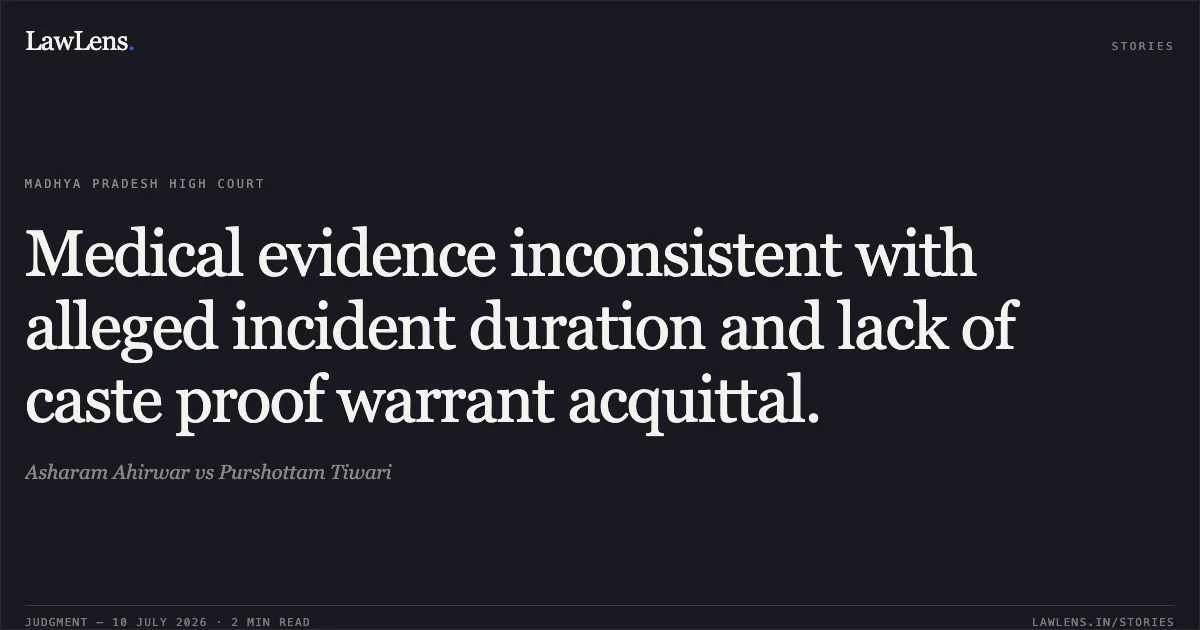
The High Court found no perversity in the trial court’s findings. First, while the appellant’s caste was proven, his wife’s was not, weakening the SC/ST Act charges related to her.
Source reference: para. 8Second, the medical evidence provided by PW-4 contradicted the oral testimonies; the only injury found on the appellant was a contusion less than 24 hours old, whereas the medical exam took place 48 hours after the alleged incident.
Source reference: para. 9Third, the court highlighted a police enquiry report (Ex.D/5) which concluded the complainant lodged a false report to pressure the respondents into compromising a separate pending criminal case against him.
Source reference: para. 10Finally, the two-day delay in lodging the FIR remained unexplained, and independent witnesses (PW-3) turned hostile. Consequently, the High Court determined the trial court's decision to grant the benefit of doubt was a reasonable and plausible conclusion based on the evidence.
Source reference: para. 11, 15Holding
The High Court dismissed the application for leave to appeal, holding that the trial court’s appreciation of evidence was comprehensive and its findings were not faulty.
The court reaffirmed that the presumption of innocence is further strengthened by an acquittal and should only be reversed in cases of manifest illegality or perversity, neither of which were present here. Application I.A. No. 29040 of 2024 and the criminal appeal were dismissed.
Source reference: para. 12-16Acts & Sections Cited
10 provisions across 3 statutes referred to in this judgment. Each provision opens on LawLens.
Indian Penal Code, 18606
Code of Criminal Procedure, 19733
Scheduled Castes and the Scheduled Tribes (Prevention of Atrocities) Act, 19891
Original Court PDF
Asharam AhirwarvsPurshottam Tiwari
Click to open original judgment
Original judgment, available to read, download and summarize on LawLens.in