Facts
The State of Chhattisgarh appealed against the judgment dated 27.07.2017, passed by the Additional Sessions Judge, Katghora, which acquitted the respondent of charges under Sections 302 and 201 of the IPC
Source reference: para. 1On 10.03.2016, a merg intimation was filed reporting that the deceased, Naihar Lal Dhanuhaar, had gone fishing at Amahwa Nala the previous day and failed to return.
Source reference: para. 2His body was subsequently found in the water
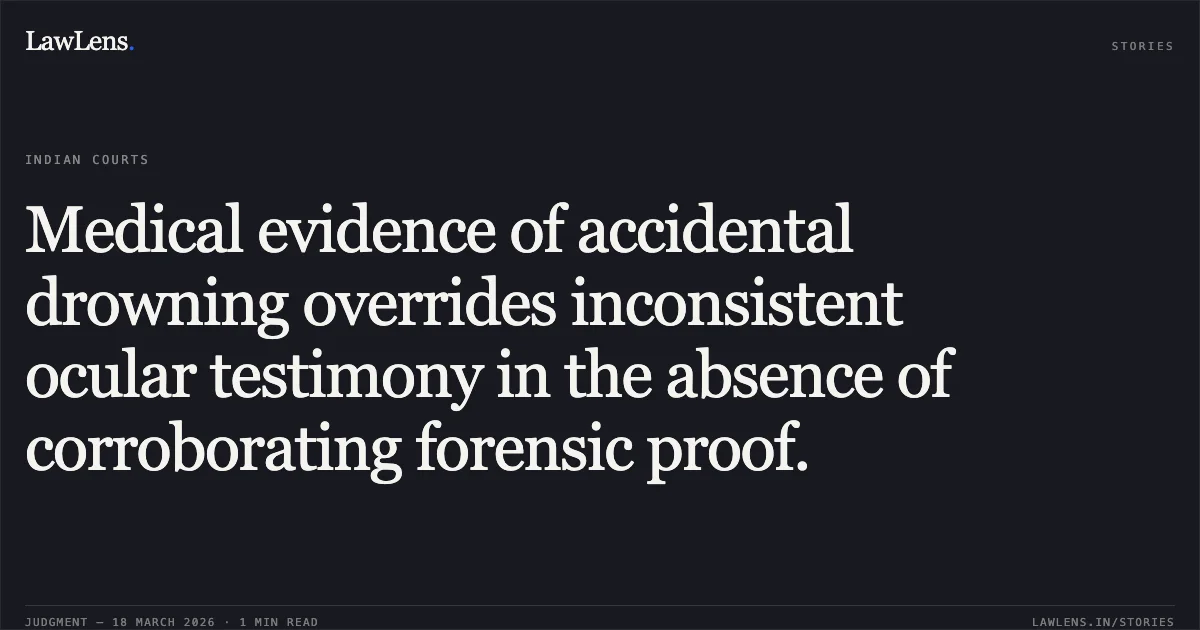
Source reference: para. 2The post-mortem report by Dr. Deepak Singh (PW-13) concluded the cause of death was asphyxia due to drowning and classified the nature of death as accidental
Source reference: para. 2, 10During the investigation, the police suspected the respondent of assaulting the deceased and drowning him.
Source reference: para. 3, 6The prosecution relied on the testimony of an alleged eye-witness (PW-7) and the seizure of a wooden stick, a liquor bottle, and a tangi (axe) following the respondent’s memorandum statement
Source reference: para. 3, 6Issues
1. Whether the death of the deceased, Naihar Lal Dhanuhaar, was homicidal in nature.
Source reference: para. 92. Whether the respondent was the perpetrator of the alleged crime.
Source reference: para. 113. Whether the High Court should interfere with a judgment of acquittal when the Trial Court’s view is plausible.
Source reference: para. 8, 15Law Applied
The Court applied Sections 302 (Murder) and 201 (Causing disappearance of evidence) of the Indian Penal Code
Source reference: para. 1The standard for appellate interference in acquittals established in Jafarudheen and others v. State of Kerala (2022), which emphasizes the "double presumption of innocence" in favor of the accused
Source reference: para. 8Principles from Mallappa and Ors. v. State of Karnataka (2024), which dictate that an appellate court must only reverse an acquittal if the trial court's decision is legally implausible, perverse, or suffers from an error of law or fact
Source reference: para. 15The court also reaffirmed the principle that "suspicion, however grave, cannot take the place of proof"
Source reference: para. 14Reasoning
The Court found that the medical evidence directly contradicted the prosecution's theory of murder.
Source reference: para. 10, 14PW-13 and the inquest report (Ex.P-7) confirmed the death was accidental drowning, noting an absence of visible injuries or rope marks on the body
Source reference: para. 10, 14Regarding the perpetrator's identity, the Court dismissed the testimony of the sole eye-witness, Dileram (PW-7), noting he was intoxicated at the time and admitted to arriving at the spot only after the deceased was already in the water.
Source reference: para. 12PW-7’s name was significantly omitted from the initial merg intimation
Source reference: para. 12Regarding physical evidence, the Court noted that the seized items (stick, bottle, tangi) were common rural articles with no forensic or scientific link to the crime; no blood stains were found, and the medical officer (PW-13) confirmed no injuries matching these weapons were present on the deceased
Source reference: para. 13Consequently, the Court determined the prosecution's case rested on mere suspicion rather than evidence
Source reference: para. 14Holding
The Court held that the prosecution failed to establish the guilt of the respondent beyond a reasonable doubt
It concluded that the trial court’s view was a plausible one and lacked any patent illegality or perversity that would justify interference.
Source reference: para. 16The High Court dismissed the acquittal appeal and upheld the trial court’s judgment
Source reference: para. 17Acts & Sections Cited
2 provisions across 1 statute referred to in this judgment. Each provision opens on LawLens.
Indian Penal Code, 18602
Original Court PDF
STATE OF CHHATTISGARHvsJAGDEO DHANUHAAR @ GHOSARIHA
Click to open original judgment
Original judgment, available to read, download and summarize on LawLens.in


