Facts
The Petitioner (Accused No. 12) was among approximately 35 individuals present at a "rave party" organized at "Ellavoma House" on the night of May 24-25, 2025
Source reference: p. 3Following a police raid authorized by the Assistant Commissioner of Police, a FIR was registered against unknown persons for offenses under Sections 20(b), 22(a), 27(b), and 25 of the NDPS Act, and Sections 292, 296, 3(5), and 111(2) of the Bharatiya Nyaya Sanhita (BNS)
Source reference: p. 4The Petitioner was allegedly arrested and released on the same day (May 25, 2025), but police failed to prepare an arrest memo or communicate the grounds of arrest
Source reference: p. 5, 24During the purported custody, blood and urine samples were collected and sent to the Forensic Science Laboratory (FSL), which later tested positive for cocaine
Source reference: p. 6The Petitioner sought to quash the proceedings in Spl.C.No.1182/2025, arguing that the arrest was illegal and the resulting medical evidence was inadmissible
Source reference: p. 7Issues
1. Whether the arrest of the petitioner was lawful?
Source reference: p. 92. Whether the report pursuant to conduct of medical examination under Section 51 of the BNSS in the absence of such lawful arrest can be relied upon to continue the prosecution against the petitioner?
Source reference: p. 93. Whether the report of such medical examination can be relied upon as proof of consumption?
Source reference: p. 9Law Applied
Section 35 of the Bharatiya Nagarik Suraksha Sanhita (BNSS), which mandates that for offenses punishable by less than seven years, arrest is discretionary and requires the recording of reasons in writing
Source reference: p. 12, 21Satender Kumar Antil v. CBI, emphasizing that compliance with Section 35(1)(b) is a sine qua non for arrest
Source reference: p. 15, 23Section 51 of the BNSS (corresponding to Section 53 of the CrPC), which permits medical examination of an accused only when they are lawfully "arrested"
Source reference: p. 36, 38Procedural safeguards for arrest established in D.K. Basu v. State of West Bengal
Source reference: p. 31The requirement to communicate grounds of arrest under Article 22(1) as interpreted in Kasireddy Upender Reddy v. State of Andhra Pradesh
Source reference: p. 30Section 27(b) of the NDPS Act regarding the proof required for the offense of consumption
Source reference: p. 11, 45Reasoning
The Court found that since the offenses carried punishments under seven years, the police were required to justify the arrest through recorded reasons and follow the "notice over custody" principle under Section 35 BNSS, which they failed to do
Source reference: p. 10, 24The "arrest" was deemed a legal nullity because the police did not prepare an arrest memo, communicate grounds to the Petitioner, or follow the D.K. Basu guidelines
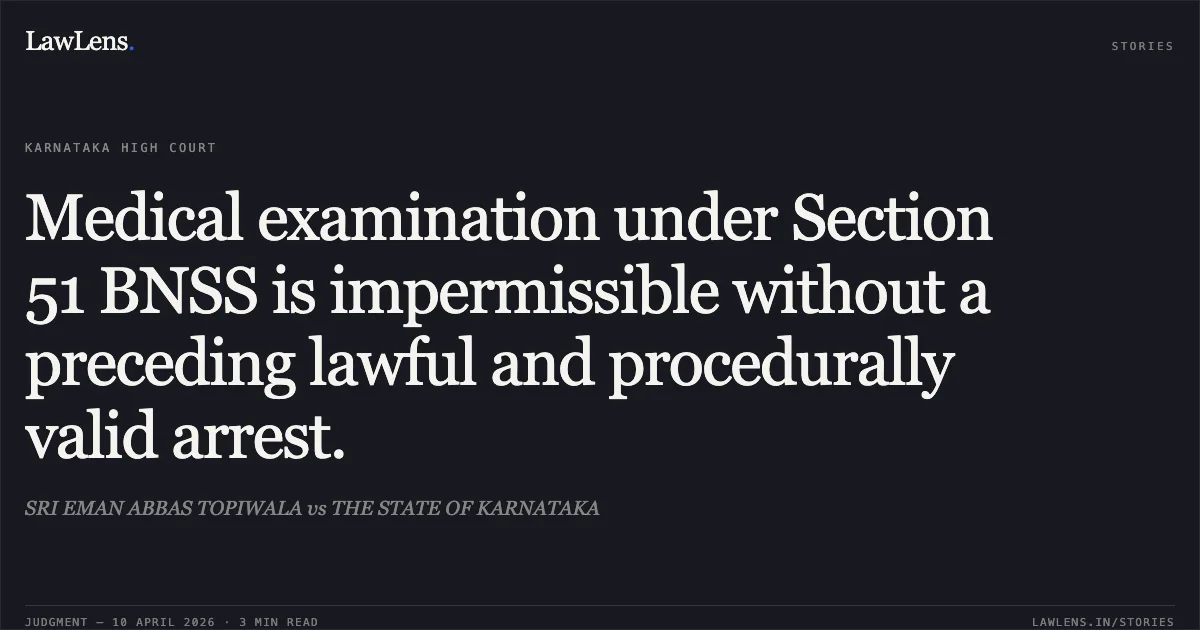
Source reference: p. 34-35Because Section 51 of the BNSS explicitly conditions the legality of a medical examination on a valid "arrest," the extraction of the Petitioner’s blood sample without a lawful arrest was held to be an unauthorized and invasive act
Source reference: p. 38, 43The Court reasoned that the medical report was a "fruit of a poisonous tree"; since the arrest was illegal, the sample collection was vitiated, and the resulting FSL report had no evidentiary value
Source reference: p. 44, 49Without this report, and in the absence of any recovery of contraband from the Petitioner’s possession, there was no material evidence to sustain a charge of consumption under Section 27(b) of the NDPS Act
Source reference: p. 49-50Holding
The Court answered the first issue in the negative, holding the arrest was patently illegal due to non-compliance with Section 35 BNSS and Constitutional safeguards
The Court answered the second and third issues in the negative, ruling that a medical report derived from an illegal arrest cannot form the basis of a prosecution
Source reference: p. 50The Court allowed the petition and quashed the entire proceedings in Special Case No. 1182 of 2025 insofar as the Petitioner (Accused No. 12) was concerned, holding that continuing the trial would constitute an abuse of the process of law
Source reference: p. 51Acts & Sections Cited
26 provisions across 4 statutes referred to in this judgment. Each provision opens on LawLens.
Code of Criminal Procedure, 1973
Narcotic Drugs and Psychotropic Substances Act, 19854
Bharatiya Nyaya Sanhita, 20234
Bharatiya Nagarik Suraksha Sanhita, 20236
Original Court PDF
SRI EMAN ABBAS TOPIWALAvsTHE STATE OF KARNATAKA
Click to open original judgment
Original judgment, available to read, download and summarize on LawLens.in


