Facts
The claimant sustained an open fracture of the ulna and radius in a road traffic accident on 17 March 2022 involving a car allegedly driven rashly and negligently by respondent No. 1.
Source reference: p. 3; para. 3; p. 4; para. 6The Tribunal awarded ₹1,95,846, including ₹20,000 for pain and suffering, ₹20,000 for loss of amenities, ₹15,000 for loss of earnings during treatment, and ₹93,846 in medical expenses; it disallowed a further ₹1,80,623 in medical expenses on the ground that the claimant had received reimbursement from Star Health Insurance.
Source reference: p. 3; para. 3; p. 5; para. 9The claimant appealed under Section 173(1) of the Motor Vehicles Act, 1988, seeking enhancement.
Source reference: p. 2; appeal description; p. 2; para. 1Issues
1. Whether the compensation awarded for pain and suffering, loss of amenities, and loss of income during the laid-up period required enhancement in view of the claimant’s injuries.
Source reference: p. 4; paras. 6–72. Whether medical expenses reimbursed under the claimant’s health insurance policy could be deducted from the compensation payable.
Source reference: p. 5; para. 9Law Applied
Section 173(1) of the Motor Vehicles Act, 1988, provides for an appeal against an award of the Motor Accident Claims Tribunal.
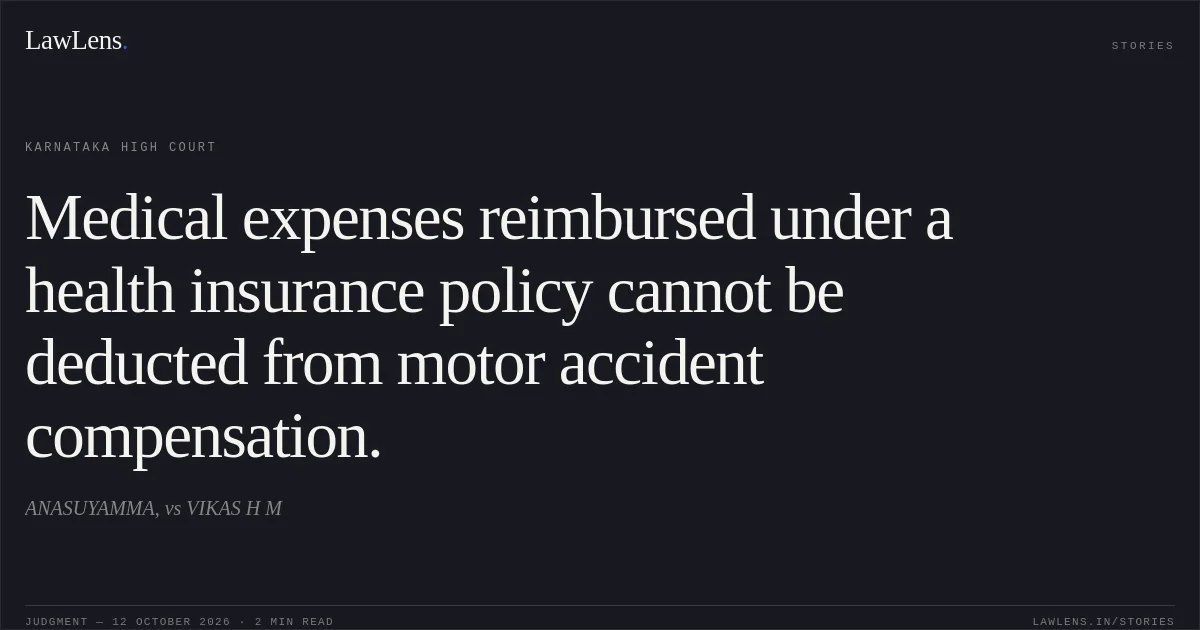
Source reference: p. 2; appeal descriptionThe Court relied on New India Assurance Company Limited v. Dolly Satish Gandhi and another, 2026 LiveLaw (SC) 504, for the rule that medical expenses reimbursed under a separate insurance policy cannot be deducted when assessing compensation for accident-related medical expenses.
Source reference: p. 5; para. 9The Court also assessed compensation by reference to the proved injuries, period of treatment and recovery, and medical expenses.
Source reference: pp. 4–5; paras. 6–9Reasoning
Given the claimant’s open fractures, the Court found the Tribunal’s awards for pain and suffering and loss of amenities inadequate, increasing them to ₹80,000 and ₹60,000 respectively.
Source reference: p. 4; para. 6It considered two months’ rest appropriate and awarded ₹31,000 for loss of income during the laid-up period.
Source reference: p. 4; para. 7It upheld the ₹47,000 awarded for attendant, conveyance, food, and nourishment expenses, having regard to the 23-day hospital admission.
Source reference: p. 5; para. 8Applying the cited Supreme Court decision, it included the ₹1,80,623 reimbursed by the claimant’s health insurer in the medical-expense award, bringing total medical expenses to ₹2,74,469.
Source reference: p. 5; para. 9Holding
The appeal was allowed in part.
The Court fixed total compensation at ₹4,92,469, an enhancement of ₹2,96,623 over the Tribunal’s award.
Source reference: p. 6; paras. 10–11The enhanced sum carries interest at 6% per annum from the date of the claim petition until realization, except for the 330-day delay period in filing the appeal. The insurer was directed to deposit the enhanced compensation with interest before the Tribunal within six weeks, and the claimant was permitted to withdraw the entire enhanced compensation.
Source reference: pp. 6–7; para. 12Acts & Sections Cited
1 provisions across 1 statute referred to in this judgment. Each provision opens on LawLens.
Motor Vehicles Act, 19881
Original Court PDF
ANASUYAMMA,vsVIKAS H M
Click to open original judgment
Original judgment, available to read, download and summarize on LawLens.in