Facts
The Appellants (legal heirs of the original plaintiff) filed a suit for permanent injunction to restrain the Delhi Development Authority (DDA) from dispossessing them or demolishing House No. F-189, Village Lado Sarai, Delhi
Source reference: p. 3They claimed ownership and long-term possession of the property, alleging it was left out of government acquisition proceedings
Source reference: p. 3-4The DDA contended the land had been duly acquired via Award No. 36/80-81 and possession was transferred to them in 1980
Source reference: p. 4The Trial Court dismissed the suit on 28.10.2021, finding that the Appellants failed to establish title or lawful possession
Source reference: p. 6-7The Appellants filed a First Appeal with a 437-day delay, along with an application for condonation of delay
Source reference: p. 7The First Appellate Court dismissed the condonation application and the appeal on 11.12.2025, citing a lack of "sufficient cause"
Source reference: p. 7-8The Appellants سپس challenged this dismissal before the High Court in a Second Appeal.
Source reference: no citationIssues
1. Whether the Appellants demonstrated "sufficient cause" under Section 5 of the Limitation Act to condone the 437-day delay in filing the first appeal
Source reference: p. 7 / para. 21-222. Whether the Second Appeal raises any substantial question of law under Section 100 of the CPC
Source reference: p. 14 / para. 54Law Applied
The Court primarily applied Section 100 of the Code of Civil Procedure (CPC), 1908, which restricts Second Appeals to cases involving a "substantial question of law"
Source reference: p. 2, 14It relied on Section 5 of the Limitation Act, 1963, which requires the applicant to show "sufficient cause" for delay
Source reference: p. 3, 7The Court invoked the presumption under Section 114, Illustration (e) of the Indian Evidence Act, 1872 (now Section 119 of the Bharatiya Sakshya Adhiniyam, 2023), that judicial acts are regularly performed
Source reference: p. 11It further applied principles from Basawaraj v. Land Acquisition Officer, which held that "sufficient cause" should be interpreted liberally to ensure justice, provided there is no negligence or lack of bona fides
Source reference: p. 13H. Guruswamy & Ors. v. Krishnaiah, which established that the "liberal approach" should not be employed to frustrate the substantive law of limitation
Source reference: p. 14Reasoning
The Court examined the Appellants' three grounds for delay: (i) non-availability of the judgment on the E-courts portal until April 2022; (ii) the COVID-19 limitation extension; and (iii) the medical incapacitation of Sh. Surender Singh, the alleged "Parokar" (lead litigant)
Source reference: p. 11-12The Court rejected the first ground, noting the Appellants failed to produce any certified copy applications to prove they were prevented from obtaining the judgment
Source reference: p. 11On the medical ground, the Court found that the submitted prescriptions for respiratory issues and fever did not indicate total incapacitation
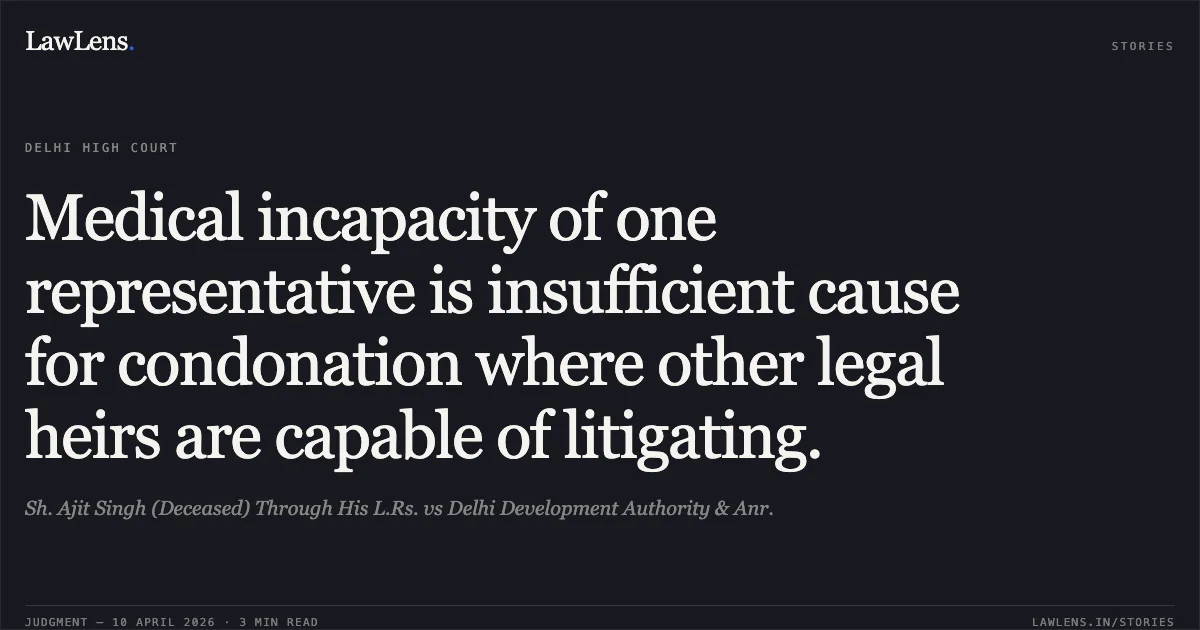
Source reference: p. 12Critically, the Court observed that as there were eight other legal heirs, the illness of one did not prevent the others from pursuing the appeal
Source reference: p. 12The Court noted that Sh. Surender Singh had not even signed the condonation application, undermining the claim that he was the sole lead litigant
Source reference: p. 13Consequently, the Court found the delay was due to negligence rather than bona fide impediments.
Source reference: no citationHolding
The Court answered both issues in the negative.
It held that the First Appellate Court's refusal to condone the 437-day delay was a proper exercise of discretion, as the Appellants failed to provide a bona fide or substantiated explanation for the inaction
Source reference: p. 14The Court further held that the appeal only challenged factual findings regarding ownership and possession, which does not constitute a "substantial question of law" under Section 100 of the CPC
Source reference: p. 14-15The Second Appeal was dismissed
Source reference: p. 15Acts & Sections Cited
6 provisions across 3 statutes referred to in this judgment. Each provision opens on LawLens.
Code of Civil Procedure, 19084
Limitation Act, 19631
Bharatiya Sakshya Adhiniyam, 20231
Original Court PDF
Sh. Ajit Singh (Deceased) Through His L.Rs.vsDelhi Development Authority & Anr.
Click to open original judgment
Original judgment, available to read, download and summarize on LawLens.in