Facts
The petitioners, Dr. Jaydeep Date and Dr. Munir Mhaskar, challenged the Medical Council of India’s order dated 24 August 2013, which reversed the Maharashtra Medical Council’s order exonerating them and directed removal of Dr. Date’s name from the medical register for six months and Dr. Mhaskar’s name for three years.
Source reference: paras. 1, 12–15The complaint arose from treatment administered to Murad Hasan Mulla, who suffered from recurrent urinary problems and urethral stricture. Dr. Mhaskar had performed cystoscopy, treatment relating to bladder-neck obstruction, and urethral procedures in 2005; Dr. Date had performed urethroplasty procedures in 2006 and 2007.
Source reference: paras. 3–10The petitioners contended that the MCI proceedings violated natural justice because they were not supplied copies of the complainant’s appeals and accompanying documents, were heard only on 23 March 2013, and were not notified of subsequent Ethics Committee meetings held on 24 and 25 May 2013.
Source reference: paras. 18–20, 29During the pendency of the petitions, the Indian Medical Council Act, 1956 was repealed and replaced by the National Medical Commission Act, 2019.
Source reference: paras. 21–22, 52–53Issues
Whether the MCI’s proceedings and order dated 24 August 2013 violated the principles of natural justice by failing to supply the appeals and documents, by conducting proceedings behind the petitioners’ back, and by denying them an effective opportunity of hearing?
Source reference: paras. 45–51Whether the MCI’s cryptic and unreasoned findings of professional misconduct and medical negligence could be sustained in law?
Source reference: paras. 50–55Whether the petitioners’ treatment amounted to medical negligence when assessed under the ordinary competent practitioner/Bolam standard, merely because an alternative treatment or procedure could have been chosen?
Source reference: paras. 55–60Whether Dr. Mhaskar, a general surgeon, lacked the qualification, training or competence to perform the procedures undertaken by him, and whether the procedures exceeded the complainant’s consent?
Source reference: paras. 61–70Whether Dr. Date could be held negligent merely because he used scrotal skin before using a buccal mucosal graft, when both procedures were recognised methods of treating urethral stricture?
Source reference: paras. 71–75Whether the proceedings ought to be remanded under the savings provision of the National Medical Commission Act, 2019, or whether the High Court should decide the petitions on merits?
Source reference: paras. 52–54Law Applied
The Court applied the principles of natural justice, particularly the right to notice, disclosure of adverse material, an effective opportunity of hearing, and a reasoned decision.
Source reference: paras. 46–51It considered the Indian Medical Council Act, 1956 and the Medical Council regulations governing professional misconduct, as well as Section 30 of the National Medical Commission Act, 2019, which provides an appellate remedy to an aggrieved medical practitioner or professional, and Section 60 concerning repeal and savings.
Source reference: paras. 21–22, 42–43, 52–53On medical negligence, the Court relied principally on Jacob Mathew v. State of Punjab, Martin F. D’Souza v. Mohd. Ishfaq, Kusum Sharma v. Batra Hospital, Arun Kumar Manglik v. Chirayu Healthcare, Bombay Hospital v. Asha Jaiswal, Dr. Neeraj Sud v. Jaswinder Singh, and Vinod Jain v. Santokba Durlabhji Memorial Hospital.
Source reference: paras. 56–59These authorities establish that a doctor is judged by the standard of an ordinarily competent practitioner possessing reasonable skill and knowledge; negligence is not established merely because treatment fails, an error of judgment occurs, or another recognised course of treatment could have been selected.
Source reference: paras. 56–59The Court also considered Samira Kohli v. Dr. Prabha Manchanda, which requires valid consent and prohibits unauthorised surgery, but distinguished it on the facts.
Source reference: paras. 37–38, 60Reasoning
The Court found that the petitioners had not been supplied the complainant’s appeals or supporting documents and were therefore handicapped in effectively answering the case against them.
Source reference: para. 47It further found that the Ethics Committee’s meetings on 24 and 25 May 2013 occurred behind the petitioners’ back, that no urology specialist was included despite the technical nature of the allegations, and that the MCI order merely stated conclusions without disclosing the reasoning or evidentiary basis for reversing the Maharashtra Medical Council.
Source reference: paras. 48–51On merits, the Court held that Dr. Mhaskar had produced material showing that cystoscopy and urethral dilatation formed part of his general-surgery training and that he possessed relevant experience; his bladder-neck incision was treated as a professional decision made during the procedure and for the patient’s benefit, not as unauthorised surgery.
Source reference: paras. 65–69The recurrence of urethral stricture, a condition having a high recurrence rate, could not by itself establish negligence.
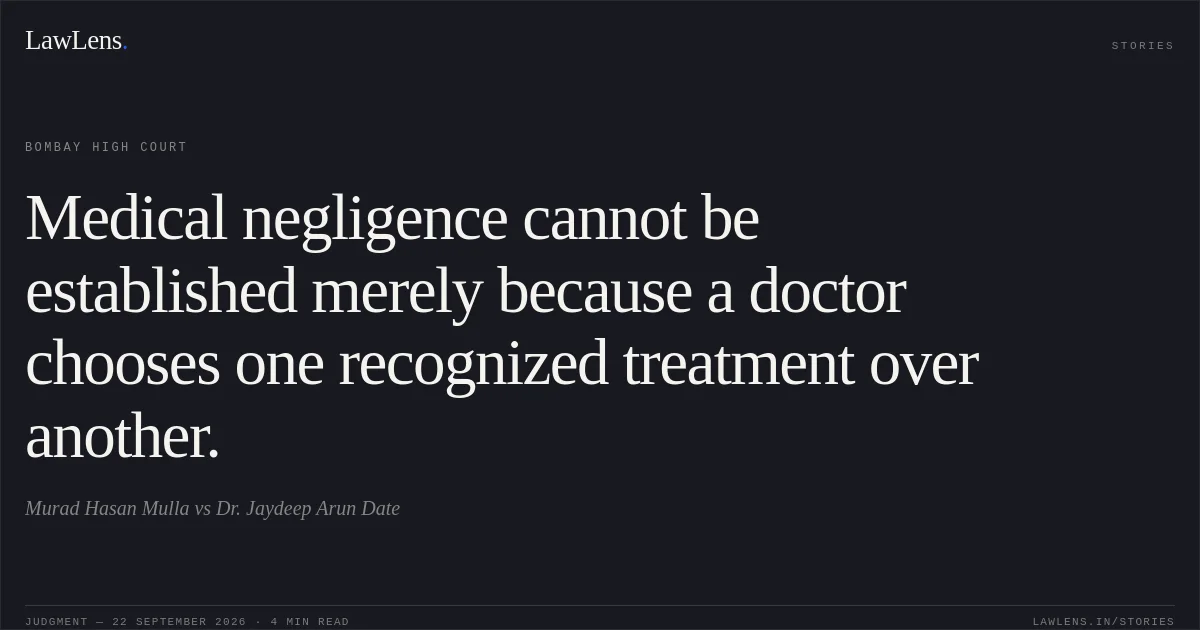
Source reference: para. 70As to Dr. Date, the Court held that the use of scrotal skin, although characterised by the complainant as a “last choice”, was a recognised procedure; choosing it instead of a buccal mucosal graft amounted at most to selecting one recognised treatment over another and did not satisfy the applicable negligence standard.
Source reference: paras. 71–74Although remand under the NMC Act’s savings clause was considered, the Court declined to remand after the parties requested adjudication on merits and because the impugned decision was independently unsustainable for breach of natural justice and absence of adequate reasons.
Source reference: paras. 52–55Holding
The Court answered the issues in favour of both petitioners. It held that the MCI proceedings violated natural justice and that the impugned order was cryptic, unreasoned, and contrary to the settled law governing medical negligence.
Neither petitioner was shown to have acted below the standard of an ordinarily competent medical practitioner; the choice of recognised treatment and the recurrence of the patient’s condition did not establish professional misconduct or negligence.
Source reference: paras. 67–74Accordingly, both writ petitions were allowed, the MCI order dated 24 August 2013 was quashed and set aside, Rule was made absolute, and the pending civil applications and notices of motion were disposed of.
Source reference: paras. 76–78Acts & Sections Cited
2 provisions across 1 statute referred to in this judgment. Each provision opens on LawLens.
National Medical Commission Act, 20192
Original Court PDF
Murad Hasan MullavsDr. Jaydeep Arun Date
Click to open original judgment
Original judgment, available to read, download and summarize on LawLens.in