Facts
The respondents (Medical Officers/Specialists) were appointed under the Rajasthan Medical and Health Service Rules, 1963.
Source reference: no citationFollowing the implementation of the Rajasthan Civil Services (Revised Pay Scale) Rules, 2017, the State fixed the pay of doctors who opted for Non-Practicing Allowance (NPA) by adding Dearness Allowance (DA) on the NPA to their basic pay.
Source reference: para 4The respondents, having consciously declined NPA to maintain their right to private practice, were excluded from this specific addition, resulting in junior doctors who opted for NPA drawing a higher salary.
Source reference: para 4, 6The Rajasthan Civil Services Appellate Tribunal allowed the doctors' appeals, directing the State to either provide a fresh option for NPA or step up their pay to match their juniors.
Source reference: para 3, 7The State challenged these orders via writ petitions, while other doctors approached the High Court directly for similar relief.
Source reference: para 1Issues
1. Whether the difference in pay fixation between Medical Officers opting for NPA and those declining it constitutes a "pay anomaly" warranting the "stepping up" of pay under Rule 11(7) of the Rules of 2017.
Source reference: para 25, 292. Whether the Rajasthan Civil Services Appellate Tribunal exceeded its jurisdiction by directing the State to grant a fresh option for NPA in the absence of a challenge to the validity of the statutory rules.
Source reference: para 33Law Applied
The Court applied Rule 11 of the Rajasthan Civil Services (Revised Pay Scale) Rules, 2017, which distinguishes pay fixation for general employees (Clause A) and Medical Officers drawing NPA (Clause B).
Source reference: para 16It relied on Rule 7(24) of the Rajasthan Service Rules, which includes emoluments specially classed as ‘pay’ by the Governor.
Source reference: para 8, 28The Court further applied the principle from Calcutta Municipal Corporation v. Sujit Baran Mukherjee (1997), establishing that stepping up of pay is inapplicable when the pay difference arises from fortuitous or special circumstances like additional allowances.
Source reference: para 30The Court followed Union of India v. P.V. Hariharan (1997), which cautions Tribunals against interfering with pay scales and statutory fixation formulas without evidence of hostile discrimination.
Source reference: para 32Reasoning
The Court reasoned that the Rules of 2017 expressly created two distinct classes for pay fixation: those covered under Rule 11(A) and those under Rule 11(B).
Source reference: para 23-24The addition of DA on NPA for the latter group was a deliberate statutory benefit for doctors who surrendered their right to private practice.
Source reference: para 24The Court observed that since the respondents consciously chose to continue private practice and declined NPA, they do not constitute a "homogeneous class" with those who opted for it; thus, no "hostile discrimination" or legal "anomaly" exists.
Source reference: para 25, 29The Court held that "stepping up" of pay under Rule 11(7) applies only to identically situated employees, which was not the case here as the juniors were receiving a legitimate benefit attached to a specific option.
Source reference: para 31, 34The Court found that the Tribunal engaged in "judicial legislation" by ordering fresh options for NPA when the underlying Notification had not been challenged.
Source reference: para 33Holding
The Court answered both issues in the negative and held that the pay difference is a legitimate consequence of a voluntary option and does not attract the principle of stepping up of pay.
The Court allowed the State's writ petitions, quashed the Tribunal's order dated 16.08.2021, and dismissed the writ petitions filed by individual doctors seeking parity.
Source reference: para 40Original Court PDF
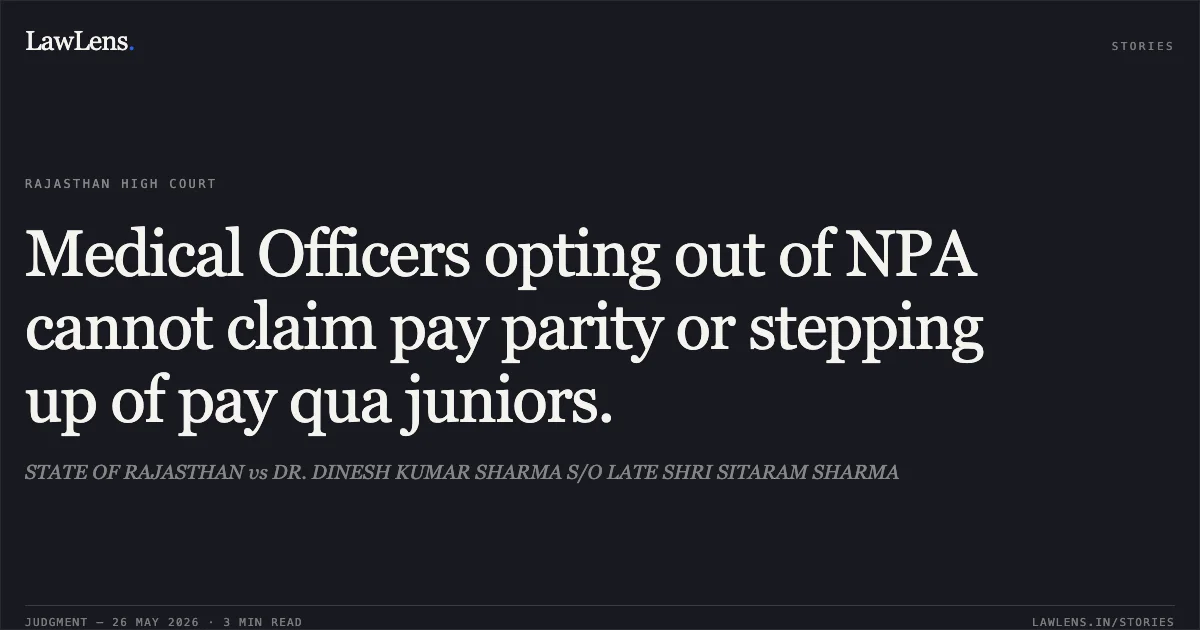
STATE OF RAJASTHANvsDR. DINESH KUMAR SHARMA S/O LATE SHRI SITARAM SHARMA
Click to open original judgment
Original judgment, available to read, download and summarize on LawLens.in