Facts
The respondent was enrolled in the Indian Army on February 25, 1994, in sound medical condition.
Source reference: para. 3, 5After 26 years of service, he was discharged on February 29, 2020, under Rule 13 (3) of the Army Rules, 1954, following a Release Medical Board (RMB) assessment.
Source reference: para. 3The RMB diagnosed him with 'Primary Hypertension' at 30% disability for life but classified it as "Neither Attributable to Nor Aggravated by Service" (NANA) because the onset occurred while he was posted at a "peace station".
Source reference: para. 3, 11The Armed Forces Tribunal (AFT) Lucknow allowed the respondent's claim in OA No. 443 of 2022, prompting the Union of India to challenge the order via this writ petition.
Source reference: para. 1, 4Issues
1. Whether a disability diagnosed during service can be deemed "attributable to or aggravated by military service" if the onset occurred at a peace station.
Source reference: para. 13, 172. Whether the Medical Board is legally mandated to provide specific reasons when opining that a disease is not attributable to service.
Source reference: para. 20, 213. Whether the absence of a recorded medical note at the time of entry into service creates a presumption of sound health in favor of the serviceman.
Source reference: para. 10, 18Law Applied
Regulation 173 of the Pension Regulations for the Army, 1961, which mandates disability pension if the disability is attributable to or aggravated by service and assessed at 20% or above.
Source reference: para. 13Regulation 423 of the Regulations for Medical Services for Armed Forces, 1983, which states that the location of onset (field vs. peace station) is immaterial and requires the Medical Board to specify reasons for its opinion.
Source reference: para. 16, 17The precedent in Dharamvir Singh v. Union of India (2013) 7 SCC 316, establishing that a member is presumed to be in sound condition upon entry unless a note to the contrary exists, and the onus of proof for non-entitlement lies with the employer.
Source reference: para. 10Maniben Maganbhai Bhariya v. Distt. Development Officer (2022) 16 SCC 343 regarding the liberal interpretation of beneficial social security legislations.
Source reference: para. 26Reasoning
The Court observed that the respondent entered service in 1994 with no recorded illness; thus, under Regulation 423(c), the disease is deemed to have arisen during service.
Source reference: para. 18, 31The Court rejected the Petitioners' argument that a "peace station" posting precludes service aggravation, noting that such stations involve rigorous training, stress, and strain.
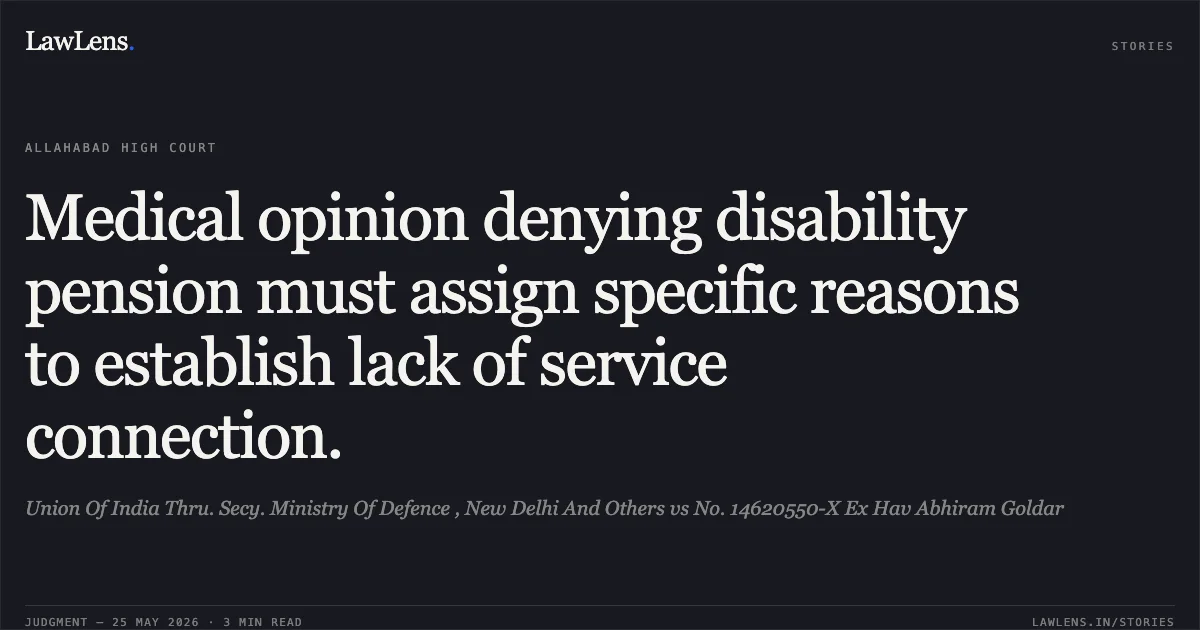
Source reference: para. 8, 36The Court found the RMB's report to be "invalid in the eyes of law" because it was devoid of specific reasoning.
Source reference: para. 29The RMB failed to explain why Hypertension could not be detected at enrolment or how 26 years of service—including high-altitude postings which may cause hypoxia-induced hypertension—did not contribute to the condition.
Source reference: para. 31, 32The Court held that since the authorities discharged the respondent involuntarily, they bore a heavy burden of proof to deny benefits, which they failed to meet by providing a "mere opinion sans reasons".
Source reference: para. 28, 30Holding
The Court held that an RMB opinion lacking reasons cannot be used to deprive a serviceman of retiral benefits.
The Court answered that the respondent's disability is deemed aggravated by military service as the Petitioners failed to discharge the onus of proving otherwise.
Source reference: para. 37The Court dismissed the writ petition, affirming the AFT's judgment and directing the Petitioners to grant the respondent disability pension with immediate effect along with all attending benefits.
Source reference: para. 38, 41Original Court PDF
Union Of India Thru. Secy. Ministry Of Defence , New Delhi And OthersvsNo. 14620550-X Ex Hav Abhiram Goldar
Click to open original judgment
Original judgment, available to read, download and summarize on LawLens.in