Facts
The State of Rajasthan appealed against the judgment dated 07-08-1997 passed by the Additional District and Sessions Judge, Barmer, which acquitted the respondent of charges under Sections 363, 376, 343, and 451 of the Indian Penal Code (IPC).
Source reference: para 1The prosecution alleged that the victim "M" (stated to be 13 years old) went missing, and it was discovered she was with the respondent.
Source reference: para 5They were eventually found by the police in a secluded area.
Source reference: para 2, 5The trial court concluded that the prosecution failed to prove the victim's minority and that she appeared to be a consenting party.
Source reference: para 8-9Issues
1. Whether the prosecution proved beyond reasonable doubt that the victim was below 16 years of age at the time of the incident.
Source reference: para 5, 82. Whether the act of sexual intercourse was committed without the victim's consent.
Source reference: para 5, 93. Whether the respondent committed the offenses of kidnapping and wrongful confinement.
Source reference: para 5, 10Law Applied
The Court applied the provisions of the Indian Penal Code, specifically Section 375 (Clause 6) regarding the age of consent (then 16 years).
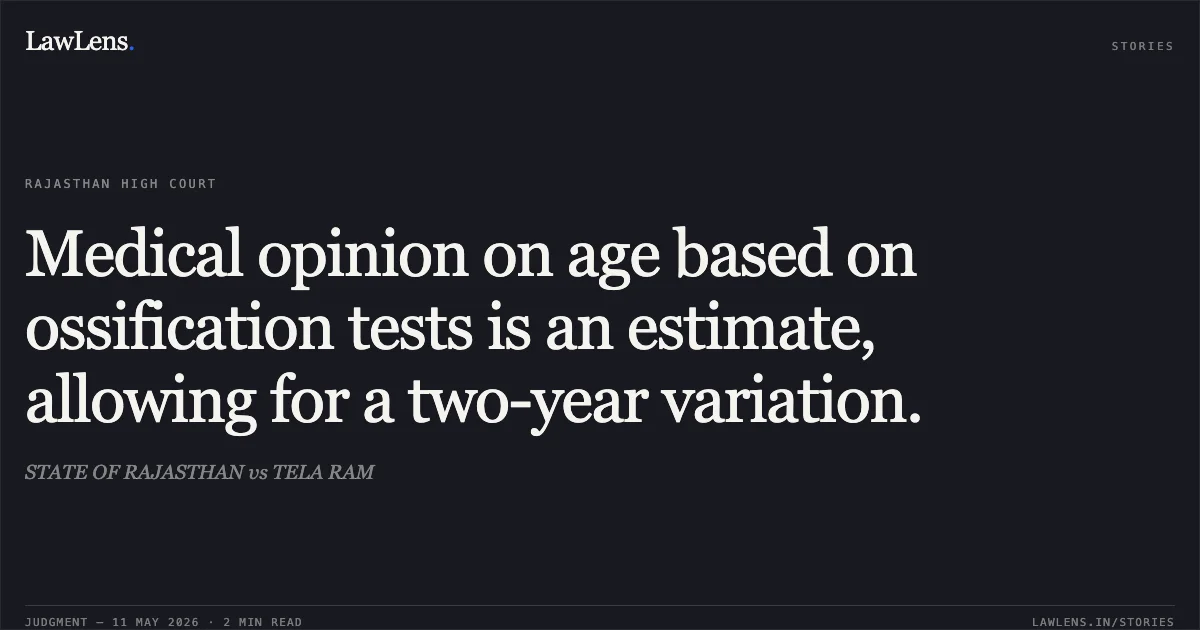
Source reference: para 5Regarding age determination, the Court relied on the medical jurisprudence principle that ossification test results provide an estimated age with a possible margin of error of two years.
Source reference: para 8It further adhered to the precedents of Jaya Mala v. Home Secretary, Government of Jammu & Kashmir (AIR 1982 SC 1297) and Birad Mal Singhvi v. Anand Purohit (1988 AIR 1796), which establish that clinical/radiological opinions on age are estimated "opinions" rather than absolute certainties.
Source reference: para 7Reasoning
The Court observed that no academic or birth records were produced to prove the victim's age.
Source reference: para 6The radiologist (PW-8) estimated the victim's age between 14-16 years based on the fusion of epiphysis in the humerus, radius, and ulna, but admitted in cross-examination that she could be 17 years old.
Source reference: para 7-8Applying the standard of "proof beyond reasonable doubt" and accounting for the two-year margin of error, the Court held the prosecution failed to establish her minority.
Source reference: para 8Regarding consent, the Court noted that the victim remained with the respondent for three days, traveled to various places, and met third parties without raising any alarm or complaint.
Source reference: para 9Furthermore, medical evidence (PW-7) showed no signs of struggle or injuries on her person, which typically occur in cases of forced intercourse on rough terrain.
Source reference: para 9Consequently, the elements of kidnapping and wrongful confinement were also found to be unsubstantiated.
Source reference: para 10Holding
The Court held that the presumption of innocence is strengthened following an acquittal by a competent trial court and should only be interfered with if the judgment is perverse or legally unsustainable.
The Court found no factual or legal error in the trial court's finding that the victim was a consenting party whose minority was not proven.
Source reference: para 4, 11The High Court dismissed the appeal and upheld the acquittal; the bail bonds were discharged.
Source reference: para 13Acts & Sections Cited
5 provisions across 1 statute referred to in this judgment. Each provision opens on LawLens.
Indian Penal Code, 18605
Original Court PDF
STATE OF RAJASTHANvsTELA RAM
Click to open original judgment
Original judgment, available to read, download and summarize on LawLens.in