Facts
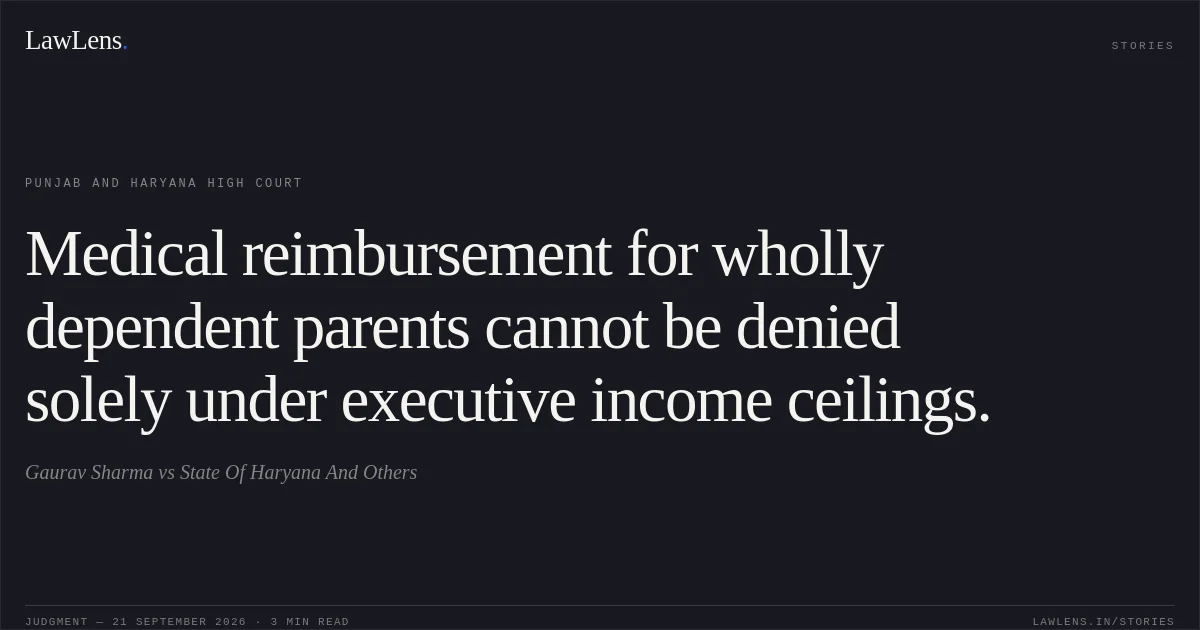
The petitioner, a Mechanic Instructor, sought reimbursement of medical expenses amounting to ₹3,23,921 incurred for the surgery and treatment of his wholly dependent mother at Shah Multispeciality Hospital, Kaithal.
Source reference: para. 2He submitted an affidavit stating that his mother had no independent source of income other than ₹3,400 per month received as Old Age Samman Allowance and was wholly dependent upon him.
Source reference: para. 2The respondents rejected the claim by order dated 31 October 2025 on the ground that the combined income of the dependent parents exceeded the ₹3,500 per month ceiling prescribed under the Government Instructions dated 15 January 2008.
Source reference: para. 2The petitioner challenged the rejection order and the validity of the income ceiling, relying upon the decision in Manoj Kumar v. State of Haryana and others , decided on 19 May 2017.
Source reference: paras. 1, 3He also relied upon a clarification dated 10 October 2025 stating that income reflected in the Parivar Pehchan Patra was merely a slab and did not represent actual income.
Source reference: para. 2Issues
1. Whether the petitioner’s claim for medical reimbursement could be rejected solely because the income of his dependent mother or parents exceeded the ₹3,500 per month ceiling prescribed by the Government Instructions dated 15 January 2008?
Source reference: paras. 4, 6–92. Whether the expression “wholly dependent” under the applicable medical reimbursement rules can be determined exclusively by applying a rigid monetary ceiling?
Source reference: paras. 6–73. Whether the petitioner was entitled to reimbursement of ₹3,23,921, with interest, for the treatment of his mother?
Source reference: paras. 8–10Law Applied
The Court applied the Punjab Medical Attendance Rules, 1940, which include wholly dependent parents within the definition of “family” for medical reimbursement purposes.
Source reference: para. 7It held that the expression “wholly dependent” cannot be confined to a rigid monetary test and must be assessed in the factual context of each case, including financial and physical dependence.
Source reference: para. 6This principle was drawn from State of Madhya Pradesh v. M.P. Ojha , 1998(1) S.C.T. 333, as relied upon in Manoj Kumar v. State of Haryana and others .
Source reference: para. 6The Court further held that executive instructions dated 15 January 2008 cannot override, dilute, or curtail the substantive benefit available under statutory rules by imposing an artificial income ceiling.
Source reference: para. 7A small amount received as pension or old-age allowance does not, by itself, establish that an otherwise dependent parent is financially independent.
Source reference: paras. 6, 9Reasoning
The respondents rejected the claim solely by applying the ₹3,500 monthly income ceiling contained in the executive instructions, without properly examining whether the petitioner’s mother was, in substance, dependent upon him.
Source reference: paras. 2, 8Applying M.P. Ojha and Manoj Kumar , the Court held that dependency involves a flexible assessment and is not limited to mere financial dependence; physical support and the circumstances of old age and illness are also relevant.
Source reference: para. 6The petitioner had furnished an affidavit confirming that his mother had no independent source of income apart from the Old Age Samman Allowance, and the treatment and expenditure were supported by the record.
Source reference: paras. 2, 8–9Since the statutory rules did not prescribe the impugned rigid monetary ceiling, the respondents could not rely upon executive instructions to deny reimbursement.
Source reference: para. 7The respondents also failed to distinguish the binding reasoning in Manoj Kumar .
Source reference: para. 4Accordingly, rejection of the claim solely on the basis of the income ceiling was held legally unsustainable.
Source reference: para. 9Holding
The writ petition was allowed.
The order dated 31 October 2025 rejecting the petitioner’s medical reimbursement claim was quashed and set aside.
Source reference: para. 10The respondents were directed to release ₹3,23,921 to the petitioner towards medical reimbursement, together with interest at 6% per annum from the date the amount became due until realization, within two months from receipt of a certified copy of the judgment.
Source reference: para. 10Pending miscellaneous applications, if any, were also disposed of.
Source reference: para. 11Original Court PDF
Gaurav SharmavsState Of Haryana And Others
Click to open original judgment
Original judgment, available to read, download and summarize on LawLens.in