Facts
The appellant, a manufacturer of automobile rubber products, filed Fringe Benefit Tax (FBT) returns for the assessment years 2006-2007, 2007-2008, and 2008-2009.
Source reference: p. 2The Assessing Officer (AO) disallowed claims regarding medical reimbursements up to ₹15,000 made to employees.
Source reference: p. 2Relying on CBDT Circular No. 08/2005, the AO levied a 20% tax on these amounts, asserting that since they were excluded from the employees' taxable income as perquisites, they must be taxed as fringe benefits in the hands of the employer.
Source reference: p. 2-3The appellant’s challenges before the CIT (Appeals) and the Income Tax Appellate Tribunal (ITAT) were dismissed, leading to this appeal before the High Court.
Source reference: p. 4Issues
Whether the Tribunal was right in law in holding that medical reimbursement up to ₹15,000/- per employee is chargeable to Fringe Benefit Tax under Section 115WB(2) of the Income Tax Act, 1961
Source reference: p. 4Law Applied
Section 115WB of the Income Tax Act, 1961, which defines "Fringe Benefits," and Section 115WB(3), which excludes "perquisites" paid to employees from the computation of FBT.
Source reference: p. 5-6Section 17(2), Proviso (v), which excludes medical treatment value up to ₹15,000 per annum from the definition of "perquisite" for the employee.
Source reference: p. 6The court relied on the democratic legal principle that "there shall be no taxation without valid legislation"
Source reference: p. 6followed the precedent set by the Karnataka High Court in CIT-III, Bangalore v. WIPRO Ltd. (2021) 430 ITR 34 (Kar), which established that medical reimbursements exempt in the hands of employees are not liable for FBT in the hands of employers.
Source reference: p. 7Reasoning
The Court examined whether a benefit exempt from "perquisite" tax for an employee could be frictionally deemed a "fringe benefit" for the employer.
Source reference: p. 5-6The Revenue contended that the CBDT Circular No. 08/2005 necessitated such taxation as a corollary to the employee's exemption.
Source reference: p. 5-6However, the Court rejected this logic, stating that charging sections in tax statutes must be clear and cannot be inferred by "reading between the lines".
Source reference: p. 6By analyzing Section 115WB alongside Section 17(2), the Court found no statutory mandate to levy FBT on reimbursements below the ₹15,000 threshold.
Source reference: p. 7It noted that the Karnataka High Court's reasoning in the Wipro Ltd. case was sound, as it clarified that if the sum is not taxable in the hands of the employee under the proviso to Section 17(2), it cannot be subjected to FBT in the hands of the employer.
Source reference: p. 7Holding
The High Court answered the substantial question of law in favor of the assessee and against the Revenue.
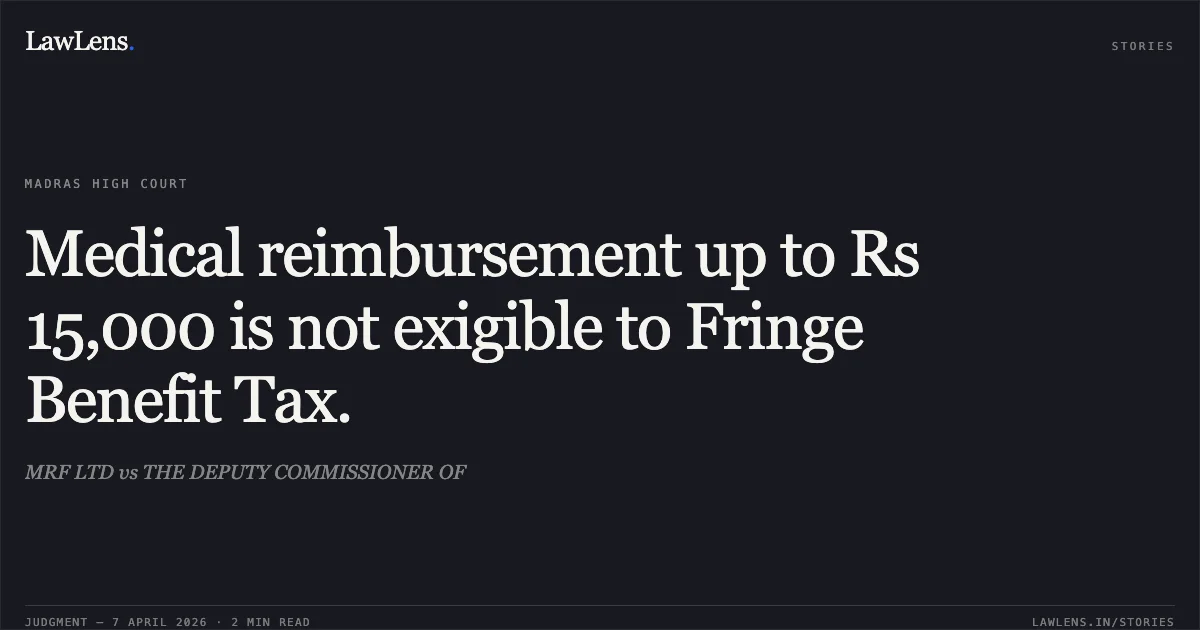
It held that medical reimbursements up to ₹15,000 per annum per employee are not chargeable to Fringe Benefit Tax under Section 115WB(2) of the Act.
Source reference: p. 8Consequently, the Court set aside the impugned assessment orders and the orders of the ITAT, allowing the Tax Case Appeals with no order as to costs.
Source reference: p. 8Acts & Sections Cited
3 provisions across 1 statute referred to in this judgment. Linked provisions open on LawLens.
Income Tax Act, 19613
Original Court PDF
MRF LTDvsTHE DEPUTY COMMISSIONER OF
Click to open original judgment
Original judgment, available to read, download and summarize on LawLens.in