Facts
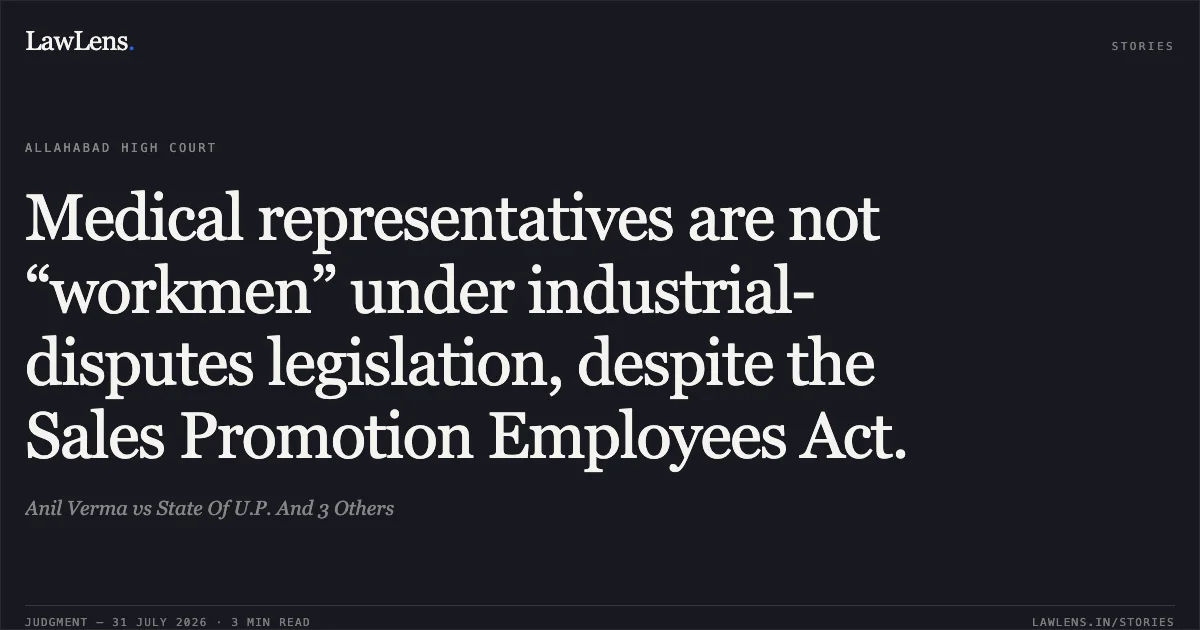
The writ petitions raised a common question concerning the status of medical representatives under the U.P. Industrial Disputes Act, 1947 (“the 1947 Act”) read with the Sales Promotion Employees (Conditions of Service) Act, 1976 (“the 1976 Act”).
Source reference: para. 2The petitioners relied, inter alia, on M/s Nicholas Piramal India Ltd. v. Presiding Officer, Labour Court, H.R. Adyanthaya v. Sandoz (India) Ltd., and M/s Pfizer Ltd. v. State of U.P., to contend that medical representatives were “workmen” for the purposes of industrial-dispute legislation.
Source reference: para. 4The respondents relied on S.G. Pharmaceuticals, Novartis India Ltd., Sh. Samarendra Das, and Jyoti Kumar, which held that medical representatives engaged principally in sales promotion were not “workmen” under Section 2(s) of the 1947 Act.
Source reference: para. 5The petitions were heard together because they involved the same legal issue.
Source reference: para. 1Issues
Whether a medical representative or sales-promotion employee is a “workman” under Section 2(s) of the 1947 Act read with Section 6(2) of the 1976 Act?
Source reference: paras. 2, 11Whether the decision in M/s Nicholas Piramal India Ltd., holding that medical representatives are deemed to be workmen under Section 6(2) of the 1976 Act, represented the correct interpretation of H.R. Adyanthaya?
Source reference: paras. 6–9, 13Whether disputes involving medical representatives could be entertained by the Labour Court under the applicable industrial-disputes legislation?
Source reference: paras. 22, 25Law Applied
Section 2(s) of the Industrial Disputes Act, 1947 defines a “workman” by reference to persons employed to perform manual, unskilled, skilled, technical, operational, clerical or supervisory work, subject to specified exclusions.
Source reference: para. 5Section 2(d) of the Sales Promotion Employees (Conditions of Service) Act, 1976 includes persons employed to perform work relating to promotion of sales or business, but excludes those mainly employed in managerial or administrative capacities and certain supervisory employees.
Source reference: para. 5Section 6(2) of the 1976 Act extends the provisions of the Industrial Disputes Act to sales-promotion employees as they apply to workmen, but does not independently enlarge the substantive definition of “workman” under the 1947 Act.
Source reference: para. 11In May & Baker (India) Ltd. v. Their Workmen, Burmah Shell Oil Storage & Distributing Co. v. Their Workmen, and H.R. Adyanthaya v. Sandoz (India) Ltd., the Supreme Court held that a medical representative principally engaged in canvassing and promoting sales does not perform manual, clerical, skilled, technical, operational or supervisory work within Section 2(s).
Source reference: paras. 4, 16, 20The Court also relied on Rhone-Poulenc (India) Ltd. v. State of U.P., and the Division Bench decisions in Novartis India Ltd., S.G. Pharmaceuticals, and Jyoti Kumar, which affirmed that medical representatives are not workmen under the relevant industrial-disputes legislation.
Source reference: paras. 8–10, 13Reasoning
The Court held that H.R. Adyanthaya had been incorrectly understood in Nicholas Piramal.
Source reference: paras. 6, 13Although Section 6(2) of the 1976 Act extends the Industrial Disputes Act to sales-promotion employees, it does not automatically make every medical representative a “workman”; the employee must still fall within one of the categories specified in Section 2(s) of the 1947 Act.
Source reference: paras. 6, 11, 13The Supreme Court in H.R. Adyanthaya had rejected the argument that medical representatives perform “skilled,” “technical” or “operational” work, observing that sales promotion is distinct from those statutory categories.
Source reference: para. 4; paras. 16, 20The Court further noted that the direction in H.R. Adyanthaya to treat a particular complaint as an industrial dispute was issued under Article 142 of the Constitution and therefore did not establish a general precedent that medical representatives are workmen.
Source reference: para. 7The contrary view in Nicholas Piramal was accordingly not followed, while the reasoning of the cited Division Bench decisions was preferred.
Source reference: paras. 8–10, 13Holding
The Court answered the principal issue in the negative and held that a medical representative or sales-promotion officer principally engaged in promoting sales is not a “workman” under Section 2(s) of the 1947 Act, notwithstanding Section 6(2) of the 1976 Act.
Consequently, disputes concerning such employees could not be entertained by the Labour Court on the footing that they were workmen under the 1947 Act.
Source reference: para. 22The Court declined to follow the contrary reasoning in Nicholas Piramal and dismissed all three writ petitions as devoid of merit.
Source reference: paras. 13–14Acts & Sections Cited
7 provisions across 5 statutes referred to in this judgment. Linked provisions open on LawLens.
U.P. Industrial Disputes Act, 19471
Sales Promotion Employees (Conditions Of Service) Act, 19762
Industrial Disputes Act, 19472
Sales Promotion Employees (Conditions of Service) Amendment Act, 19861
Employee1
Original Court PDF
Anil VermavsState Of U.P. And 3 Others
Click to open original judgment
Original judgment, available to read, download and summarize on LawLens.in