Facts
In the underlying revision, the Court had set aside an order of the Principal Sub Court, Puducherry, and directed the first respondent’s evidence to be recorded in person, declining his request to testify virtually on grounds of age and ill health.
Source reference: p.2, para. 1The witness appeared in court and filed his proof affidavit on 10 March 2026; his examination-in-chief was completed through video conferencing on 23 March 2026.
Source reference: p.3, para. 4He later sought permission for his cross-examination to be conducted through video conferencing, relying on worsening health and medical records. After the Trial Court dismissed his application, and a further revision was dismissed with liberty to seek clarification, he filed the present petition under Section 151 CPC.
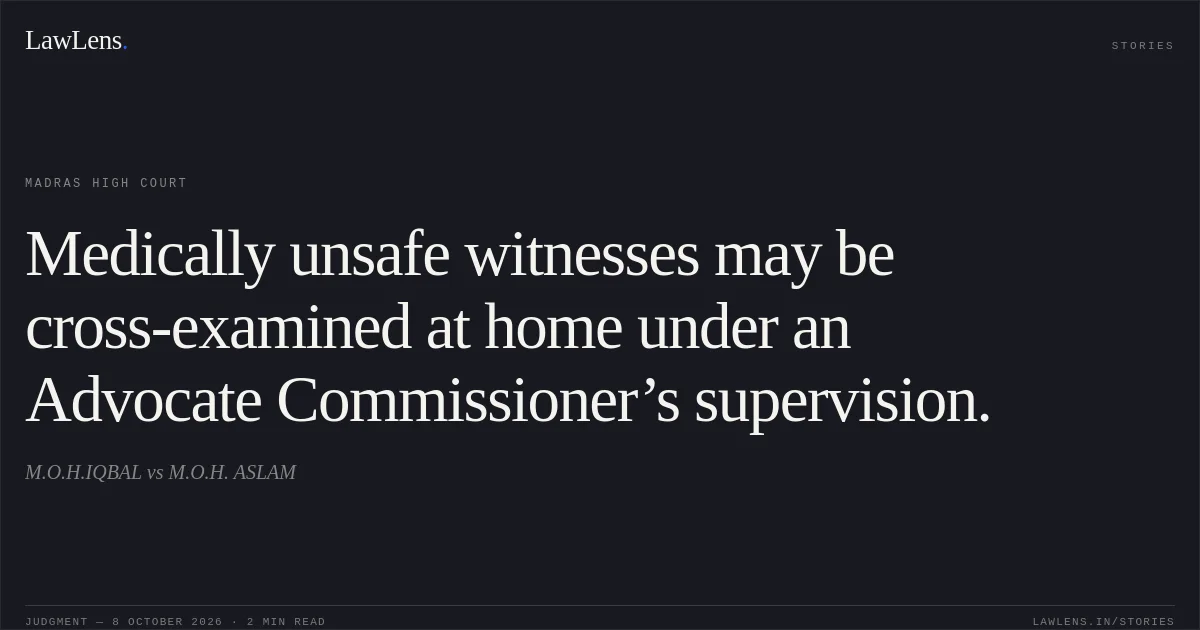
Source reference: p.4, para. 6A Court-appointed Advocate Commissioner and doctor examined him at home. Their reports indicated that he was cognitively capable of answering questions, but that travel was medically inadvisable and unsafe.
Source reference: pp.5–7, paras. 9–12Issues
Whether the Court should clarify or recall its earlier direction requiring the witness to appear in person for cross-examination, given his medical condition.
Source reference: pp.2, 4, paras. 1–2, 6Whether the witness’s cross-examination should be conducted by video conference or through an Advocate Commissioner at his residence.
Source reference: pp.4–8, paras. 6–12, 13(i)Law Applied
The petition invoked the High Court’s inherent powers under Section 151 CPC.
Source reference: p.4, para. 6The Court also considered the Madras High Court Video Conferencing in Courts Rules, 2026, observing that those Rules permitted evidence to be recorded at a witness’s residence but that practical difficulties—including handling voluminous documents and providing adequate video-conferencing infrastructure—could arise in this case.
Source reference: p.8, para. 13(i)Reasoning
The Court weighed the witness’s medical evidence against the opposing party’s objections concerning his ability to travel, the need to put voluminous documents to him, and the risk of prompting during remote testimony.
Source reference: pp.4–6, paras. 7–8, 10The Commissioner’s report and the doctor’s assessment, including the doctor’s view that travel could be unsafe and might cause the witness to collapse, persuaded the Court that requiring him to attend court was not appropriate.
Source reference: pp.6–7, paras. 9–12At the same time, given the practical concerns associated with video conferencing, the Court directed that cross-examination be recorded by an Advocate Commissioner at the witness’s residence, with the original case bundle and documents made available.
Source reference: pp.8–9, paras. 13(i)–(iii)Holding
The Court allowed the petition and recalled its order dated 19 September 2025.
It appointed an Advocate Commissioner to record the witness’s cross-examination at his residence, directed the Trial Court to transmit the complete case bundle, and required the Commissioner to arrange for the transcript to be signed and returned with the documents. The Court also ordered the petitioner to pay the Commissioner’s remuneration and specified travel and incidental expenses for the opposing party’s counsel.
Source reference: pp.8–10, paras. 13(i)–(iv), 14Acts & Sections Cited
1 provisions across 1 statute referred to in this judgment. Each provision opens on LawLens.
Code of Civil Procedure, 19081
Original Court PDF
M.O.H.IQBALvsM.O.H. ASLAM
Click to open original judgment
Original judgment, available to read, download and summarize on LawLens.in