Facts
The respondent met with a motor vehicle accident and filed a claim before the Motor Accidents Claims Tribunal (MACT) seeking compensation for loss of income, medical expenses, and other heads
Source reference: para. 2Simultaneously, the respondent received reimbursement for the same medical expenses under a private Mediclaim insurance policy
Source reference: para. 2The High Court of Judicature at Bombay, resolving a conflict between its own previous decisions, held that Mediclaim benefits are not deductible from MACT awards
Source reference: para. 3The appellant (Insurance Company) challenged this, arguing that such non-deduction leads to a "double benefit" and exceeds the principle of restitution
Source reference: para. 4.1.1Issues
Whether the amount of money received as Mediclaim, in terms of a Mediclaim policy, is deductible from an award passed by a Claims Tribunal under the Motor Vehicles Act, 1988
Source reference: para. 3.1Law Applied
Sections 146, 147, 166, and 168 of the Motor Vehicles Act, 1988 (MVA), which mandate "just compensation" for accident victims
Source reference: paras. 4.1.4, 4.3.4The principle from Helen C. Rebello v. Maharashtra SRTC (1999), which established that benefits accruing independently of an accident (like life insurance or provident funds) are not deductible as "pecuniary advantages"
Source reference: paras. 4.1.3, 8.1United India Insurance Co. Ltd. v. Patricia Jean Mahajan (2002) and Sebastiani Lakra v. National Insurance Co. Ltd. (2019), which distinguish between statutory entitlements and contractual benefits supported by the payment of premiums
Source reference: paras. 8.2, 8.4Distinguished Reliance General Insurance Co. Ltd. v. Shashi Sharma (2016), where statutory "double benefits" under the same head (e.g., government ex gratia vs. MVA) were held deductible
Source reference: paras. 4.1.2, 8.3Reasoning
The Court reasoned that a Mediclaim policy is a private contract where the insured pays premiums to secure financial protection against medical uncertainties
Source reference: para. 9This contractual benefit is independent of the statutory right to compensation under the MVA
Source reference: para. 10The Court observed that "double benefit" is a misnomer in this context because the Mediclaim proceeds are the "fruit of amounts already paid" in premiums
Source reference: para. 11Deducting these amounts would unjustly enrich the tortfeasor's insurer by allowing them to benefit from the claimant’s foresight and thrift
Source reference: para. 10While MVA compensation is based on the principle of "just compensation" without a fixed ceiling, Mediclaim is strictly limited by the contract's sum insured
Source reference: para. 10Therefore, the two claims operate in different spheres—one statutory/beneficial and the other contractual—and do not overlap in a manner that warrants deduction
Source reference: paras. 7.3.3, 11Holding
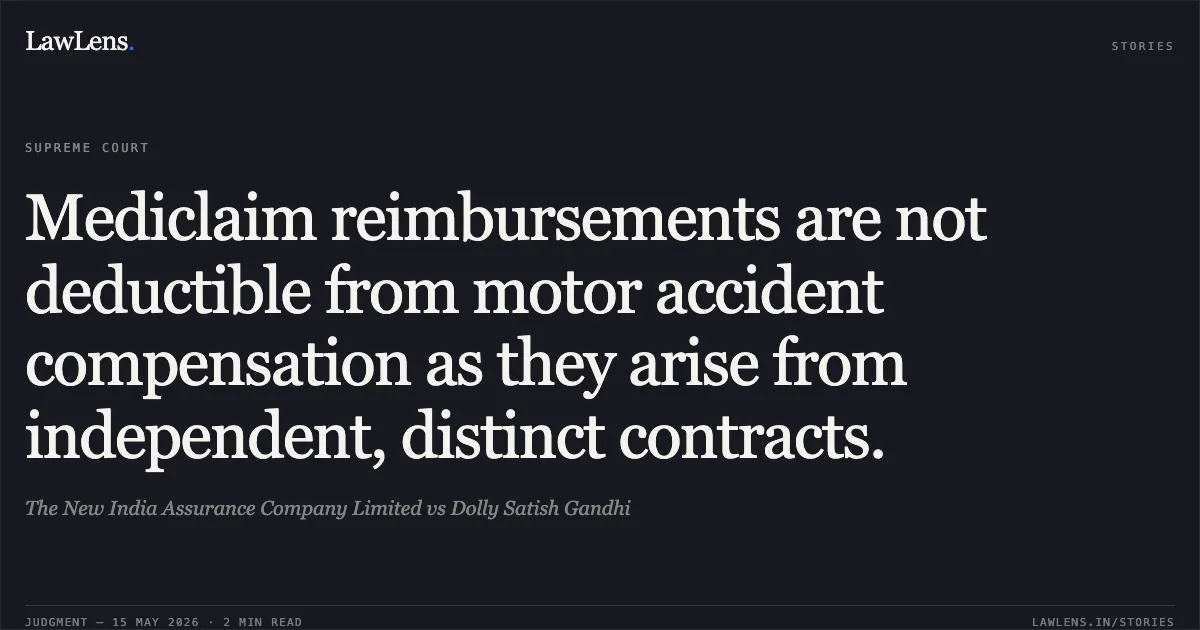
The Court answered the issue in the negative, holding that Mediclaim/medical insurance reimbursements are not deductible from compensation awarded by a Tribunal under the MVA
The Court clarified that the two entitlements stand on different footings: one is a statutory consequence of a motor accident, while the other is a sequitur of prior premium payments
Source reference: para. 15The appeal was dismissed as meritless, and the matter was remanded to the High Court for determination consistent with this legal opinion
Source reference: para. 16Acts & Sections Cited
1 provisions across 1 statute referred to in this judgment. Each provision opens on LawLens.
Motor Vehicles Act, 19881
Original Court PDF
The New India Assurance Company LimitedvsDolly Satish Gandhi
Click to open original judgment
Original judgment, available to read, download and summarize on LawLens.in