Facts
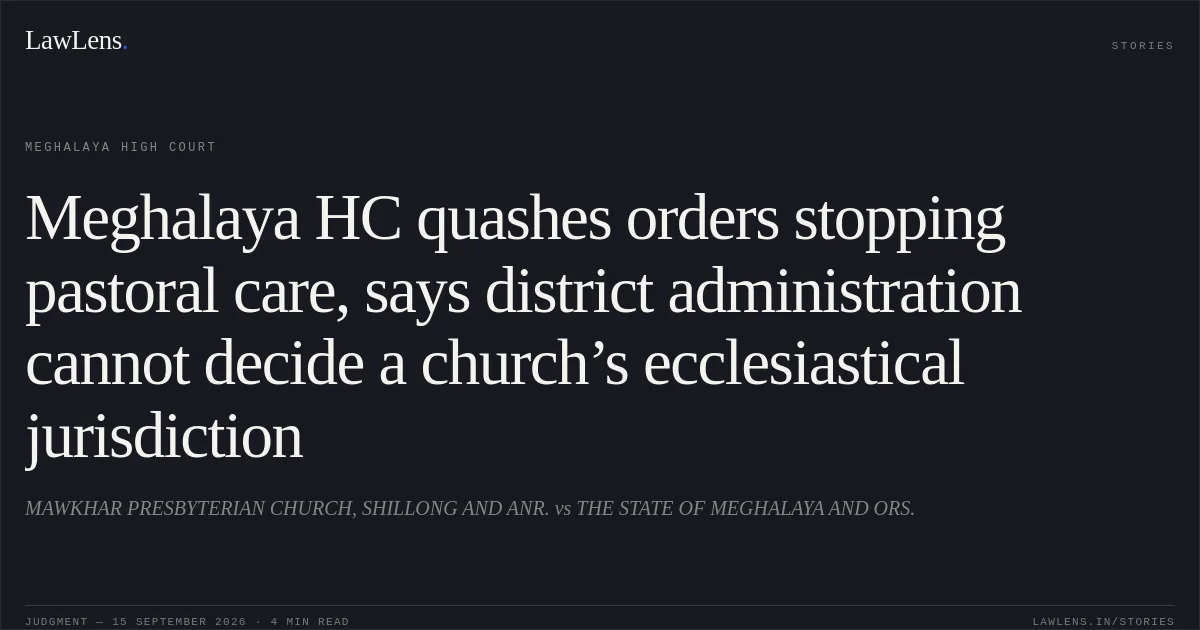
Mawkhar Presbyterian Church, Shillong, a society registered under the Meghalaya Societies Registration Act, challenged various communications and orders issued by the Deputy Commissioner, East Khasi Hills, concerning a dispute between rival factions of the Church.
Source reference: pp. 4–6The dispute arose after allegations of financial irregularities, disciplinary action against the Pastor, and the petitioner Church’s resolution dated 01.02.2026 seeking disassociation from the KJP Synod Sepngi.
Source reference: pp. 4–6On 12.03.2026, the Deputy Commissioner prohibited meetings in the Church’s schools, halls and premises, citing apprehension of breach of peace.
Source reference: pp. 20–22On 08.05.2026, he directed that only normal and funeral services could be conducted and prohibited “external interference” in the Church’s affairs pending an enquiry by the Joint Registrar of Societies.
Source reference: pp. 20–22A show-cause notice dated 13.05.2026 was thereafter issued to the petitioner’s Secretary concerning the decision of the KJP Synod Mihngi to provide pastoral care to the Church.
Source reference: pp. 22–24On 19.06.2026, the Deputy Commissioner directed the petitioner to pursue pastoral and ecclesiastical issues before the competent authorities under the Constitution of the Presbyterian Church of India and directed the KJP Synod Mihngi to stop administering sacraments and providing pastoral services to the petitioner Church.
Source reference: pp. 24–27Issues
Whether the Deputy Commissioner exceeded his administrative and preventive jurisdiction by determining the ecclesiastical jurisdiction of rival Synods and regulating the provision of pastoral care and administration of religious sacraments?
Source reference: paras. 23–26; pp. 19–21, 27–30Whether the impugned directions violated the petitioner’s rights under Articles 25 and 26 of the Constitution by interfering with the internal religious and ecclesiastical affairs of the Church?
Source reference: paras. 23, 26, 29, 33–34; pp. 19–21, 27–31Whether the blanket prohibition on meetings in the Church’s schools, halls and premises was a valid preventive measure for maintaining public order?
Source reference: paras. 24, 30, 36; pp. 20, 29–32Whether the existence of internal Church Courts and alternative ecclesiastical remedies precluded the exercise of writ jurisdiction under Article 226?
Source reference: paras. 27–28, 32; pp. 28–31Law Applied
The Court applied Articles 25 and 26 of the Constitution, recognising that freedom of religion and the right of a religious denomination to manage its religious affairs are subject to public order, morality and health, but do not authorise the State to determine internal theological or ecclesiastical questions.
Source reference: para. 23; p. 19Relying principally on Commissioner, Hindu Religious Endowments, Madras v. Sri Lakshmindra Thirtha Swamiar of Sri Shirur Mutt, AIR 1954 SC 282, the Court held that the State may regulate secular activities associated with religious institutions in accordance with law, but cannot substitute its own determination for that of the denomination in matters properly belonging to religious affairs.
Source reference: para. 33; p. 31Preventive administrative power must be directed to an actual or reasonably apprehended breach of public order, must have a rational nexus with the apprehended danger, and must be proportionate to the object sought to be achieved.
Source reference: paras. 23, 30; pp. 19–20, 29–30The Court further held that registration as a society does not confer upon the District Administration authority to regulate the Church’s religious or ecclesiastical functions.
Source reference: para. 28; p. 28The availability of internal ecclesiastical remedies does not validate an otherwise unlawful exercise of executive power.
Source reference: para. 27; p. 28Reasoning
The Court accepted that the rival claims, complaints, counter-complaints and criminal proceedings gave the District Administration a legitimate basis to take limited preventive measures for preserving public tranquillity.
Source reference: para. 24; pp. 20–21Accordingly, the initial meeting and preventive steps could not be held wholly without jurisdiction merely because the underlying dispute was ecclesiastical.
Source reference: para. 24; pp. 20–21However, the Deputy Commissioner went beyond prevention of an imminent breach of peace by interpreting the PCI Constitution and relying upon it to decide which Synod had authority to provide pastoral care and administer sacraments.
Source reference: para. 25; pp. 21, 24–27Such questions concerned ecclesiastical jurisdiction, religious functions and the internal administration of the denomination, and could not be conclusively determined by the District Administration.
Source reference: paras. 25–26, 29; pp. 21, 27–29The Court also found that the prohibition on meetings in Church premises was blanket and indefinite, without sufficient material showing a continuing or specific threat to public order, and was therefore disproportionate.
Source reference: para. 30; pp. 29–30The internal Church dispute, including the validity of the alleged disassociation and the competing claims of the Synods, was left open for determination by the competent ecclesiastical, civil or statutory forum.
Source reference: paras. 19, 37–39; pp. 18–19, 32–33Holding
The writ petition was partly allowed.
The Court quashed and set aside the show-cause notice dated 13.05.2026 and the orders dated 19.06.2026 directing the petitioner and the KJP Synod Mihngi concerning pastoral care, ecclesiastical services and administration of sacraments, holding that they impermissibly determined ecclesiastical jurisdiction.
Source reference: para. 35; p. 32The communication dated 08.05.2026 and the directions contained in the minutes dated 12.03.2026 were interfered with to the extent that they imposed a blanket or indefinite prohibition on the Church’s internal administration and functioning.
Source reference: para. 36; p. 32The Court expressly declined to decide the validity of the disassociation resolution, the appointment or removal of pastors or office-bearers, the jurisdiction of either Synod, or the rival claims to management and control of the Church.
Source reference: para. 37; pp. 32–33The authorities remained free to take lawful, specific and proportionate action against any actual or imminent threat to public order or any cognizable offence.
Source reference: paras. 31, 38–40; pp. 30, 33–34Acts & Sections Cited
2 provisions across 1 statute referred to in this judgment. Each provision opens on LawLens.
Bharatiya Nagarik Suraksha Sanhita, 20232
Original Court PDF
MAWKHAR PRESBYTERIAN CHURCH, SHILLONG AND ANR.vsTHE STATE OF MEGHALAYA AND ORS.
Click to open original judgment
Original judgment, available to read, download and summarize on LawLens.in