01Facts
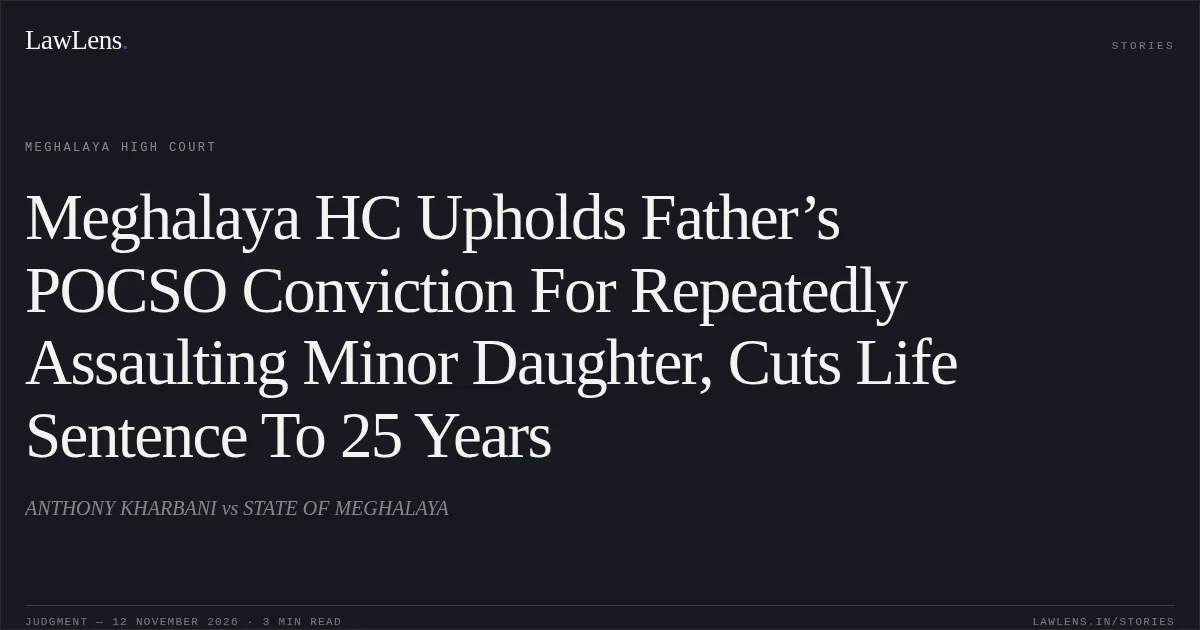
The appellant was charged with aggravated penetrative sexual assault of his minor daughter, allegedly committed repeatedly over approximately four years, with the latest incident in November 2018.
pp. 2–3The survivor’s mother lodged the FIR on 27 January 2019; the survivor was then about 13 years old.
pp. 2–3The Trial Court framed a charge under Section 6 of the POCSO Act, recorded the prosecution evidence despite the appellant’s plea of guilty, and convicted him under Sections 5(l)(m) and 5(n), sentencing him under Section 6 to life imprisonment and a fine of ₹10,000
pp. 2–3On appeal, the appellant challenged the charge, the reliability and sufficiency of the evidence, and the sentence, including its compatibility with Article 20(1) of the Constitution
pp. 3–602Issues
i.1. Whether the discrepancy between the charge framed under Section 6 of the POCSO Act and the conviction under Sections 5(l)(m) and 5(n) vitiated the trial or caused prejudice to the appellant.
pp. 9–10ii.2. Whether the survivor’s testimony, considered with the supporting evidence, was sufficient to sustain the conviction despite the asserted lack of specific dates and other alleged evidentiary deficiencies.
pp. 10–14iii.3. Whether the sentence of life imprisonment was appropriate for an offence committed before the 2019 amendment to Section 6 of the POCSO Act, and whether it should be modified.
pp. 18–2303Law Applied
Under Sections 222 and 464 of the CrPC, omission or defect in a charge does not automatically invalidate a conviction; the court must assess whether the accused understood the essential case and whether the defect caused a failure of justice.
pp. 9–10A survivor’s credible and reliable testimony can sustain a conviction without corroboration; corroborative evidence may be sought where the court has reason to doubt that testimony.
pp. 13–17The court may assess the survivor’s age from reliable documentary evidence and apply the relevant aggravated-offence provisions of the POCSO Act.
p. 18Sentencing must reflect the gravity of the offence while taking account of relevant aggravating and mitigating circumstances; a constitutional court may substitute a fixed-term sentence for life imprisonment, provided the term is not below the statutory minimum applicable under Section 433-A of the CrPC.
pp. 19–22Provisions in the judgment · 19 · Linked ones open on LawLens
Protection of Children from Sexual Offences Act, 2012 Section 4Section 5Section 6
Code of Criminal Procedure, 1973 13 provisions
Section 161Section 164Section 211Section 222Section 229Section 235Section 248Section 313Section 325Section 360Section 361Section 433Section 464Indian Penal Code, 1860 Section 53Section 302Section 376
04Reasoning
The Court held that the charge discrepancy did not, by itself, invalidate the conviction: applying the principles in Pynchem alangaki Bareh v. State of Meghalaya and the cited authorities, it found no basis to conclude that the defect had caused a failure of justice.
pp. 9–10It accepted the survivor’s account of repeated assaults, noting that the appellant had not materially challenged or contradicted her evidence in cross-examination; it also relied on the medical evidence of a ruptured hymen and the birth certificate establishing her age.
pp. 12–14, 17–18The Court therefore upheld the conviction.
pp. 12–14, 17–18On sentence, it considered the pre-amendment offence and the appellant’s personal circumstances, but also the seriousness of the repeated abuse by a father against his daughter; it concluded that a fixed term of 25 years’ rigorous imprisonment was appropriate.
pp. 18–2305Holding
The appeal was allowed only to the extent of modifying the sentence.
p. 23The conviction was upheld, while the life sentence was replaced with 25 years’ rigorous imprisonment; the fine of ₹10,000 and the default sentence of three months’ rigorous imprisonment were maintained.
p. 23Original Court PDF
ANTHONY KHARBANIvsSTATE OF MEGHALAYA
Click to open original judgment
Original judgment, available to read, download and summarize on LawLens.in