Facts
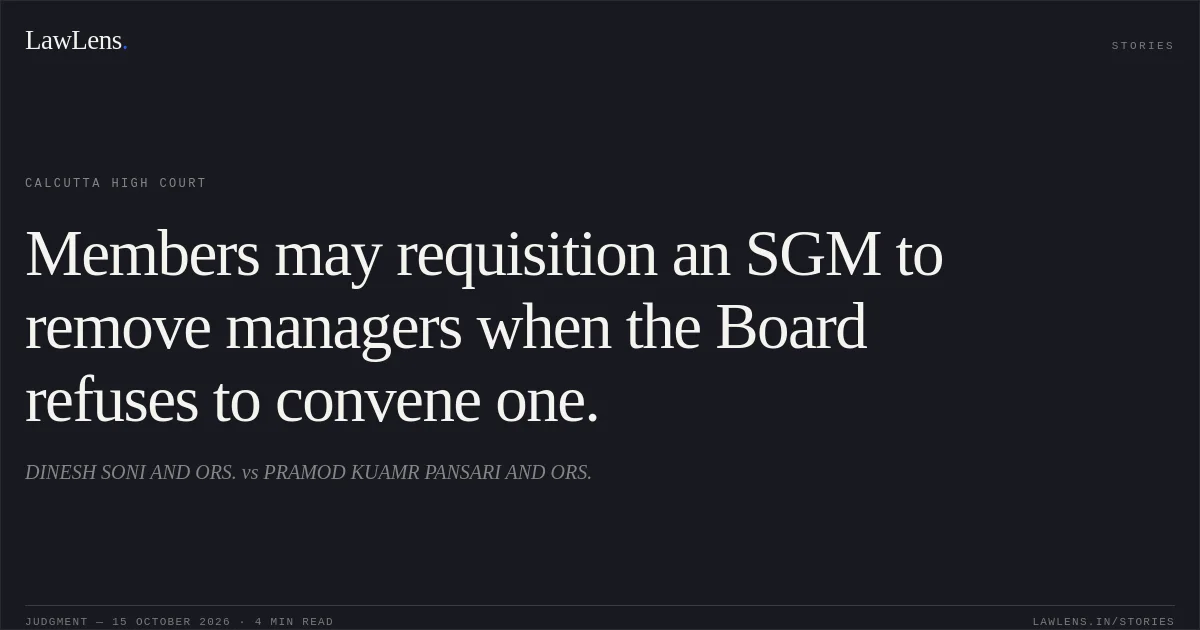
Seventy-eight members of the Sunrise Towers Apartment Owners Association requisitioned a Special General Meeting (SGM) to consider, among other matters, removing the Association’s President, Secretary and Treasurer.
Source reference: para. 1–3After the office-bearers declined to convene the meeting, the requisitionists issued a further notice.
Source reference: para. 1–3The Competent Authority (CA) held the requisition valid and directed that its agenda be considered before the agenda of the Association’s Annual General Meeting (AGM).
Source reference: para. 1–3The Trial Court refused an ad interim injunction on 29 May 2026; the AGM was held on 31 May, and the proposed SGM agenda was considered, resulting in the removal of the office-bearers and a resolution to resume the election process.
Source reference: para. 4–7On a subsequent injunction application, the Trial Court restrained the appellants from holding any Association meeting.
Source reference: para. 8–10Issues
1. Whether the CA’s orders dated 27 May and 6 August 2026 were within its statutory and bye-law powers
Source reference: para. 38(i)2. Whether the notices requisitioning the SGM were valid under the Association’s bye-laws, including whether defaulting members could requisition a meeting to remove Managers and whether Bye-laws 6, 10 and 13 applied
Source reference: para. 38(ii)3. Whether the Trial Court’s injunction exceeded the relief sought in the suit and the second injunction application
Source reference: para. 38(iii)4. Whether refusal of ad interim relief on the first injunction application barred the subsequent application at the same interim stage
Source reference: para. 38(iv)5. Whether the failure to join all signatories to the requisition notices rendered the suit or injunction applications defective
Source reference: para. 38(v)Law Applied
The Court considered Sections 10A, 13 and 16B of the West Bengal Apartment Ownership Act, 1972: the CA’s powers include receiving declarations and amendments, framing bye-laws, issuing directions where an Association’s Manager or Board of Managers (BoM) fails to perform its functions, and removing a Manager or superseding a BoM subject to statutory safeguards.
Source reference: para. 40–47Bye-law 39 permits the CA to issue general guidelines to remove difficulty in applying the bye-laws, not to adjudicate particular Association meetings.
Source reference: para. 42, 45Bye-law 6(2) allows one-third of members to requisition an SGM on matters of general importance within the Act and bye-laws, and permits requisitionists to convene it if the President does not do so within the prescribed period; Bye-law 6(4) provides for the President or a member chosen by those present to preside.
Source reference: para. 54, 61–65Bye-laws 10 and 11 govern removal of Managers and specified election-related disqualifications, while Bye-law 13 concerns removal of office-bearers from those offices.
Source reference: para. 54–57, 67–69The Court also considered Order XXXIX Rules 1 and 2 and Sections 94(e) and 151 of the Code of Civil Procedure, 1908 (CPC), holding that inherent powers do not justify bypassing the applicable injunction procedure where it covers the relief sought.
Source reference: para. 77–79Under Order I Rule 8 CPC, representative proceedings require leave, and an order made without such leave does not bind non-parties; non-joinder may be curable in appropriate circumstances (Dr. Vimal Sukumar v. D. Lawrence, 2025 INSC 622).
Source reference: para. 83–91The Court applied res judicata to a second request for interim relief at the same stage where the earlier request had been refused on substantially the same cause and relief.
Source reference: para. 74–81Reasoning
The Court held that Sections 16B(1) and bye-law 39 did not empower the CA to decide the validity of particular requisition notices, prescribe who must chair a meeting contrary to bye-law 6(4), or invalidate the resulting meetings; the CA’s orders were therefore prima facie without jurisdiction.
Source reference: para. 43–53It found that bye-law 6(2) could be used to requisition the SGM because the proposed business was of general importance and the office-bearers had refused to convene it.
Source reference: para. 55–69Even excluding five disputed signatories, 73 remained—more than the required one-third of the Association’s 192 members.
Source reference: para. 55–69Bye-law 11’s disqualifications applied to voting and candidacy in elections, not to requisitioning a meeting or removing Managers; Bye-law 10, rather than bye-law 13, governed the proposed removal from the office of Manager.
Source reference: para. 55–69The second injunction application concerned the same notices and meeting as the first, and the Court found that the earlier refusal had also considered the merits; the second application therefore could not secure the same interim restraint by being recast under Sections 94(e) and 151 CPC.
Source reference: para. 74–81The blanket restraint against holding any Association meeting also exceeded the relief sought, and the failure to join the other signatories raised a further defect: the plaintiffs’ Order I Rule 8 request was framed for themselves to sue representatively, not to proceed against the other requisitionists in a representative capacity.
Source reference: para. 70–73, 82–91The Court additionally noted that the impugned order gave no reasons and rested on the CA’s invalid direction concerning the chair.
Source reference: para. 93–95Holding
It held, for the purpose of considering the interim orders, that the CA’s orders were without jurisdiction, the requisition notices were valid, and the blanket injunction was beyond the relief sought and unsustainable.
The High Court allowed all four appeals and set aside the Trial Court’s injunction order of 1 June 2026 and the subsequent extension orders.
Source reference: para. 92–100The associated application, CAN 1 of 2026, was dismissed; there was no order as to costs.
Source reference: para. 92–100Acts & Sections Cited
7 provisions across 3 statutes referred to in this judgment. Each provision opens on LawLens.
West Bengal Apartment Ownership Act, 19722
Code of Civil Procedure, 19083
Specific Relief Act, 19632
Original Court PDF
DINESH SONI AND ORS.vsPRAMOD KUAMR PANSARI AND ORS.
Click to open original judgment
Original judgment, available to read, download and summarize on LawLens.in