Facts
On April 28, 2019, an FIR was registered against four individuals for allegedly withdrawing ₹55,40,000 from the bank account of a complainant whose land had been acquired for a National Highway
Source reference: para. 2The petitioner’s name was not in the FIR; however, he was later implicated based solely on memorandum statements of the co-accused
Source reference: para. 4-5Investigations revealed the complainant had previously agreed to sell the land to the co-accused, and a bank manager testified that the complainant voluntarily consented to the fund transfer
Source reference: para. 3, 16Despite a seven-year investigation, no supplementary charge-sheet was filed against the petitioner
Source reference: para. 6, 10The petitioner sought quashment of the FIR under Article 226 of the Constitution
Source reference: para. 1Issues
1. Whether an accused can be prosecuted solely on the basis of memorandum statements of co-accused persons in the absence of any recovery or discovery of fact
Source reference: para. 5, 122. Whether the continuation of criminal proceedings against the petitioner, after a seven-year delay without incriminating evidence, constitutes an abuse of the process of law
Source reference: para. 7, 18Law Applied
The court applied Section 27 of the Indian Evidence Act, noting that statements are admissible only regarding the discovery of a fact
Source reference: para. 12It relied on Tofan Singh v. State of Tamil Nadu (2021) 4 SCC 1, which excludes confessional statements to officers without corroborating discovery
Source reference: para. 13Pulukuri Kottaya v. King Emperor AIR 1947 PC 67 regarding the limited admissibility of such facts
Source reference: para. 13The principle in Kashmira Singh v. State of Madhya Pradesh AIR 1952 SC 159 was applied to establish that co-accused confessions are not substantive evidence
Source reference: para. 14The court cited Manoj Kumar Soni v. State of M.P. (2023) regarding the inadequacy of disclosure statements alone for conviction and the landmark State of Haryana v. Bhajan Lal (1992) for the criteria to quash malicious or baseless proceedings
Source reference: para. 15, 17Reasoning
The court reasoned that the petitioner had no role in the original FIR and no monetary trail or overt act connected him to the offence
Source reference: para. 4, 12Applying the rule from Kashmira Singh and Tofan Singh, the court found the memorandum statements of the co-accused inadmissible as substantive evidence because they led to no discovery of facts or recovery of property from the petitioner
Source reference: para. 12-14The court noted the Bank Manager’s testimony, which confirmed the complainant’s voluntary consent to the transfer, effectively negating the allegation of fraud
Source reference: para. 16The failure of the agency to file a charge-sheet after seven years was viewed as a clear indicator of a lack of substance, bringing the case within the Bhajan Lal guidelines for quashing proceedings that lack legal foundation
Source reference: para. 10, 17Holding
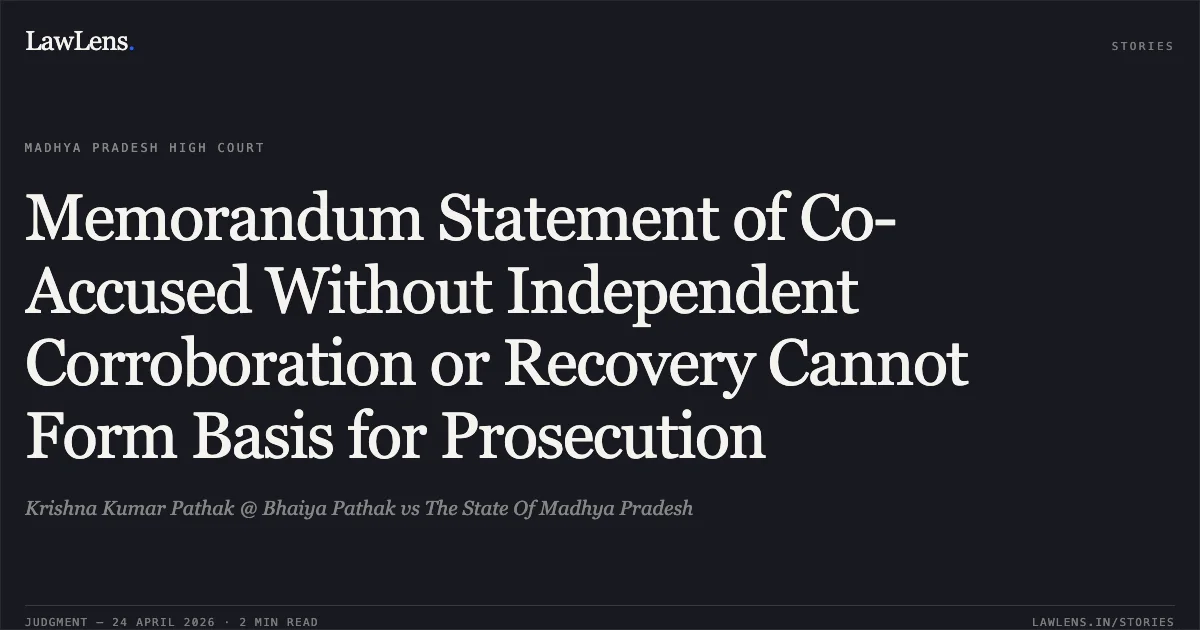
The court answered that proceedings cannot be sustained solely on inadmissible co-accused statements
The petition was allowed, and the FIR (Crime No. 126/2019, P.S. Bamitha) and all consequential proceedings against the petitioner were quashed
Source reference: para. 19The court held that continuing the prosecution would result in a miscarriage of justice and violate the petitioner’s fundamental rights under Article 21
Source reference: para. 18-19Acts & Sections Cited
2 provisions across 2 statutes referred to in this judgment. Linked provisions open on LawLens.
Indian Penal Code, 18601
Indian Evidence Act, 18721
Original Court PDF
Krishna Kumar Pathak @ Bhaiya PathakvsThe State Of Madhya Pradesh
Click to open original judgment
Original judgment, available to read, download and summarize on LawLens.in