Facts
The State appealed against the judgment dated 21.09.2016 passed by the Sessions Judge, Sidhi, which acquitted the respondents of charges under Sections 498-A and 306 of the IPC
Source reference: para. 1The prosecution alleged that Anju Singh, married in 1998, committed suicide by jumping into a well on 29.12.2013 due to constant harassment and dowry demands for a motorcycle, TV, and fridge by her in-laws
Source reference: para. 2 & 6However, medical evidence suggested the cause of death was drowning and scratch-like injuries found could have been sustained from the well walls
Source reference: para. 8Extensive defense evidence and testimony from independent witnesses indicated that the deceased suffered from "bipolar disorder," had a history of mental instability, and had previously attempted suicide by self-immolation
Source reference: para. 9-11Issues
1. Whether the prosecution established the ingredients of "abetment to suicide" under Section 306 IPC, specifically regarding active instigation by the accused
Source reference: para. 14-152. Whether the acquittal by the trial court was perverse or illegal given the conflicting testimonies regarding dowry demands and the deceased’s documented mental health history
Source reference: para. 20-21Law Applied
The court applied Section 306 (Abetment of suicide) and Section 498-A (Cruelty) of the IPC. It relied on the definition of abetment under Section 107 IPC, which requires instigation, conspiracy, or intentional aid
Source reference: para. 14The court followed the precedent in S.S. Cheena v. Vijay Kumar Mahajan [para. 16] and M. Mohan v. State [para. 17], establishing that Section 306 requires a clear mens rea and an active act intended to push the deceased to suicide.
Source reference: para. 16-17it applied the standards for interfering with acquittals as laid down in Mallappa v. State of Karnataka, holding that if two views are possible, the view favoring the accused must prevail
Source reference: para. 21-22Reasoning
The court found significant inconsistencies in the prosecution’s case. While family members alleged dowry harassment, they failed to lodge any police complaint during the 15 years of marriage
Source reference: para. 12-13Crucially, independent witness P.W.1 and defense witnesses D.W.1 through D.W.5 established that the deceased suffered from bipolar disorder, exhibited abnormal behavior, and had previously damaged a government vehicle and attempted self-immolation
Source reference: para. 9-11Medical testimony by Dr. Saxena (D.W.5) confirmed her treatment for mania and depression
Source reference: para. 11The court observed that "mere threatening or beating" does not automatically constitute instigation for suicide
Source reference: para. 19Since the prosecution could not prove any "positive act" of instigation in close proximity to the death, and the defense effectively proved a history of mental instability, the trial court’s decision was deemed a legally plausible view
Source reference: para. 20-23Holding
The High Court dismissed the appeal and affirmed the acquittal of the respondents
The court held that the prosecution failed to establish the charges under Sections 306 and 498-A IPC beyond a reasonable doubt
Source reference: para. 20It concluded that there were no grounds to interfere with the trial court's findings as they were neither perverse nor illegal
Source reference: para. 23Acts & Sections Cited
5 provisions across 2 statutes referred to in this judgment. Each provision opens on LawLens.
Code of Criminal Procedure, 19731
Indian Penal Code, 18604
Original Court PDF
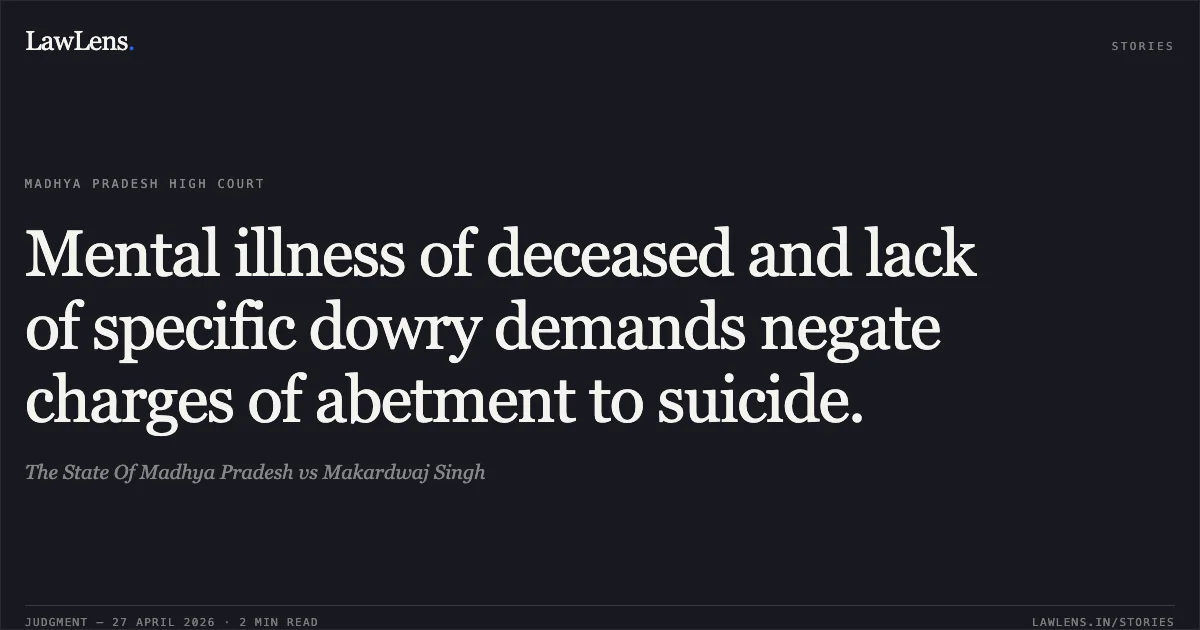
The State Of Madhya PradeshvsMakardwaj Singh
Click to open original judgment
Original judgment, available to read, download and summarize on LawLens.in


