Facts
Sita Devi was found dead at her matrimonial home on 21 July 2017.
Source reference: para. 2–5Her father alleged that her husband, Kailash Ram, and his second wife, Lalita Devi, had killed her by throttling.
Source reference: para. 2–5The post-mortem doctor opined that death resulted from asphyxia due to throttling.
Source reference: para. 2–5The prosecution had no eyewitness; several witnesses testified that the appellants were absent when they arrived, and some allegations against them were hearsay.
Source reference: para. 14, 21–24, 36The trial court convicted both appellants under Sections 302/34 IPC and sentenced each to life imprisonment and a fine.
Source reference: para. 2–5, 36They appealed under Section 374(2) CrPC.
Source reference: para. 2–5, 36Issues
1. Whether the prosecution proved that Sita Devi’s death was homicidal.
Source reference: para. 37(i)2. Whether the circumstantial evidence formed a complete chain establishing the appellants’ guilt.
Source reference: para. 37(ii)3. Whether the trial court erred in convicting both appellants under Section 302/34 IPC, including whether common intention was proved against Lalita Devi.
Source reference: para. 37(iii), 93–96Law Applied
Section 302 IPC prescribes punishment for murder, while Section 34 IPC imposes joint liability where a criminal act is done in furtherance of a common intention; common intention requires a prior concert or meeting of minds, which may be inferred from proved circumstances (Pandurang v. State of Hyderabad; Devi Lal v. State of Rajasthan).
Source reference: para. 97–99Section 106 of the Evidence Act does not relieve the prosecution of its burden to prove guilt, but may apply where the prosecution establishes foundational facts and the relevant further facts are especially within the accused’s knowledge (Shambhu Nath Mehra v. State of Ajmer; State of W.B. v. Mir Mohammad Omar; Sucha Singh v. State of Punjab).
Source reference: para. 50–53In a circumstantial-evidence case, the circumstances must be established, consistent with guilt, and form a complete chain excluding reasonable hypotheses consistent with innocence (Hanumant v. State of Madhya Pradesh; Sharad Birdhichand Sarda v. State of Maharashtra; Padala Veera Reddy v. State of A.P.).
Source reference: para. 74–80The Court also relied on the principles concerning deaths inside the matrimonial home and an accused’s failure to explain relevant circumstances (Trimukh Maroti Kirkan v. State of Maharashtra; State of Rajasthan v. Kashi Ram).
Source reference: para. 69–71Reasoning
The Court accepted the medical evidence and testimony concerning marks on the deceased’s neck as establishing homicidal death by throttling.
Source reference: para. 39–44It found that the body was recovered inside Kailash Ram’s house and that both appellants were absent when witnesses and the investigating officer arrived.
Source reference: para. 55–60It further relied on evidence of marital discord and cruelty, the deceased’s childlessness, and Kailash Ram’s second marriage as motive.
Source reference: para. 63–68, 82–87Applying Sections 106 and 114 of the Evidence Act and the circumstantial-evidence principles, the Court concluded that the proved circumstances, including Kailash Ram’s failure to explain the death in his home, established his guilt.
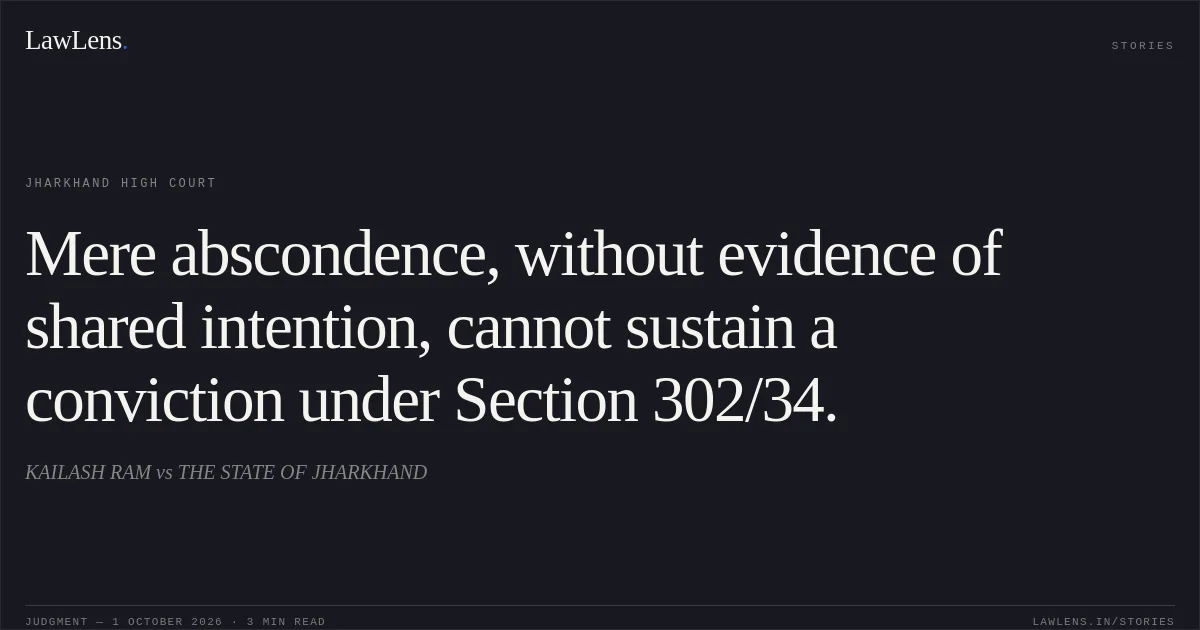
Source reference: para. 61–72, 88–89, 112–115As to Lalita Devi, the Court found no evidence of an overt act, participation in cruelty, or prior meeting of minds; her absence from the house alone did not establish common intention under Section 34 IPC.
Source reference: para. 100–110Holding
The appeal was partly allowed.
Kailash Ram’s conviction was modified from Section 302/34 IPC to Section 302 IPC alone; his life sentence and fine were upheld.
Source reference: para. 116Lalita Devi’s conviction and sentence were set aside, and she was acquitted; as she was on bail, she was discharged from her bail bonds.
Source reference: para. 119–121The trial court records were ordered to be returned.
Source reference: para. 124Acts & Sections Cited
5 provisions across 2 statutes referred to in this judgment. Each provision opens on LawLens.
Code of Criminal Procedure, 19732
Indian Penal Code, 18603
Original Court PDF
KAILASH RAMvsTHE STATE OF JHARKHAND
Click to open original judgment
Original judgment, available to read, download and summarize on LawLens.in